
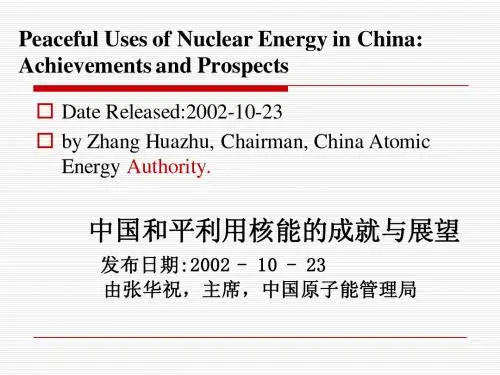
Peaceful Uses of Nuclear Energy in China Achievements and Prospects
- 格式:ppt
- 大小:152.50 KB
- 文档页数:71

B1U6-U8课后段落翻译中英对照版B1 U6Part IGap year(间隔年)refers to a period of time---not necessarily a year--- in which students take timeoff and do something other than schooling, such as travel or work. The year out is most commonlytaken after high school and before going to university. During this time, a student might travel,engage in volunteer work or undertake (承担)a working holiday abroad.A new trend is toparticipate in international education programs that combine language study, home stays, culturalexchange, community service, and independent study. The practice of taking a year out developedin the United Kingdom in the 1960s. It has grown very popular among students in the UK, Australia, New Zealand, and Canada. In the United States however, the practice of taking a year off remains the exception (例外). But in recent years, taking a year out has become slightly more common for Americans. Some 40,000 American students participated in 2013 in gap year programs, an increase of almost 20% since 2006. Universities such as Princeton University, Harvard University,Massachusetts Institute of Technology have formal policies allowing students to defer (延期)admission.间隔年指的是学生休假不去上学而去旅游或工作等的一段时间,但不一定是一年。

中法建交60周年英语China and France Celebrate 60 Years of Diplomatic RelationsThe year 2024 marks the 60th anniversary of the establishment of diplomatic relations between China and France. Over the past six decades, the relationship between the two countries has evolved into a multifaceted partnership encompassing economic cooperation, cultural exchanges, and political dialogue. This milestone provides an opportunity to reflect on the progress made and the prospects for future collaboration between China and France.Economic Ties: A Strong FoundationSince the establishment of diplomatic relations in 1964, economic cooperation has been a cornerstone of the China-France relationship. Trade between the two countries has grown exponentially, with China becoming France's largest trading partner in Asia. In 2019, bilateral trade reached a record high of 66 billion euros. French companies have also invested heavily in China, with sectors such as automotive, energy, and luxury goods leading the way.Investments and infrastructure projects have further strengthened economic ties. Chinese companies have played an essential role in France's development, particularly in the energy and transportation sectors. The successful partnership between China National Nuclear Corporation andÉlectricité de France in the construction of nuclear power plants is a testament to the mutual benefits of collaboration.Cross-cultural Exchanges: Deepening UnderstandingCultural exchanges have fostered a deeper understanding and appreciation between China and France. The two countries have organized numerous cultural events, such as art exhibitions, film festivals, and music performances, allowing people from both nations to experience each other's rich heritage.Language learning programs have also flourished, promoting linguistic diversity and creating opportunities for greater exchange. Confucius Institutes established in France have introduced the Chinese language to a broad audience, while the French Embassy in China has initiated programs to teach French to Chinese students. These efforts have not only enhanced bilateral communication but have also cultivated lasting friendships.Political Dialogue: Strengthening CooperationChina and France engage in regular political dialogue to strengthen their bilateral relationship. High-level visits, including state visits, ministerial meetings, and strategic dialogues, have provided a platform for leaders from both countries to exchange views on various global and regional issues.Moreover, China and France have worked together in global governance forums such as the United Nations, the G20, and the Paris Agreement on climate change. Their joint efforts have demonstrated commitment to addressing shared challenges and promoting global stability, sustainable development, and multilateralism.Prospects for Future CollaborationLooking ahead, there are significant opportunities for further collaboration between China and France. The comprehensive strategicpartnership established in 2014 lays a solid foundation for future cooperation in areas such as science and technology, innovation, and sustainable development.Climate change represents a crucial area for collaboration. Both China and France have made significant commitments to combating climate change and transitioning to a low-carbon economy. Deeper cooperation on renewable energy, energy efficiency, and sustainable transportation can contribute to global efforts to mitigate climate change.Additionally, the digital economy presents new avenues for cooperation. France's expertise in artificial intelligence, cybersecurity, and digital governance complements China's technological advancements. Enhanced collaboration in these areas can promote mutual technological progress and shape the digital landscape of the future.ConclusionThe 60th anniversary of diplomatic relations between China and France is a testament to the enduring friendship and fruitful cooperation between the two nations. Through economic ties, cultural exchanges, and political dialogue, China and France have built a comprehensive partnership that contributes to global peace, prosperity, and development. As they look to the future, opportunities for further collaboration abound, ensuring that the China-France relationship will continue to thrive and make significant contributions in various fields for years to come.。
新能源专业英语通过整理的新能源专业英语相关文档,渴望对大家有所扶植,感谢观看!新能源专业英语1.Put the following phrase into English. Unit 1 1.温室效应the greenhouse effect 2.可再生能源renewable energy 3.太阳能电池solar cell 4.风力发电系统wind turbine system 5.核能nuclear energy 6.海洋能ocean energy Unit 2 1.辐射度irradiance 2.负载load 3.耐候性weather fastness 4.光电效应photoelectric effect 5.光生伏打效应photovoltaic effect Unit 3 1.风电场wind farm 2.装机容量installed capacity 3.涡轮机turbine 4.水泵water pumping 5.风光互补wind and photovoltaic hybrid power 6.混合动力装置hybrid power system 7.电网utility grid 8.电池battery Unit 4 1.热交换器heat exchanger 2.核反应堆nuclear reactor 3.浓缩铀enriched uranium 4.低温冷却水subcooled water 5.千瓦kilowatt 6.沸水反应堆boiling water reactor 7.商用发电站commercial power plant 8.快速中子反应堆 a fast neutron reactor Unit 5 1.生物质biomass 2.植物vegetation 3.肥料manure 4.残留物residue 5.光合作用photosynthesis 6.碳水化合物carbohydrate 7.化石燃料fossil fuels 8.固定碳carbon fixed Unit 6 1.万有引力gravitational pull 2.潮汐tide 3.大陆架continental shelf 4.海岸线coastline 5.农历lunar6.港湾harbor7.月亮角度正交moon quadrature8.局部共振local resonance Unit 7 1.火山爆发volcanic eruption 2.放射性衰变radioactive decay 3.间歇岩geyser 4.注射injection 5.水库reservoir 6.裂纹crack Unit 8 1.利用harness 2.盐度salinity 3.潮汐tide 4.动能kinetic energy 5.水力发电hydro-electric power 6.引力gravitational pull 2.Translate the following sentences. Unit 1 1. Energy is an important material and energy foundation of human survival and development , its plays a vital role in the development of human civilization . New energy usually refers to the new energy technologies based on new development and utilization of energy , including solar , biomass , wind , geothermal , ocean energy and hydrogen etc. 能源是人类生存和发展的重要材料和能量基础,它在人类文明的发展中扮演着至关重要的角色。

中国太空研究成就英语作文China's Space Exploration Achievements: A Testament to Technological Prowess and National AmbitionChina's space program has experienced remarkable growth and success in recent decades, solidifying the country's position as a global leader in space exploration. From the launch of its first satellite to the recent achievements of its lunar and Mars missions, China has consistently demonstrated its technological capabilities and scientific ambition, captivating the world with its space-related accomplishments.One of the most significant milestones in China's space exploration journey was the launch of its first satellite, Dong Fang Hong I, in 1970. This historic event marked the beginning of China's foray into the realm of space technology, showcasing the country's determination to establish itself as a major player in the global space race. The successful launch of this satellite not only instilled a sense of national pride but also paved the way for the development of more advanced space programs.In the following years, China continued to make impressive strides in its space exploration efforts. The launch of the Shenzhou spacecraft series, which began in 1999, represented a crucial step towards manned space missions. The Shenzhou program culminated in the successful crewed space flights of Shenzhou 5 in 2003, which saw China become the third country in the world, after the United States and Russia, to independently send a human into space.The establishment of the Tiangong space station program in 2011 further solidified China's ambitions in the realm of space exploration. The Tiangong program, which consists of a series of modular space stations, has enabled China to conduct long-duration crewed missions and engage in various scientific experiments in the microgravity environment of space. The successful launch and operation of the Tiangong-1 and Tiangong-2 space stations have demonstrated China's ability to maintain a sustained human presence in space, a significant achievement that has contributed to the country's growing scientific and technological capabilities.One of the most recent and highly publicized accomplishments of China's space program is the successful landing of the Tianwen-1 mission on Mars in 2021. This mission, which included the deployment of a rover and a lander, marked China's first successful interplanetary exploration, placing the country among the elitegroup of nations that have successfully landed a spacecraft on the surface of the Red Planet. The Tianwen-1 mission has not only provided valuable scientific data about the Martian environment but has also showcased China's advancements in deep space exploration and robotic technology.Furthermore, China's lunar exploration program has also achieved remarkable success. The Chang'e series of lunar probes, named after the mythical Chinese moon goddess, have made significant contributions to our understanding of the Moon. The Chang'e-4 mission, which landed a spacecraft on the far side of the Moon in 2019, was a groundbreaking achievement, as it marked the first time a spacecraft had successfully navigated and landed on the lunar surface that is not visible from Earth. This mission has provided unprecedented insights into the geology and environment of the far side of the Moon, expanding our knowledge of our celestial neighbor.In addition to these significant accomplishments, China's space program has also made strides in other areas, such as the development of advanced satellite technology, the establishment of a global navigation system (BeiDou), and the exploration of the Sun and near-Earth objects. These achievements have not only contributed to China's scientific and technological prowess but have also positioned the country as a key player in the global spacelandscape.One of the driving forces behind China's space exploration successes is the country's unwavering commitment to invest in and support its space program. The Chinese government has consistently allocated significant resources, both financial and human, to the development of its space capabilities, recognizing the strategic and scientific importance of space exploration. This sustained investment has enabled China to attract and nurture a talented pool of scientists, engineers, and technicians, who have been instrumental in the design, development, and execution of the country's space missions.Moreover, China's space program has also been driven by a strong sense of national pride and ambition. The successful launch of the Dong Fang Hong I satellite in 1970 was a pivotal moment in China's history, as it demonstrated the country's ability to overcome technological challenges and join the ranks of space-faring nations. This national pride has continued to fuel China's space exploration efforts, with each successive achievement serving as a source of inspiration and motivation for the Chinese people.As China's space program continues to evolve and expand, it is clear that the country is poised to play an increasingly prominent role in the global space landscape. The successful landing of the Tianwen-1 rover on Mars, the ongoing operation of the Tiangong space station,and the planned future missions to the Moon and beyond all point to China's growing confidence and expertise in space exploration.In conclusion, China's space exploration achievements are a testament to the country's technological prowess, scientific ambition, and national pride. From the launch of its first satellite to the recent successes on Mars and the Moon, China has consistently demonstrated its ability to push the boundaries of space exploration, captivating the world with its remarkable accomplishments. As China continues to invest in and develop its space program, it is clear that the country will play a pivotal role in shaping the future of space exploration, contributing to the advancement of human knowledge and the exploration of the final frontier.。