
British and Americal election system
- 格式:ppt
- 大小:1.95 MB
- 文档页数:12

英国美国政治制度英语作文English: The political systems of the United Kingdom and the United States have key differences that stem from their historical development and principles. The UK operates under a constitutional monarchy with a parliamentary system, where the monarch is the head of state but the Prime Minister is the head of government. The US, on the other hand, is a federal republic with a presidential system, where the President is both the head of state and government. In the UK, Parliament consists of two houses - the House of Commons and the House of Lords - with the Prime Minister being the leader of the majority party in the Commons. In the US, Congress is divided into the House of Representatives and the Senate, with the President being elected independently from Congress. Additionally, the UK has a unitary system where power is centralized in Westminster, while the US has a federal system with power divided between the federal government and state governments. These differences in political systems lead to varying approaches to governance, decision-making, and checks and balances between branches of government.中文翻译: 英国和美国的政治制度有着根源于历史发展和原则的重要差异。

英美政治制度The Political Systems of the United States and United Kingdom (UK)The United States and the United Kingdom, two influential democratic countries with rich histories and global impacts, each have their own unique political systems. While both systems are built on democratic principles and have many similarities, there are also distinct differences between them.The United States, as a federal republic, operates under a system known as a presidential system. The country is divided into 50 states, each with its own government, and a central federal government. The President of the United States is the head of state and government and is elected by the citizens through an electoral college system. The president serves as the chief executive and has the power to veto bills passed by the Congress. The Congress, composed of the House of Representatives and the Senate, is responsible for making and passing laws. The members of the Congress are elected by the people through direct voting.On the other hand, the United Kingdom operates under a constitutional monarchy system with a parliamentary democracy. The monarch, currently Queen Elizabeth II, serves as the head of state, while the Prime Minister is the head of government. The Prime Minister is appointed by the monarch and is the leader of the majority party or coalition in the House of Commons, the lower chamber of the UK Parliament. Members of Parliament (MPs) are elected by the people in their respective constituencies. The House of Lords, the upper chamber, consists of appointed members,including life peers and bishops.One key difference between the two systems is the role of the head of state. In the United States, the president holds both the ceremonial role as the head of state and the executive power as the head of government. On the other hand, in the United Kingdom, the queen or king serves as the ceremonial head of state, while the Prime Minister holds the executive power. This distinction allows the United Kingdom to separate the monarchy's symbolic role from the political decision-making process.Another difference lies in the election processes. In the United States, the president is elected by an electoral college, a group of electors from each state who vote for the president. This system was put in place to balance the interests of both the states and the population. In contrast, in the United Kingdom, the Prime Minister is not elected directly but is chosen by the majority party or coalition in the House of Commons. The citizens vote for their local MPs, who then choose the Prime Minister.The United States and the United Kingdom both have effective systems of checks and balances, ensuring the division of powers and preventing abuse of power. However, the specific mechanisms differ. In the United States, the Constitution sets forth a system of checks and balances between the legislative, executive, and judicial branches. The president's power to veto legislation and the Supreme Court's authority to interpret laws are examples of these checks. In the United Kingdom, the parliamentary system provides checks and balances through debates, questioning, and scrutiny by both the House of Commons and the House of Lords.In conclusion, while both the United States and the United Kingdom have democratic political systems, they differ in their governance structure and election processes. The United States operates under a presidential system, with the president holding both the ceremonial and executive powers. On the other hand, the United Kingdom operates under a constitutional monarchy system with a parliamentary democracy, separating the roles of the head of state and the head of government. Both systems have been effective in maintaining democracy and ensuring the separation of powers.。
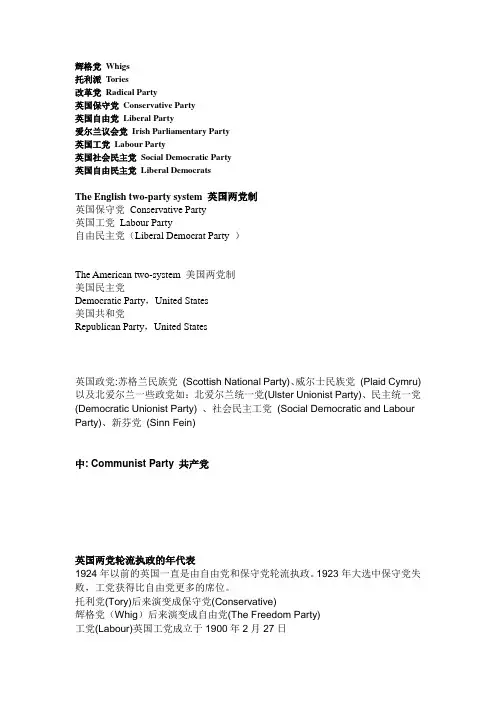
辉格党Whigs托利派Tories改革党Radical Party英国保守党Conservative Party英国自由党Liberal Party爱尔兰议会党Irish Parliamentary Party英国工党Labour Party英国社会民主党Social Democratic Party英国自由民主党Liberal DemocratsThe English two-party system 英国两党制英国保守党Conservative Party英国工党Labour Party自由民主党(Liberal Democrat Party )The American two-system 美国两党制美国民主党Democratic Party,United States美国共和党Republican Party,United States英国政党:苏格兰民族党(Scottish National Party)、威尔士民族党(Plaid Cymru) 以及北爱尔兰一些政党如:北爱尔兰统一党(Ulster Unionist Party)、民主统一党(Democratic Unionist Party) 、社会民主工党(Social Democratic and Labour Party)、新芬党(Sinn Fein)中: Communist Party 共产党英国两党轮流执政的年代表1924年以前的英国一直是由自由党和保守党轮流执政。
1923年大选中保守党失败,工党获得比自由党更多的席位。
托利党(Tory)后来演变成保守党(Conservative)辉格党(Whig)后来演变成自由党(The Freedom Party)工党(Labour)英国工党成立于1900年2月27日英国历任首相列表罗伯特·沃波尔1721年04月04日-1742年02月11日辉格党威尔明顿伯爵1742年02月16日-1743年07月02日辉格党亨利·佩尔汉姆1743年08月27日-1754年03月07日辉格党纽卡斯尔公爵1754年03月16日-1756年11月16日辉格党德文郡公爵1756年11月16日-1757年06月25日辉格党纽卡斯尔公爵1757年07月02日-1762年05月26日辉格党比特伯爵1762年05月26日-1763年04月16日托利党乔治·格兰维尔1763年04月16日-1765年07月13日辉格党白金汉侯爵1765年07月13日-1766年07月30日辉格党查塔姆伯爵(老皮特)1766年07月30日-1768年10月14日辉格党格拉夫顿公爵1768年10月14日-1770年01月28日辉格党诺斯勋爵1770年01月28日-1782年03月22日托利党白金汉侯爵1782年03月27日-1782年07月01日辉格党谢尔本伯爵1782年07月04日-1783年04月02日辉格党波特兰公爵1783年04月02日-1783年12月19日托利党/福克斯-诺斯联合内阁小皮特1783年12月19日-1801年03月14日托利党亨利·埃丁顿1801年03月17日-1804年05月10日托利党小皮特1804年05月10日-1806年01月23日托利党格伦维尔勋爵1806年02月11日-1807年03月31日Whig/Ministry of All the Talents(联合内阁)波特兰公爵1807年03月31日-1809年10月04日托利党斯潘塞·帕西瓦尔1809年10月04日-1812年05月11日托利党利物浦伯爵1812年06月09日-1827年04月10日托利党乔治·坎宁1827年04月10日-1827年08月08日托利党戈德里奇子爵1827年08月31日-1828年01月22日托利党威灵顿公爵1828年01月22日-1830年11月22日托利党格雷伯爵1830年11月22日-1834年07月16日辉格党墨尔本子爵1834年07月16日-1834年11月17日辉格党威灵顿公爵1834年11月17日-1834年12月09日保守党罗伯特·皮尔爵士1834年12月10日-1835年04月18日保守党墨尔本子爵1835年04月18日-1841年08月30日辉格党罗伯特·皮尔爵士1841年08月30日-1846年06月30日保守党约翰·罗素勋爵1846年06月30日-1852年02月23日辉格党德比伯爵1852年02月23日-1852年12月19日保守党阿伯丁伯爵1852年12月19日-1855年02月06日Peelite/联合内阁帕尔姆斯顿子爵1855年02月-06日1858年02月20日辉格党德比伯爵1858年02月20日-1859年06月12日保守党帕尔姆斯顿子爵1859年06月12日-1865年10月18日自由党罗素伯爵1865年10月29日-1866年06月28日自由党德比伯爵1866年06月28日-1868年02月27日保守党本杰明·迪斯雷利1868年02月27日-1868年12月03日保守党威廉·格莱斯顿1868年12月03日-1874年02月20日自由党本杰明·迪斯雷利1874年02月20日-1880年04月23日保守党威廉·格莱斯顿1880年04月23日-1885年06月23日自由党索尔兹伯里侯爵1885年06月23日-1886年02月01日保守党威廉·格莱斯顿1886年02月01日-1886年07月25日自由党索尔兹伯里侯爵1886年08月03日-1892年08月15日保守党威廉·格莱斯顿1892年08月15日-1894年03月05日自由党罗斯贝利伯爵1894年03月05日-1895年06月25日自由党索尔兹伯里侯爵1895年06月25日-1802年07月12日保守党亚瑟·贝尔福1902年07月12日-190年12月05日保守党亨利·坎贝尔-班内南爵士1905年12月05日-1908年04月07日自由党赫伯特·亨利·阿斯奎斯1908年04月07日-1916年12月07日自由党大卫·劳合乔治1916年12月07日-1922年10月23日National Liberal/联合内阁安德鲁·伯纳尔·劳1922年10月23日-1923年05月22日保守党斯坦利·鲍德温1923年05月22日-1924年01月22日保守党拉姆赛·麦克唐纳1924年01月22日-1924年11月04日工党斯坦利·鲍德温1924年11月04日-1929年06月05日保守党拉姆赛·麦克唐纳1929年06月05日-1931年08月24日工党拉姆赛·麦克唐纳1931年08月24日-1935年06月07日National Labour/国民内阁斯坦利·鲍德温1935年06月07日-1937年05月28日保守党/国民内阁尼维尔·张伯伦1937年05月28日-1940年05月10日保守党/国民内阁温斯顿·丘吉尔1940年05月10日-1945年05月23日保守党/联合内阁温斯顿·丘吉尔1945年05月23日-1945年07月26日保守党/过渡政府克莱门特·艾德礼1945年07月26日-1951年10月26日工党温斯顿·丘吉尔爵士1951年10月26日-1955年04月06日保守党安东尼·艾登爵士1955年04月06日-1957年01月10日保守党哈罗德·麦克米伦1957年01月10日-1963年10月19日保守党道格拉斯-霍姆爵士1963年10月19日-1964年10月16日保守党哈罗德·威尔逊1964年10月16日-1970年06月19日工党爱德华·希思1970年06月19日-1974年03月04日保守党哈罗德·威尔逊1974年03月04日-1976年04月05日工党詹姆斯·卡拉汉1976年04月05日1979年05月04日工党玛格利特·撒切尔1979年05月04日1990年11月28日保守党唯一的女首相约翰·梅杰1990年11月28日1997年05月02日保守党托尼·布莱尔1997年05月02日2007年06月27日工党戈登·布朗2007年06月27日在任工党英国总统和国王(女皇)注:维多利亚女王(Alexandrina Victoria)。