
the Enlightenment
- 格式:ppt
- 大小:5.41 MB
- 文档页数:27

启蒙运动哲学派的英文
The Enlightenment philosophers were a diverse group,
each with their own unique voice and ideas. Guys like John
Locke talked about how people were born with certain
natural rights, like freedom and the pursuit of happiness.
He said that governments should only exist to protect those
rights, not take them away.
On the other hand, there were philosophers like
Voltaire who were more focused on criticizing the
established order. He was like a rebel with a pen, pointing
out all the hypocrisy and injustice in society. He believed
in reason and progress, and thought that humanity could
only improve if we stopped following outdated traditions
and started thinking for ourselves.
Then there were the philosophers who were really into
science and nature, like Rousseau. He thought that humans
THE ROMANTIC MOVEMENT
浪漫主义运动
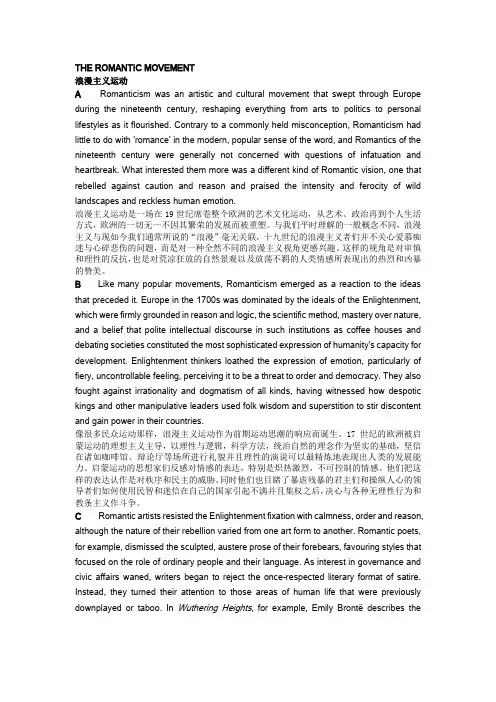
A Romanticism was an artistic and cultural movement that swept through Europe
during the nineteenth century, reshaping everything from arts to politics to personal
lifestyles as it flourished. Contrary to a commonly held misconception, Romanticism had
little to do with 'romance' in the modern, popular sense of the word, and Romantics of the
nineteenth century were generally not concerned with questions of infatuation and
heartbreak. What interested them more was a different kind of Romantic vision, one that
rebelled against caution and reason and praised the intensity and ferocity of wild
landscapes and reckless human emotion.
浪漫主义运动是一场在19世纪席卷整个欧洲的艺术文化运动,从艺术、政治再到个人生活方式,欧洲的一切无一不因其繁荣的发展而被重塑。与我们平时理解的一般概念不同,浪漫主义与现如今我们通常所说的“浪漫”毫无关联,十九世纪的浪漫主义者们并不关心爱慕痴迷与心碎悲伤的问题,而是对一种全然不同的浪漫主义视角更感兴趣。这样的视角是对审慎和理性的反抗,也是对荒凉狂放的自然景观以及放荡不羁的人类情感所表现出的热烈和凶暴的赞美。

Romanticism began in the mid-18th century and reached its
height in the 19th century.It was an artistic, literary, and
intellectual
movement that originated in Europe.The ideologies and events of
the
French Revolution and the Industrial Revolution laid the
background
for Romanticism. The Enlightenment also had influence
on
Romanticism .It was a revolt against the aristocratic social and political
norms of the Age of Enlightenment and a reaction against the scientific
rationalization of nature.The movement validated strong emotion as
an
authentic source of
aesthetic experience, placing new emphasis on such
emotions as apprehension, horror and terror, and awe.The Romantic
literature of the nineteenth century concentrating on emotion, nature, and
the expression of "nothing".famous romanticism writers are such as

1.the Renaissance: the period in Europe between the 14th and mid 17th centuries,when the art,
literature, and ideas of ancient Greece were discovered again and widely studied, causing a rebirth of
activity in all these things. On the foundations of medieval society and culture the Renaissance first rose
in Italy in the 14th century and came to a flowering in the 15th century and then in the 16th century it
spread to other countries, notably France, and then to Germany and England and Spain and the other
countries.
2.Humanism: a system of beliefs and standards concerned with the needs of people, and not with
religious ideas人文主义;人道主义
3.Metaphysical poem is a derogatory term invented by John Dryden and later adopted by Samuel
Johnson describing a school of highly intellectual poetry marked by bold and ingenious(别出心裁的)conceits((尤指诗歌中)奇想;夸张的比喻), incongruous(不和谐的,不匀称的,不一致的)imagery(比喻), complexity of thought, frequent use of paradox, and often by deliberate harshness or rigidity of