语法-句子09.12.6已打印
- 格式:doc
- 大小:42.00 KB
- 文档页数:4
英语的句子种类
(一)按使用目的可分为陈述句、疑问句、祈使句和感叹句。
1)陈述句(Declarative Sentences):说明一个事实或陈述一种看法。
e.g. Light travels faster than sound.He doesn’t like eggs. It sounds boring.
2)疑问句(Interrogative Sentences):提出问题。
有以下四种:
a.一般疑问句(General Questions):Can you finish the work in time?
Do you have a basketball? Is he Tom’s father? Are you a driver?
b.特殊疑问句(W Questions; H Questions):
What are those? Where is the jacket?How do you know that?
Which one do you like best? Who’s that? Whose pen is it?
When is your birthday? What time is it now? Why not?
c.选择疑问句(Alternative Questions):Do you want tea or coffee?
d.反意疑问句(Tag-Questions):He doesn't know her, does he?
3)祈使句(Imperative Sentences):提出请求,建议或发出命令
e.g. Sit down, please.Don't be nervous!Be quiet, please!
4)感叹句(Exclamatory Sentences):表示说话人惊奇、喜悦、愤怒等情绪
e.g. What good news it is!多好的消息啊!
(二)句子按其结构可以分为以下三类:
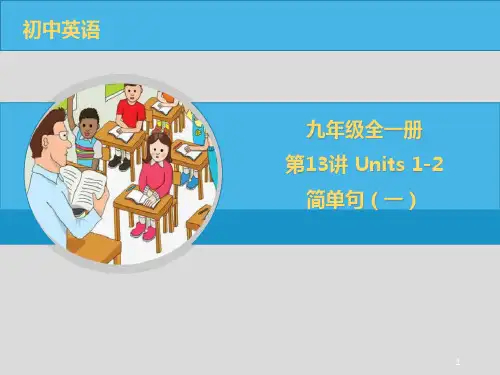
1)简单句(Simple Sentences):只包含一个主谓结构句子叫简单句
e.g. She is fond of collecting stamps.她喜欢集邮。
2)并列句(Compound Sentences):包含两个或两个以上主谓结构的句子叫并列句,句与句之间通常用并列连词或分号来连接
e.g. The food was good, but he had little appetite.食物很精美,但他却没什么胃口。
3)复合句(Complex Sentences):包含一个主句从句和一个或几个从句的句子叫复合句,从句由从属连词引导
e.g. The film had begun when we got to the cinema.
英语中的五大基本句型
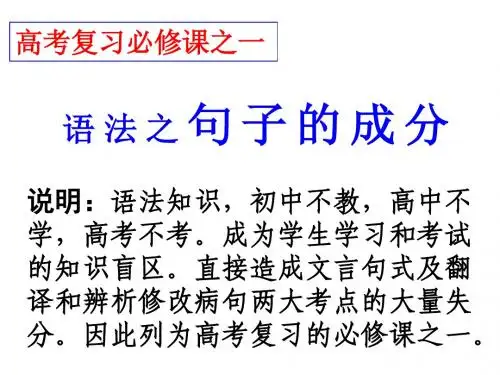
英语句子是由主语(subject), 谓语动词(verb),宾语(object), 表语(predicative),状语(adverbial),宾语补足语(object complement)等成分组成,按照这些成分的组合方式英语句子可分为五种基本句型
句型一:主语+不及物动词
不及物动词本身就可以表达完整的意念,不需要宾语及补语,但有时可有副词,介词短语等状语修饰语。
e.g.The rain stopped . The old man walks in the park .
句型一的扩展:
1.主语+不及物动词+状语
e.g. The machine works smoothly. (机器运转正常。
)
2.There +不及物动词+主语
e.g. There is some milk in the bottle . There comes the bus .
3. 主语+不及物动词+ 动词不定式
e.g. They stopped to take a short rest . (他们停下来稍作休息)
特别提醒动词stop 可用作不及物动词,也可用作及物动词。
作不及物动词时, 通常后接动词不定式,表示停下来的目的是做另一件事。
作及物动词时,通常后接动名词,表示停止做这件事。
e.g. They stopped taking a rest .
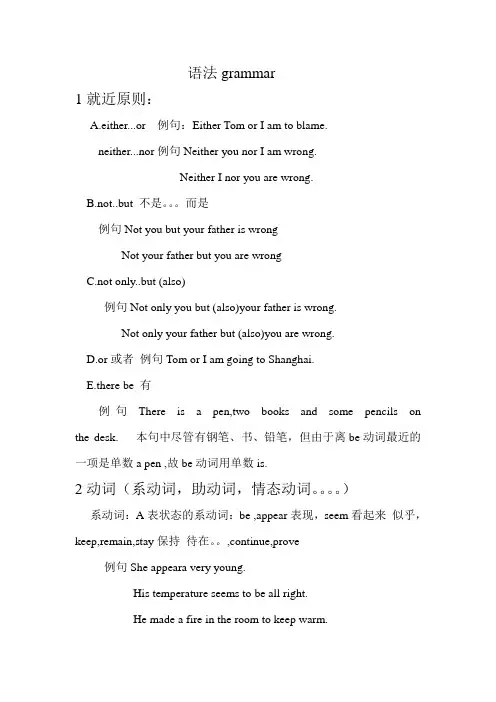
句型二:主语+系动词+表语
系动词本身不能表达完整的意念,需要形容词,名词,介词短语等来补充说明主语,也叫主语补语。
My sister is a teacher . I feel quite hungry . The ball is under the desk .
句型三:主语+及物动词+宾语
及物动词本身需要一个动作的接受者(宾语),才可以表达一个完整的意念。
e.g. We are learning English . Do you know him ?
Your radio needs repairing . She hopes to see her uncle.
句型四:主语+及物动词+间接宾语+直接宾语
有些及物动词需要两个宾语才能表达一个完整意念。
e.g. Her mother bought her a skirt. Give me the book, please.
特别提醒:A. 在此句型中,通常是间接宾语(人)在前,直接宾语(物)在后,有时直接宾语和间接宾语可以对调,这时间接宾语前应加上适当的介词。
直接宾语与间接宾语对调时,间接宾语前加介词to的动词有:
give(给), tell(告诉) , lend(借给) , sell(卖), teach(教) , send(寄给), write(写给), show(出示) , return(还给), bring(带给), pass(递给), leave(留给), offer(提供),
hand(交给)
间接宾语前加介词for的动词有:
buy(买), choose(选择), get (弄到), make(做), order(订购), sing (唱歌), do (做),
play(演奏)
e.g. Her mother bought a skirt for her . Give the book to me ,
B. 如果直接宾语为人称代词那么必须把直接宾放在间接宾语前,且间接宾语前要加上适当的介词。
e.g. I handed it to our teacher . 不能说:I handed our teacher it .
C. 此句型变为被动语态时,可分为两种情况。
e.g. Her mother bought her a skirt .
She was bought a skirt by her mother . A skirt was bought for her by her mother.
句型五:主语+及物动词+宾语+宾语补足语
及物动词本身需要一个宾语外,还需要一个名词,形容词,副词, 动词不定式,分词来补充说明宾语,才能表达一个完整的意念。
e.g. We elected Li Yang our monitor. The news made us sad.
The teacher asked me to answer the question . I found the man stealing the money .
特别提醒 A. 现在分词为宾语补足语时,宾语与现在分词之间是主动关系;过去分词为宾语补足语时,宾语与过去分词之间是被动关系。
B. 在let(让),make(使得),have(请,让,使得),see(看),hear(听到),watch(观看),feel(感觉到),listen to (倾听),look at (看到),notice(注意到)等动词后的宾语补足语如果为不定式,则省掉”to”,但变为被动语态时,则要带”to”.
e.g. We hear her sing next door. She is heard to sing next door .
美国的主要节日
January 1 New Year's Day (新年)
February 14 Valentine's Day (情人节)
March 8 International Women's Day(国际妇女节)
April 1 April Fools Day (愚人节)
May Mother's Day (母亲节) the second Sunday of May
June Father's Day(父亲节) the third Sunday of June
July 4 Independence Day (美国独立日)
August 2 Friendship Day
September Labor Day(劳动节) the first Monday of September October 31 Halloween (万圣节前夜)
November Thanksgiving Day (感恩节) the last Thursday of November December 25 Christmas Day(圣诞节)。