算法导论 第三版 第27章 答案 英
- 格式:pdf
- 大小:7.33 MB
- 文档页数:22
Chapter27
MichelleBodnar,AndrewLohr
April12,2016
Exercise27.1-1
Thismodificationisnotgoingtoaffecttheasymptoticvaluesofthespan
workorparallelism.Allitwilldoisaddanamountofoverheadthatwasn’t
therebefore.ThisisbecauseassoonastheFIB(n−2)isspawnedthespawn-
ingthreadjustsitsthereandwaits,itdoesnotaccomplishanyworkwhileit
iswaiting.Itwillbedonewaitingatthesametimeasitwouldofbeenbefore
becausetheFIB(n−2)callwilltakelesstime,soitwillstillbelimitedbythe
amountoftimethattheFIN(n−1)calltakes.
Exercise27.1-2
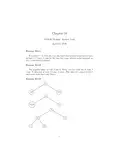
Thecomputationdagisgivenintheimagebelow.Thebluenumbersby
eachstrandindicatethetimestepinwhichitisexecuted.Theworkis29,span
is10,andparallelismis2.9.
Exercise27.1-3
1
Supposethattherearexincompletestepsinarunoftheprogram.Since
eachofthesestepscausesatleastoneunitofworktobedone,wehavethat
thereisatmost(T1−x)unitsofworkdoneinthecompletesteps.Then,we
supposebycontradictionthatthenumberofcompletestepsisstrictlygreater
than(T1−x)/P.Then,wehavethatthetotalamountofworkdoneduringthe
completestepsisP·((T1−x)/P+1)=P(T1−x)/P+P=(T1−x)−((T1−x)
modP)+P>T1−x.Thisisacontradictionbecausethereareonly(T1−x)
unitsofworkdoneduringcompletesteps,whichislessthantheamountwe
wouldbedoing.NoticethatsinceT∞isaboundonthetotalnumberofboth
kindsofsteps,itisaboundonthenumberofincompletesteps,x,so,
TP≤(T1−x)/P+x≤(T1−T∞)/P+T∞
Wherethesecondinequalitycomesbynotingthatthemiddleexpression,asa
functionofxismonotonicallyincreasing,andsoisboundedbythelargestvalue
ofxthatispossible,namelyT∞.
Exercise27.1-4
Thecomputationisgivenintheimagebelow.Letvertexuhavedegreek,
andassumethattherearemverticesineachverticalchain.Assumethatthis
isexecutedonkprocessors.Inoneexecution,eachstrandfromamongthek
ontheleftisexecutedconcurrently,andthenthemstrandsontherightare
executedoneatatime.Ifeachstrandtakesunittimetoexecute,thenthetotal
computationtakes2mtime.Ontheotherhand,supposethatoneachtimestep
ofthecomputation,k−1strandsfromtheleft(descendantsofu)areexecuted,
andonefromtheright(adescendantofv),isexecuted.Ifeachstrandtake
unittimetoexecuted,thetotalcomputationtakesm+m/k.Thus,theratio
oftimesis2m/(m+m/k)=2/(1+1/k).Askgetslarge,thisapproaches2asdesired.
2
Exercise27.1-5
TheinformationfromT10appliedtoequation(27.5)giveusthat
42≤T1−T∞10+T∞
whichtellusthat
420≤T1+9T∞
Subtractingthesetwoequations,wehavethat100≤8T∞.
IfweapplythespanlawtoT64,wehavethat10≥T∞.Applyingthework
lawtoourmeasurementforT4getsusthat320≥T1.Now,lookingattheresult
ofapplying(27.5)tothevalueofT10,wegetthat
420≤T1+9T∞≤320+90=410
acontradiction.So,oneofthethreenumbersforruntimesmustbewrong.
However,computersarecomplicatedthings,anditsdifficulttopindownwhat
canaffectruntimeinpractice.ItisabitharshtojudgeprofessorKarantoo
poorlyforsomethingthatmayofbeenoutsidehercontrol(maybetherewasjust
agarbagecollectionhappeningduringoneofthemeasurements,throwingitoff).
Exercise27.1-6
We’llparallelizetheforloopoflines6-7inawaywhichwon’tincurraces.
WiththealgorithmP−PRODgivenbelow,itwillbeeasytorewritethecode.
Fornotation,letaidenotetheithrowofthematrixA.
Algorithm1P-PROD(a,x,j,j’)
1:ifj==jthen
2:returna[j]·x[j]
3:endif
4:mid=j+j2
5:a’=spawnP-PROD(a,x,j,mid)
6:x’=P-PROD(a,x,mid+1,j’)
7:sync
8:returna’+x’
Exercise27.1-7
Theworkisunchangedfromtheserialprogrammingcase.Sinceitisflipping
Θ(n2)manyentries,itdoesΘ(n2)work.ThespanofitisΘ(lg(n))thisisbe-
causeeachoftheparallelforloopscanhaveitschildrenspawnedintimelg(n),
sothetotaltimetogetalloftheconstantworktasksspawnedis2lg(n)∈Θ(lg).
3Algorithm2MAT-VEC(A,x)
1:n=A.rows
2:letybeanewvectoroflengthn
3:parallelfori=1tondo
4:yi=0
5:end
6:parallelfori=1tondo
7:yi=P-PROD(ai,x,1,n)
8:end
9:returny
Sincetheworkofeachtaskiso(lg(n)),thatdoesn’taffecttheT∞runtime.The
parallelismisequaltotheworkoverthespan,soitisΘ(n2/lg(n)).
Exercise27.1-8
TheworkisΘ(1+nj=2j−1)=Θ(n2).ThespanisΘ(n)becauseinthe
worstcasewhenj=n,thefor-loopofline3willneedtoexecutentimes.The
parallelismisΘ(n2)/Θ(n)=Θ(n).
Exercise27.1-9
WesolveforPinthefollowingequationobtainedbysettingTP=TP.
T1P+T∞=T1P+T∞2048
P+1=1024
P+81024
P=71024
7=P
Sowegetthatthereshouldbeapproximately146processorsforthemto
havethesameruntime.
Exercise27.2-1
Seethecomputationdagintheimagebelow.Assumingthateachstrand
takesunnittime,theworkis13,thespanis6,andtheparallelismis136
4