
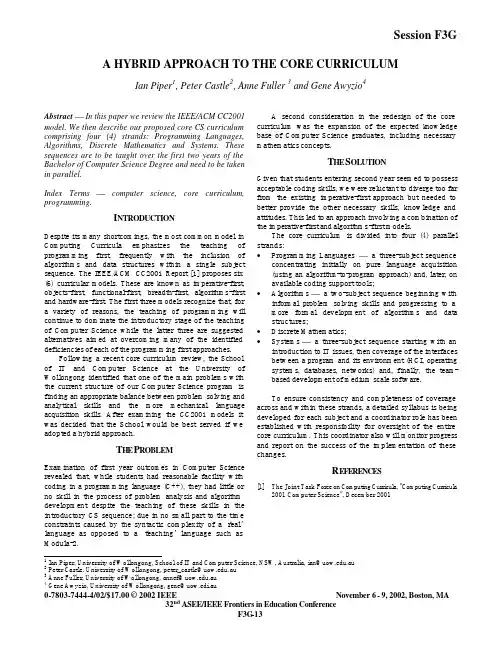
A HYBRID APPROACH TO THE CORE CURRICULUM
- 格式:pdf
- 大小:14.32 KB
- 文档页数:1
Unit 3 Section A Where Principles Come FirstI. Background information1. Brief introduction of Hyde:The school opened in 1999 with 240 students in grades 7-9 and currently serves 698 students in grades K-4 and 6-12. It will eventually serve more than 1,000 students in grades K-12. The core philosophy of Hyde Leadership PCS is that each individual is gifted with unique potential that defines a destiny. The unique potential is developed through a character-based curriculum that stresses a student-parent-teacher partnership and creates a family-school bond.2. Key Words about Hyde School:Character-Based:One of Hyde’s basic purposes is to develop students' character. This focus on character unleashes the deepest motivation in students' self-discovery. The school helps students answer the following three questions: Who am I? Where am I going? What do I need to do to get there?Five Words: Our Five Words are what we believe define character: Leadership - I am a leader through asking the best of myself and the best of others.Integrity - I am gifted with a unique potential and conscience as my guide to discovering it.Curiosity - I am responsible for my own learning.Courage - I learn the most by facing challenges and taking risks.Concern - I need a challenging and supportive community in which to develop my character.Five Principles: Our Five Principles guide the conduct of all the school’s activity:Destiny - Each of us is gifted with a unique potential that defines a destiny. Humility - We trust in a power and purpose beyond ourselves.Conscience - We achieve our best through character and conscience.Truth - Truth is our primary guide.Brother's Keeper - We help others achieve their best.3. Focus of Hyde: Attitude more than aptitude; Effort more than ability;Character more than talentII. Structure Analysis1.What is the text mainly about?The text is about the Hyde School’s successful search for a new approach in education, which is centered upon teaching students the merit of such values as truth, integrity, leadership, curiosity and concern.2.How is the text organized?The writer developed the topic by employing the reading technique of 'questions and answers',with which the writer, on behalf of the reader, asks himself one question after another first, and then answers them one by one until his ideas are made clear to the reader. This is a very important technique of bringing out the relationship between the paragraphs, as shown below. Question 1: What are the principles?Key words:merits of values, academic achievement, preparing sb. for a way of lifeQuestion 2: What are people’s attitudes towards the principles?Key words: willing, protesting, eyeing, fearingQuestion 3: What are the detailed principles?Key words: 1) potential based on character, conscience & hard work, success measured by growth, responsibility2) providing preparation for college, taking performing arts and sports3) requiring the parents’ commitment & participationQuestion 4: What are the beneficial results?Key words: role model for children, fruitful relationship, an example of a student, going to collegeIII. New words and expressions1. to operate on the principle that…以…为原则(宗旨)运作We employ people on the principle that the sky is so high that any bird can fly freely — there is scope for everyone to exercise his talents freely.2. to naturally follow 自然会随之而来Much better results will naturally follow as long as you never give up trying.3. to receive considerable publicity for its work 因其工作备受关注More than 50 years after WWII, the chemical weapons Japan left behind in China receive considerable publicity for this incident.4. to see ourselves as 把我们视为…His frequent questions were seen as interrupting the class.5. to cultivate a comprehensive set of principles 倡导一整套价值观念The writer has created a comprehensive set of vivid images in her novel.6. to spread his idea to public schools 把他的理念向公立学校推广If you allow your child to attend school he could spread the bad cold to the other children.7. (sth.) to be suspended (某事)暂时搁置The air service in some countries has been suspended because of the alarming spread of this disease.8. to be associated with 与…相关People often complain about the mental strain associated with modern life.9. (sth.) to be scheduled to (某事)计划This school’s new educational reform project is scheduled to be started up in three months.10. to eye the program 关注这个教学计划Many people are eyeing the progress of the new project.11. to open a magnet program 启动一项引人注目的计划The market-oriented economy has opened up the market to those with great competence and learning.12. over parents' protests 不顾家长们的抗议The nurse gave the boy an injection over his protest.13. the quest for truth 对真理的追求There will be no limit to our quest for a better life.14. in an energetic exchange 采用激烈讨论的方式They tend to reach an agreement in an energetic exchange.15. to spend the last five minutes evaluating sth. 用最后五分钟评估某事What worries parents most is that their children spend more and more time chatting online.16. to put one’s best effort forth / to do one’s utmost 全力以赴I will put my best effort forth if it is for the sake of my motherland.17. (sth.) to be based on …, not …(某事的)基础是…而不是…One’s success is based largely on his internal factors, not external factors.18. to be measured by …, not …由…来衡量,而不是由…来衡量The value of one’s life should be measured by how much good he does to society, not how long he lives in the world.19. (sb.) to be required to do sth. (某人)必须做某事With the situation being urgent, we are required to make an immediate decision.20. to have nothing to do with 与…无关Success in teaching has everything to do with a strong sense of responsibility.21. complete with English 包括英语学习There is a good hotel not far from the city, complete with a swimming pool and a garden leading to the beach.22. to work out 制订; 解决; 算出; 锻炼We will leave it to the committee to work out the details of the plan.23. at the outset of sth. 在(某事的)一开始The committee did not run into any difficulty from the outset of the investigation.24. kind of 有几分;有点儿I’m not sure why, but, I feel kind of sorry for him.IV. Language Points1. Hyde School founder Joseph Gauld claims success with the program at the $18,000-a-year high school in Bath, Maine, which has received considerable publicity for its work with troubled youngsters. (Para. 1)Meaning: Joseph Gauld, the founder of the Hyde School, declares that the program at the high school in Bath, Maine is successful. The school, which charges a student $18,000 per year, has drawn considerable attention from the public and news media because of its successful work with troubled students.2.We see ourselves as preparing kids for a way of life—by cultivating a comprehensive set of principles that can affect all kids. (Para. 2) Meaning: We think our duty is to prepare students for a way of life—by teaching them a complete set of principles that can influence all students.Don’t confuse ‘comprehensive’ with ‘comprehensible’, which means ‘easy to understand’.The book is written in clear, comprehensible language. 这本书语言清楚易懂。

大学英语教育指南2022电子版Here is a 1000-word essay on the topic of "A Guide to University English Education 2022 (Electronic Version)":As the world becomes increasingly interconnected, the importance of English proficiency has never been more crucial. For university students, mastering the English language is not only a crucial academic requirement but also a gateway to countless professional and personal opportunities. In the ever-evolving landscape of higher education, the guide to university English education in 2022 offers a comprehensive blueprint for students to navigate this critical aspect of their academic journey.Firstly, the curriculum design of university English education must adapt to the changing needs of the modern learner. Gone are the days when a one-size-fits-all approach could suffice. The 2022 guide emphasizes the importance of tailored course offerings that cater to the diverse linguistic backgrounds and learning preferences of students. This may include specialized tracks for English as a Second Language (ESL) learners, advanced classes for proficient speakers, and interdisciplinary courses that integrate English proficiency with subject-specific knowledge.Moreover, the delivery of English instruction must evolve to harness the power of technology. The 2022 guide encourages universities to embrace the potential of digital learning platforms, virtual classrooms, and interactive multimedia resources. By leveraging these tools, students can engage in self-paced learning, access a wealth of online materials, and participate in collaborative projects with peers from around the world. This hybrid approach to English education not only enhances the learning experience but also prepares students for the digital-centric workplaces of the future.In addition to curricular and instructional innovations, the guide also emphasizes the critical role of language assessment and feedback mechanisms. Recognizing that proficiency is not a static endpoint but a continuum of growth, the 2022 guide recommends the implementation of comprehensive assessment systems that track student progress, identify areas for improvement, and provide personalized feedback. This holistic approach to evaluation enables students to take ownership of their learning, adapt their strategies, and ultimately achieve their language learning goals.Furthermore, the guide underscores the importance of integrating English proficiency across the broader university experience. Beyond the walls of the language classroom, students should be encouraged to apply their English skills in various academic and extracurricularsettings. This may include participating in English-medium discussions, delivering presentations, engaging in research projects, and even exploring international exchange programs. By fostering a campus-wide culture of English language use, universities can empower students to develop their communicative competence in real-world contexts.Crucially, the 2022 guide also addresses the need for a highly qualified and continuously trained faculty. University English educators must not only possess exceptional language skills but also be equipped with the pedagogical expertise to deliver effective and engaging lessons. The guide recommends that universities invest in professional development opportunities, such as workshops, conferences, and collaborative research initiatives, to ensure that their faculty remain at the forefront of best practices in language teaching and learning.Beyond the classroom experience, the 2022 guide also emphasizes the importance of nurturing a vibrant ecosystem of English language resources and support services. This may include well-stocked libraries with a diverse collection of English-language materials, writing centers that provide personalized tutoring, and language clubs that foster extracurricular language practice. By creating a comprehensive support network, universities can empower students to develop their English proficiency holistically and unlock the fullpotential of their academic and personal journeys.Finally, the 2022 guide acknowledges the global reach of English language education and encourages universities to cultivate international partnerships and collaborative initiatives. This may involve student exchange programs, joint research projects, or the establishment of satellite campuses in strategic locations. By fostering a globally connected approach to English education, universities can expose their students to diverse cultural perspectives, expand their professional networks, and prepare them for the demands of an increasingly globalized world.In conclusion, the 2022 guide to university English education offers a comprehensive and forward-looking framework for institutions to enhance the quality and relevance of their language instruction. By embracing curricular innovation, technological advancements, holistic assessment, faculty development, and global collaboration, universities can empower their students to become confident and competent communicators in English, positioning them for successin the 21st-century world.。

基于微助教的《计算机网络技术》改革实践作者:田建立孟凡佳曹伯强汪垚来源:《科技资讯》2022年第04期摘要:当前部分高职院校《计算机网络技术》课程教学中还存在重理论轻实践等问题,文章结合学院实际,重构了该课程内容,并在教学实践中运用一款轻量级辅助教学手段—微助教,构建了一种“线上+线下”相结合的混合教学模式,提高了学生职业素养及能力,促进了学生自主学习。
这也为高职院校其他课程的改革提供了广阔的思路。
关键词:高职计算机网络课程标准建设教学中图分类号:TP393-4;G642文献标识码:A 文章編号:1672-3791(2022)02(b)-0000-00Teaching Reform and Practice of Computer Network Technology with the Assistance of TeachermateAbstracts: In order to solve the problems existing in the teaching of "computer network technology" course in some higher vocational colleges, the research group extensively consulted the literature, reconstructed the course content of "computer network technology" , we use a lightweight auxiliary teaching method micro assistant in teaching practice to construct a hybrid teaching mode of "Online+offline", which improves students' professional quality and ability,promotes students' autonomous learning. These also provide broad ideas for the reform of other courses in higher vocational colleges.Key Words: Higher vocational education;Computer network;Curriculumstandards;Construction;Teaching《计算机网络技术》是高职计算机类专业的一门基础性课程,开设内容较为宽泛。

《中西方教育方式的比较》高中生英语作文【中英文版】Title: A Comparison of Eastern and Western Educational Approaches Education systems across the globe vary significantly, reflecting the diverse cultures and values of each region.Eastern countries, such as China, often emphasize rote learning, respect for authority, and academic rigor, while Western countries, like the United States, tend to prioritize critical thinking, creativity, and individualism.This essay will explore the key differences between Eastern and Western educational approaches, shedding light on their respective strengths and weaknesses.In Eastern education systems, there is a significant emphasis on discipline and respect for authority.Students are expected to follow strict guidelines and adhere to a structured curriculum.Rote learning, which involves memorizing information through repetition, is a common method used to ensure that students retain key concepts.This approach enables students to perform well on exams andmemorize large amounts of information.However, it can sometimes stifle creativity and critical thinking, as students may focus too heavily on memorizing facts rather than understanding the underlying principles.In contrast, Western educational systems tend to prioritize critical thinking, creativity, and individualism.Students are encouraged to question authority, challenge ideas, and explore their own interests.Thecurriculum is often more flexible, allowing students to choose courses that align with their passions and career goals.This approach fosters a love for learning and encourages students to develop their unique talents.However, it can also lead to higher dropout rates and less emphasis on basic knowledge, as students may prioritize their personal interests over academic requirements.Another key difference between Eastern and Western educational approaches is the role of technology.In Eastern countries, technology is often used as a tool to support traditional teaching methods.For example, teachers may use digital textbooks and online resources to enhance their lectures and create interactive lessons.In Western countries, technology is more integrated into the curriculum, with students using digital tools to collaborate, conduct research, and create projects.This approach prepares students for the digital age and helps them develop essential 21st-century skills.Despite these differences, both Eastern and Western educational systems have their strengths and weaknesses.Eastern systems produce well-disciplined and knowledgeable students who excel in standardized tests and academic competitions.Western systems, on the other hand, foster creativity, critical thinking, and individualism, preparing students for success in a rapidly changing world.In conclusion, Eastern and Western educational approaches havedistinct differences that reflect their respective cultures and values.While Eastern systems emphasize discipline, respect for authority, and rote learning, Western systems prioritize critical thinking, creativity, and individualism.Both approaches have their strengths and weaknesses, and a hybrid of the two may provide a more balanced and effective education for students worldwide.As an aspiring educator, it is essential to understand these differences and adapt teaching methods to meet the needs of diverse students.By doing so, we can create a more inclusive and effective educational system that prepares students for success in an increasingly globalized world.。