初三英语复习(句子成分及其句子种类)人教版(配有练习题)
- 格式:doc
- 大小:219.00 KB
- 文档页数:10
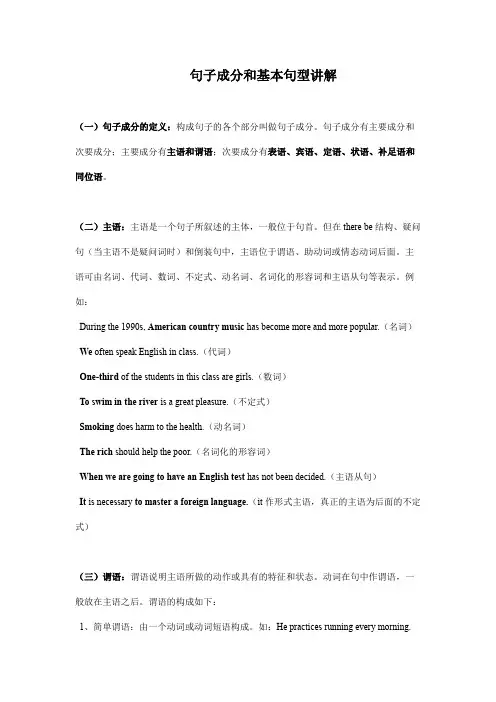
学习好资料 欢迎下载 01初三英语复习(句子成分及其句子种类)人教版 (配有练习题) 一.教学内容: 复习句子成分及其句子种类 组成句子的各部分叫做句子成分。句子的成分有:主语、谓语、表语、宾语、宾语补足语、定语和状语。 二. 句子最基本的结构是:主语+谓语 主语:在句子中的位置是放在句首:可以作主语的词类有名词、代词、数词、不定式以及词组、从句等等。 e.g. The boys are playing football now. 名词作主语 Two and two are four. 数词作主语 To learn a foreign language is very useful. 动词不定式作主语 This is a key. 代词作主语。 谓语:谓语放在主语之后,动词作谓语,包括及物动词,不及物动词,系动词。 e.g. The students are reading books. 动词作谓语 表语:放在谓语之后,结构是:主语+谓语(系动词)+表语 用作表语的词有名词,代词,数词,形容词,副词,不定式,词组,从句等等。 e.g. We are students. 名词作表语 This desk is hers. 代词作表语 Lee is fifteen. 数词作表语 Sarah’s car looks nice. 形容词作表语 Our plan is to plant trees. 动词不定式作表语 Is your father in? 表示地点的副词作表语 宾语:宾语放在谓语之后,结构是:主语+谓语(及物动词)+宾语,宾语分为直接宾语和间接宾语,直接宾语指物,间接宾语指人。 e.g. Please pass me the salt. 间接宾语 直接宾语 用作宾语的词有:名词,代词,数词,不定式短语,名词性的形容词或从句。 e.g. Do you need any help? 名词作宾语 Would you like to help me? 代词作宾语 He bought ten oranges. 数词作宾语 The teacher wants to take these chairs out of the room. 动词不定式作宾语 宾语补足语:在句子中放在宾语之后,结构是:主语+谓语(及物动词)+宾语+宾语补足语 可以用作宾语补足语的词有:名词,形容词,不定式和分词。名词或者代词+形容词/名词/不定式/分词 e.g.
The good news made me happy. 形容词作宾补 Did you hear her sing just now? 动词不定式作宾补 I saw him cleaning the window yesterday. 分词作宾补 Let us have a rest. 不定式短语作宾补 状语:一般放在句尾,有时放句首或句中。作状语的词有:副词,介词短语、词组,不定式短语,分词短语以及从句。 学习好资料 欢迎下载 e.g. Immediately he started to sing. 副词放句首,作状语 I’m never late. 副词放句中作状语 He drives fast. 副词放句尾作状语。 Please park the car in front of the building. 介词短词作状语放句尾 They went to Shanghai to have a meeting. 动词不定式作状语 Jack watched TV day and night. 词组作状语 定语:请记住有名词或代词的地方都可以有定语。一般情况下单个的名词,代词,形容词放在所修饰的名词之前,而词组、短语、从句要放在所修饰的名词之后。 可以用作定语的词有:形容词,代词,数词,名词或名词所有格、介词短语,不定式短语,词组,分词短语和从句。 e.g.
Ben is an old man. 形容词用作定语,放在名词之前。
Do you want another cake? 代词用作定语放在所修饰的名词前 The girl asked her mother two questions. 数词用作定语放在所修饰的名词之前。 The worker put the flowers in a paper bag. 名词用作定语放在所修饰的名词之前。 Who’s the man over there? 介词短语作定语放在所修饰的名词之后。
Could you bing me something to drink, please? 动词不定式作定语,放在不定代词之后。 The plane that can fly is a machine. 从句用作定语放在所修饰的名词之后。
三. 句子的结构:简单句,并列句和复合句 首先看简单句的五种基本句型 (1)主语+谓语(不及物动词) e.g. Summer is coming. (2)主语+谓语(连系动词)+表语。 e.g. You are very busy. (3)主语+谓语(及物动词)+宾语 e.g. Mr Liu teaches English. (4)主语+谓语(及物动词)+宾语+宾语 e.g. Mum gave me a dictionary. = Mum gave a dictionary to me. (5)主语+谓语(及物动词)+宾语+宾语补足语 e.g. Lina asked him to go shopping together. 学习好资料 欢迎下载 We call him “Uncle Wang” The students watched the teacher doing the experiment. 并列句: 并列句由两个或两个以上的简单句构成。常用的并列连词有:and, but, or, so, not only …but also…, both …and …等等。 e.g. John got up late, so he had to go to school without breakfast. 约翰起床晚了,所以只好不吃早饭而上学。 Hurry up, or, you’ll be late. 快点儿,否则要迟到了。 We like not only music but also art. 我们不但喜欢音乐,而且也喜欢艺术。
复合句: 复合句是由一个主句和一个或几个从句构成。根据从句在句中的成分可以称为主语从句,宾语从句,表语从句,定语从句,状语从句和同位语从句。 e.g. Whether he will come or not is not known. 他是否会来还不知道。(主语从句) =It is not known whether he will come or not. That is what I should do. 这是我的本份。(表语从句) He asked me where Mr Pope lived. 他问我Pope先生住在哪里。(宾语从句) The idea that we asked Mike to come yesterday is quite good. 昨天我们请迈克来,这个主意太好了。(同位语从句)
This is the room where I live last summer.
这就是我去年夏天住过的房间。(定语从句) He’ll telephone his mother as soon as he gets there. 他只要一到那儿,就会给母亲打电话。(时间状语从句) Wherever there is smoke, there is fire. 无风不起浪。(地点状语从句) Jean didn’t go to work because she was ill. Jean因病没有上班。(原因状语从句) If it doesn’t rain tomorrow, we’ll go to the Science Museum. 如果明天不下雨,我们就去科学博物馆。(条件状语从句) Mr King spoke slowly so that everyone could understand him. 金先生将慢慢讲以使每个人都听懂他的话。(目的状语从句) He is so clever that all the teachers like him. 他是那么聪明,所有的老师都喜欢他。(结果状语从句) Although he was tired, he went on working. 虽然他累了,但他还在继续工作。(让步状语从句) This film is more instructive than that one. 这部电影比那部有教育意义。(比较状语从句) 细分状语从句也有不少可以引导的关联词,请同学们仔细阅读初三英语书第232页状语从句中的语法内容。
四. 句子的种类: 句子可以分为4类:陈述句、疑问句,祈使句和感叹句。 陈述句:说明一个事实或者陈述说话人的看法。陈述句包括肯定句和否定句。