
How to Write an Abstract for a Research Paper
- 格式:ppt
- 大小:143.00 KB
- 文档页数:24

关于论文写作的指导(英文版)
Guide to Writing a Research Paper
Writing a research paper can be a daunting task for many students,
as it requires extensive research, critical thinking, and effective
communication skills. However, with careful planning and a
systematic approach, anyone can write a successful research paper.
This guide aims to provide step-by-step instructions and useful tips
to help you navigate through the process of writing a well-crafted
research paper.
1. Understand the assignment: Before starting your research paper,
carefully read the assignment guidelines provided by your
instructor. Pay attention to the specific requirements, such as the
topic, length, formatting style, and deadlines. If you have any
doubts or questions, don't hesitate to seek clarification from your
instructor.
2. Choose a topic: A good research paper starts with a well-defined

1
HOW TO WRITE A RESEARCH PAPER
This introductory guide is aimed at researchers at the beginning of their careers intending to
write papers for publication in APEX and JJAP. It will provide a few tips for writing papers on
your research results.
1. Where to submit your paper
It is beneficial to decide on a target journal (APEX or JJAP) and type of paper (Letters for
APEX; Regular Paper (RP), Rapid Communication (RC), and Brief Note (BN) for JJAP) at
very beginning of your writing. This is useful because different journals and paper types
have different scientific scopes and aims and different manuscript requirements in terms of length, style, and format. By directly targeting your journal and paper type, you can ensure
the right approach and speed up the manuscript preparation.
2. How to construct your paper

WhenwritingapaperabstractinEnglish,itisessentialtofollowaspecificformat
thatclearlyandconciselysummarizesthemainpointsofyourresearch.Hereisa
stepbystepguidetohelpyoucreateawellstructuredabstractforyouracademicpaper:
1.Title:Beginwiththetitleofyourpaper,whichshouldbeconciseandreflectiveofthe
maintopic.
2.Purpose:Statethepurposeofyourresearch.Thisshouldbeabriefstatementthat
outlinestheobjectivesorresearchquestionsyouaimedtoaddress.
3.Methods:Describethemethodologyyouusedforyourresearch.Thissectionshouldbe
briefandincludethetypeofstudydesign,samplesize,andkeytechniquesortoolsused.
4.Results:Summarizethemainfindingsofyourresearch.Focusonthemostsignificant
resultsandavoidincludingdataorstatisticaldetails.
5.Conclusion:Provideabriefoverviewoftheconclusionsdrawnfromyourresearch.
Thisshouldhighlighttheimplicationsofyourfindingsandtheirrelevancetothefield.
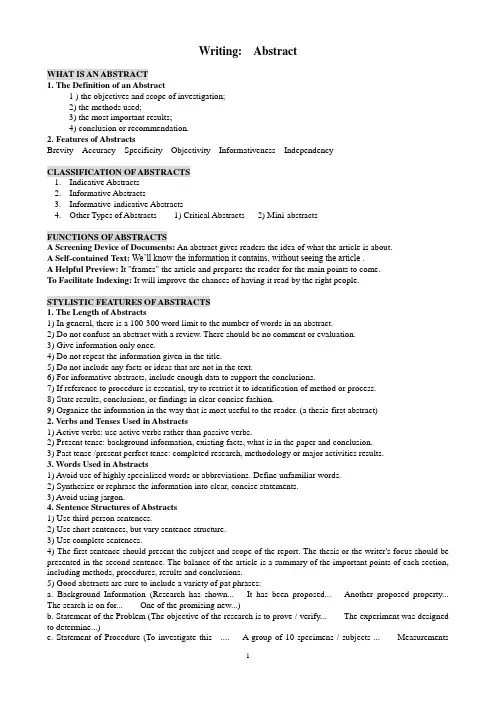
1 Writing: Abstract
WHAT IS AN ABSTRACT
1. The Definition of an Abstract
1 ) the objectives and scope of investigation;
2) the methods used;
3) the most important results;
4) conclusion or recommendation.
2. Features of Abstracts
Brevity Accuracy Specificity Objectivity Informativeness Independency
CLASSIFICATION OF ABSTRACTS
1. Indicative Abstracts
2. Informative Abstracts
3. Informative-indicative Abstracts
4. Other Types of Abstracts 1) Critical Abstracts 2) Mini-abstracts
FUNCTIONS OF ABSTRACTS
A Screening Device of Documents: An abstract gives readers the idea of what the article is about.
A Self-contained Text: We’ll know the information it contains, without seeing the article .
A Helpful Preview: It "frames" the article and prepares the reader for the main points to come.