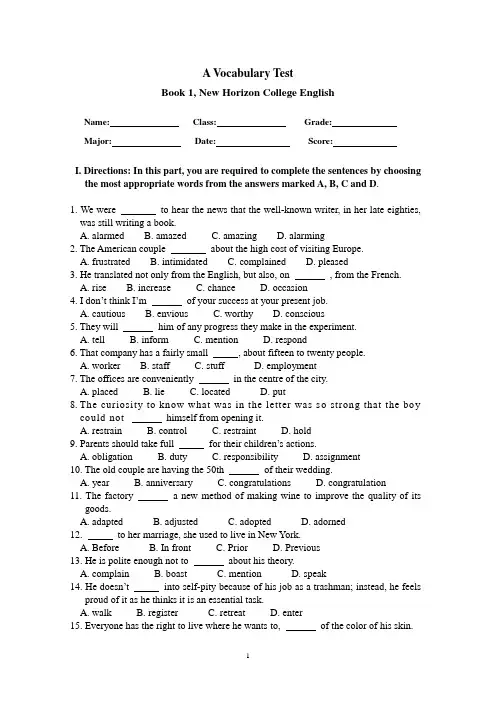
New Horizon College English book 1 Unit 1
- 格式:doc
- 大小:106.50 KB
- 文档页数:9
A Teaching Plan for Unit 1(In New Horizon College English Book 1)I. Time: the first 10 class hours in Oct. 2006II. Contents:1.Listening and Speaking2.Section A: Learning a Foreign Language3.Section B: Keys to Successful Online LearningIII. Suggested Timetable:1.The first two-class-hour session for listening and speaking2.The next four-class-hour session for Section A3.The fourth two-class-hour session for exercises of Section A4.The fifth two-class-hour session for Section B and Section CIV. Aims and Requirements:Listening and Speaking1.Train the students’ ability to understand the main idea and grasp important details of the listeningtexts.2.Give the students a chance to exchange views on the texts they have heard to enable them to havea deeper understanding of the texts.Section A: Learning a Foreign Language1.New words and expressions: reward, frustrate, positive, former, unlike, opportunity, communicate,access, technology participate, virtual, continual, finally, culture, activity, be well worth sth./ doing sth., not only… but also…, far from, get access to.2.Writing Skills: Cause and EffectSection B: Keys to Successful Online Learning1.Reading Skills: Finding out word meaning though different ways2.Teach the students how to grasp the main idea of the textV. Focal Points and Difficult Points:Listening and Speaking1.Listening skills: listen for important information rather than details2.New words and expressionsSection A: Learning a Foreign Language1.Sentence structure: how to analyze the structure of a sentenceprehension of the text3.Words and expressionsSection B: Keys to Successful Online Learning1. Ask students to retell the story2.Review the subjunctive moodVI. Suggested Teaching Procedure and Methodology:·Listening and Speaking: ( an interactive approach is introduced)1. Pre-listening Task:arrange the students in pairs and ask them to discuss the followingquestions:1.What problems do you have in trying to learn English in your middle school?2.Do you think the computer can help you in learning English, why?3.What other things do you think we can gain through English language learning?2. Background Information3. Listening to text 1 and 24. Speaking Tasks: ask the students to get into pairs and explain to them how to carry out Speaking Task A- Reflections on the texts, and then select a pair to present their views in class.·Section A: Learning a Foreign Language1. Background Information:Online learningOnline learning, a form of distance education, refers to learning and other supportive resources that are available through a networked computer. With the development of the Internet, online learning often takes place on the Internet. In an online lesson, the computer displays material (often in web browsers) in response to a learner’s request. The computer asks the learner for more information and presents appropriate material based on the learner’s input. The material can be as simple as traditional lessons and tests that are transcribed into a computer program. The material can also be a complex system that tracks users’ input and suggests learning material as a result. Or the material can be a work session that occurs through a real time chat; learning occurs through the interaction. The material can be presented as text, graphics, animated graphics, audio, video, or a combination of these that are displayed in wed browsers or other multimedia players such as Windows Media Player.2. Pre-reading ActivitiesListen to short passage twice and answer questions1.What problems do you have in trying to learn English in your middle school?2. Do you think the computer can help you in learning English, why?3. What other things do you think we can gain through English language learning?3. Text Structure AnalysisIn Reading Passage A, the author presents the reader his own language learning experiences for different stages, from middle school to online learning, and for each different stage of learning he describes an effect that results from some causes. This is an example of cause and effect writing, which makes clear the reasons why something happens by showing the relation between a cause and its effect.4. Language PointsWords and Expressions1. rewarding a. (of an experience or action) worth doing or having; worthwhile (经验或事情)有益的;值得做的;有用的e.g. Learning a foreign language was one of the most difficult yet most rewarding experiences of my life.学习外语是我最一生中最困难,然而也是最有意义的经历。