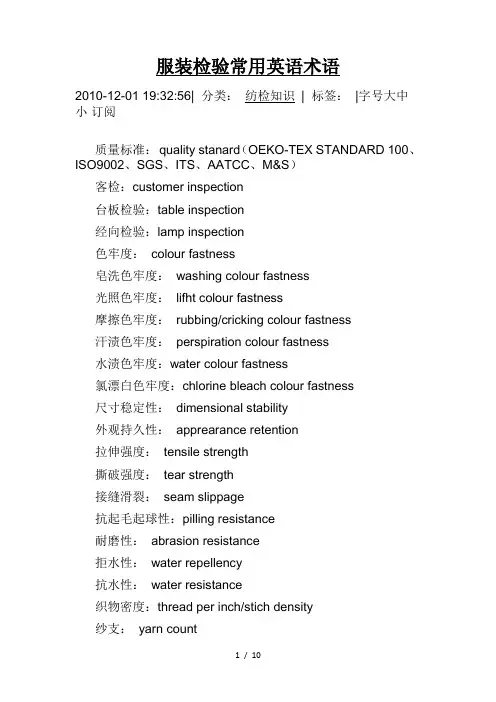
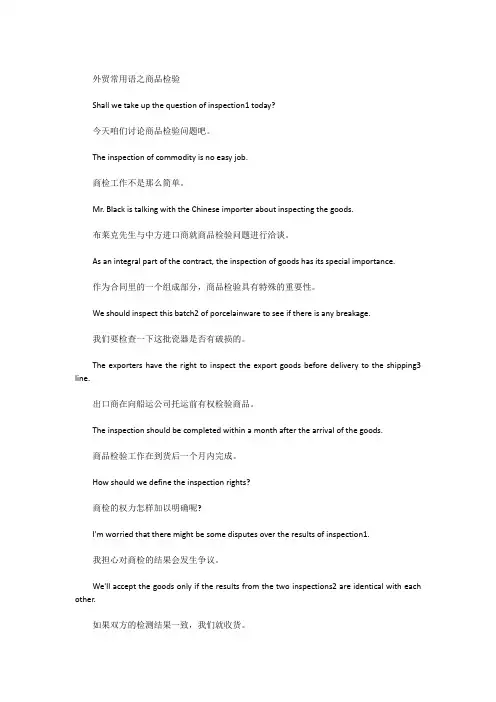
验货员英语验货专业术语
- 格式:doc
- 大小:638.50 KB
- 文档页数:51
1 附(一):语法常识: 名词的数: 1. 普通名词,集合名词为单数时前面必须加a, an, the ,但其前面有所有格(my, your等)或冠词相等语(this, that, every等)时不加冠词;若为复数形态不可加不定冠词a, an;若是指特定的人或事物,则必须加定冠词the。 2. 数量单位的词(如:dozen, hundred, million, thousand….)前有数值时不加 “s”,但前面无数值而大约表数值且接系动词时则须加 “s”。 例:I bought two dozens of eggs.(误) I bought two dozen eggs.(正) There are hundreds of students here.(正) 3. 数词与名词用 “-”连接形成复数名词做形容词用时,该名词只用单数形。 例:She is a five-year-old girl.(不可用five –years-old) 4. 有些名词通常用复数形,但须后接单数动词,例:mews, billiards, measles, wages. 复数名词的形成: 1. 规则变化: a. 一般名词之后+S,例:book->books b. 字尾为s, sh, ch[tf], z, x +es(字尾为ch且发音为[tf]才+es,否则+s)例: box->boxes, class->classes c. 字尾为f, fe时去把f, fe改 “ves”,例:wife->wives, leaf->leaves.例外:chief->chiefs, handkerchief->handkerchiefs. d. 字尾为“子音+0”时+es,例:tomato->tomatoes; 例外:planao->planos , photo->photos ,negros e. 字尾为“子音+y”时去y改成“ies”,例:baby->babies f. 字尾为“母音+y”时只+s,例:boy->boys 2. 不规则变化,例: man->men foot->feet tooth->teeth mouse->mice datum->data analysis->analyses 3. 单复数同形,例:Chinese, Japanese, cattle, sheep, deer. 4. 复合名词的复数,例: passer-by passers-by maid-servant maid-servants man-servant men-servants 5. 文字、数字、字母或记号的复数是+,例:7’s, x’s 动词的变化: 动词有三种基本形态:原形,过去式及过去分词,三种形态的变化有规则性变化和不规则变化两种。 1. 规则动词的变化: a. 大多数的动词是原形字尾加ed。例: 2
ask-asked-asked call-called-called b. 字尾为e者,只加d。例: like-liked-liked love-loved-loved c. 字尾为“子音+y” 者,去y加ied。例: study-studied-studied carry-carried-carried d. 字尾为“母音+y”者,只加ed。例: play-played-played delay-delayed-delayed e. 单音节的动词,字尾为“短母音+单子音”者,重复子音字母,再加ed。例: stop-stopped-stopped beg-begged-begged f. 两个音节且重音在后的动词,字尾为单子音者,重复子音字母,再加ed。例: permit-permitted-permitted prefer-preferred-preferred g. 字尾为c且发音为[k]的动词,加ked。例: picnic-picnicked-picnicked frolic-frolicked-frolicked 2. 不规则动词的变化: a. A-A-A- cut-cut-cut put-put-put set-set-set b. A-B-B Buy-bought-bought Say-said-said Find-found-found c. A-B-C Do-did-done Take-took-taken d. A-B-A Come-came-come Run-ran-run e. A-A-B Beat-beat-beaten 形容词的用法: 1. 形容词紧接在所修饰的(代)名词之前,以直接修饰该字时,称为形容词的限定用法。 It’s a heavy carton. 2. 形容词若被当作补语,以间接修饰(代)名词时,称为形容词的叙述用法。 The carton is heavy. 3. 大多数的形容词可同时用于限定用法及叙述用法,但某些形容词只可用于限定用法。 It’s a wooden crate.(正) 3
The crate is wooden.(误) 4. 某些形容词只可做叙述用法而不能做限定用法。 Well, ill, afraid, alive, alone She is ill.(正) She is a ill girl.(误) 5. 用来修饰something, anything, everything, nothing, someone, somebody, anyone, anybody, everybody, everybody, nobody等不定代词的形容词须放在其后。 I’ll tell you something interesting. 6. 非人称形容词:是不可用来修饰人,只可修饰物的形容词。 Amusing, exciting, useful 7. 人称形容词:可用来修饰人的形容词。 Surprised, bored, excited 数量形容词: 表示数量、程度的形容词,例如: many, little, few, much 1. many (a few, few) + 复数可数名词+复数动词/ are much ( a little, little ) + 单数不可数名词 + 单数动词 / is 2. many a + 单数可数名词 + 单数动词 / is 3. a few ( a little ) 之意为“虽少尚有”是肯定句;few ( little )之意为“几乎没有”是否定句。 4. some通常用于肯定句。 5. any通常用于否定句,条件句或疑问句。用于肯定句表示“任何一个”之意,后接单数动词。 Any one can play it. 6. Several ( both ) + 复数名词 + 复数动词/are 7. A number of +复数名词 + 复数动词 / are a good deal of ( a amount of ) + 不可数名词 + 单数动词 8. Enough ( all, some, any, no, a lot of, lots of , plenty of )其后接复数名词加复数动次或接不可数名词加单数动词。 形容词的位置: 形容词通常放在名词之前。 1.Present (出席的)和形容词片语或子句需放在名词之后,例: All the people present, a man of honesty. 2.不同种类的形容词排列顺序为:代名形容词+数量形容词+性状形容词,例: these five good cartons. 3.连系动词(be, become, feel, grow, fall, get, look, smell, taste, seem, sound….etc.)+形容词。例: the clothes smell unpleasant.(正) the clothes smell unpleasantly.(误) 4.(keep, make, find)+受词+形容词。例: he make me sick.(正) he make me sickly.(误) 冠词、形容词、名词的位置: 1. 冠词 + 名词,例: a carton 2. 冠词 + 形容词 + 名词:例: a damaged carton 4
3. 冠词 + 副词 + 形容词 + 名词,例: a badly damaged carton 4. All ( both ,many, rather, quite, such, what ) + 冠词 + 形容词 + 名词,例: All the damaged cartons 5. How ( as, so, too ) + 形容词 + 冠词 + 名词,例: How damaged the carton….. 6. Double + the + 名词,例: Double the carton ( 双倍的箱子) 副词的位置: 1. 表示时间的副词,位置如下: a. 副词 + 动词 b. be动词 + 副词 + 动词 c. 助动词 + 副词 + 主动词 2. 同种类副词以“小单位+大单位”的顺序放置。 3. 不同种类的副词依下列顺序排列: a. 地方+方法+时间 b. 状态+地方+时间 例:All the products were packed completely (状态)at the warehouse before shipment delivery(时间). 4. 作为副词的介词(on, in, down)与及物动词结成片语时,若受词为名词,可放在副词前或后,若受词为代名词,则需放在片词的中间。例: pick the cartons up(正) pick up the cartons(正) pick it up(正) pick up it(误) 5. 加强语气时可将副词放在句首,但助动词与主词的位置要倒置,若本身不是助动词,则需加do, does, did,但up, out, off, away, down放在句首时,通常动词放在主词前即可,不用再加助动词do,但若主词是代名词时,动词位置不变,例: Hardly had the inspector arrived there when it began to rain. Down fell the carton. Down it fell. 副词的种类: 1. 简单副词:单单用作修饰其他字或词句,依其意义可分为时间副词,地方副词,程度副词,方法或状态副词。 a. 时间副词,例:lately, often, soon. b. 地方副词,例:here, back, everywhere. c. 程度副词,例:hardly, quite, very. d. 方法或状态副词,例:gladly, easily, anyhow. e. 肯定或否定副词,例:yes, no, entirely. 注: 1) already通常用语肯定句;yet用语否定句或疑问句,且放在句末。 2) just(刚刚)和完成式并用;just now(刚才)与过去式并用。 3) too用于肯定和疑问句;either用于否定句,且放在句末。 4) ago用于过去式,表示以现在为起点;before用于过去完成式,表示以当时为起点,但当before不和时间副词典并用,只含糊表示“以前”之意,可和过去式,现在完成式并用。