
外研版高中英语必修四Module 3 Body Language and Nonverbal课件ppt
- 格式:ppt
- 大小:1.98 MB
- 文档页数:21


探索尚未知道的东西
deal with处理,安排;论述,涉及;做买卖deal in经营make a deal达成协议;做成交易a great/good deal常接比较级……很多a great/good deal of 大量,许多修饰不可数名词It’s a deal.口语成交;就这么办吧。 知识详解
1 involve vt. 包括;涉及;使参与
(回归课本P22)Greetings in Asian countries do not involve touching the other person,but they
always involve the hands.
亚洲人打招呼是不包括接触他人身体的,但经常会用到手。
归纳总结
例句探源
①Every day each of us makes decisions that involve taking a chance.
每天我们每个人作出的决定都包含碰运气的成分。
②(牛津P1078)I was so involved in my book that I didn’t hear you knock.
我全神贯注在看书,没听到你敲门。
③Don’t involve me in your quarrel.
不要把我卷入你们的争吵。
④Most people don’t realize the amount of effort that is involved in writing a novel.
大多数人都不明白写一本小说要花多少心血。
即境活用
1.All the children were ________in the school English competition held on Sunday.
A.attended B.joined
C.involved D.connected
解析:选C。句意为“所有的孩子都参加了学校星期天的英语竞赛”。注意题中使用了被动结构,A、B首先被排除;D项常见的搭配是be connected to或be connected with,不与介词in搭配;be involved in...“参加了……”。
高中英语课本必修四 重点课文英汉对照高效辅导
—————————————————————————————————————————————————————————————————————————
Module 3 Body Language and Non-verbal Communication 交流
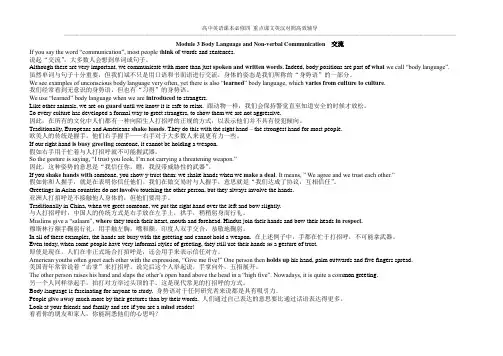
If you say the word “communication”, most people think of words and sentences.
说起“交流”,大多数人会想到单词或句子。
Although these are very important, we communicate with more than just spoken and written words. Indeed, body positions are part of what we call “body language”.
虽然单词与句子十分重要,但我们斌不只是用口语和书面语进行交流,身体的姿态是我们所称的“身势语”的一部分。
We see examples of unconscious body language very often, yet there is also “learned” body language, which varies from culture to culture.
我们经常看到无意识的身势语,但也有“习得”的身势语。
We use “learned” body language when we are introduced to strangers.
Like other animals, we are on guard until we know it is safe to relax. 跟动物一样,我们会保持警觉直至知道安全的时候才放松。
So every culture has developed a formal way to greet strangers, to show them we are not aggressive.
外研版高中英语必修4
Module 3 Body Language and Non-verbal Communication
姓名 刘艺杰 单位 陕西省铜川市第一中学
课型 文化阅读课 课时 第六课时 教学对象 高一学生
是否采用多媒体 是
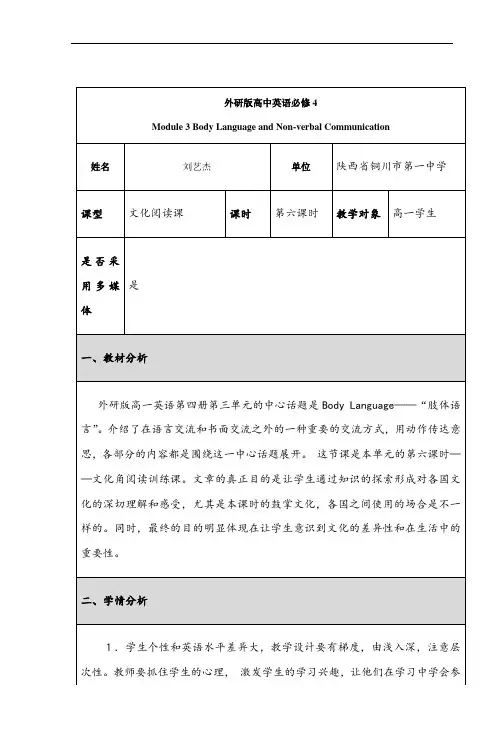
一、教材分析
外研版高一英语第四册第三单元的中心话题是Body Language——“肢体语言”。介绍了在语言交流和书面交流之外的一种重要的交流方式,用动作传达意思,各部分的内容都是围绕这一中心话题展开。 这节课是本单元的第六课时——文化角阅读训练课。文章的真正目的是让学生通过知识的探索形成对各国文化的深切理解和感受,尤其是本课时的鼓掌文化,各国之间使用的场合是不一样的。同时,最终的目的明显体现在让学生意识到文化的差异性和在生活中的重要性。
二、学情分析
1.学生个性和英语水平差异大,教学设计要有梯度,由浅入深,注意层次性。教师要抓住学生的心理, 激发学生的学习兴趣,让他们在学习中学会参
与,在参与中学会学习。
2.根据学生的心理特征,采用视、听、说的教学方法,从感性认识入手,逐渐上升到理性认识,培养学生运用英语进行表达的能力。
三、教学资源与策略
1、教学资源:教材,课件,多媒体,录音机。
2、教学策略:演示法,任务驱动教学法,多媒体辅助教学法。
四、教学目标
1. 知识与能力:学生通过阅读Clapping,了解鼓掌在各国的使用场合及它的意义,使学生掌握一些重要的词汇、短语和句型;学生学会快速阅读的方法、培养筛选局部和整体信息的能力及独立阅读的能力和合作学习的能力;训练阅读技巧,同时加强听,说,写等能力训练, 提高获取信息和处理信息的能力。
2. 过程与方法:通过多媒体技术,使学生学会快速阅读的方法,同时培养学生组织语言、运用语言的能力。
3. 情感、态度与价值观:
通过本节课的学习, 认识Body Language在日常生活交流中的重要性,特别是通过阅读Clapping深切理解文化的差异性,从而唤起学生重视文化差异的意识,在以后和不同国家的人交流时不会犯一些不该犯的错误。通过展示各国body language在本国的使用,使学生对外国文化产生兴趣,进一步激发他们学

2013高考立体设计英语外研版版
必修4 Module 3 Body Language and Non-verbal
Communication单元强化训练
Ⅰ.单词拼写
1.What do you do for__________(娱乐) in this town?
2.Without teachers’ a ,the students cannot enter the language laboratory.
3.Most members of the committee were in favour of the suggestion,only a m__________were
against it.
4.He bought this book as a__________(纪念品) of his visit to Qingdao.
5.Don’t be always dreaming to be a queen.It’s just a__________(幻想).
Ⅱ.单项填空
3.—What a pity!I’ve not got a ticket for the football match.
—Don’t worry.It’ll be broadcast .
A.live
B.lively
C.alive
D.living
4.The meaning of life__________according to the nature of one’s lifestyle.
A.moves
B.changes C.varies
D.turns
5.Our team__________very well in the match yesterday and won second place.
rmed
B.performed
C.reformed
D.uniformed
6.Don’t__________anything to others for it is still under discussion.