
赣南师范大学811作文2015年考研专业课真题试卷
- 格式:pdf
- 大小:424.77 KB
- 文档页数:2
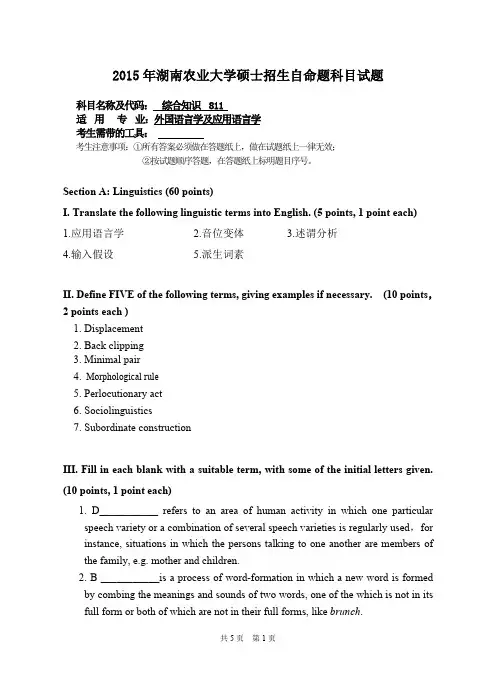
共5页 第1页2015年湖南农业大学硕士招生自命题科目试题 科目名称及代码: 综合知识 811 适 用 专 业:外国语言学及应用语言学 考生需带的工具: 考生注意事项:①所有答案必须做在答题纸上,做在试题纸上一律无效; ②按试题顺序答题,在答题纸上标明题目序号。 Section A: Linguistics (60 points) I. Translate the following linguistic terms into English. (5 points, 1 point each) 1.应用语言学 2.音位变体 3.述谓分析 4.输入假设 5.派生词素 II. Define FIVE of the following terms, giving examples if necessary. (10 points,2 points each ) 1. Displacement 2. Back clipping 3. Minimal pair 4. Morphological rule 5. Perlocutionary act 6. Sociolinguistics 7. Subordinate construction III. Fill in each blank with a suitable term, with some of the initial letters given. (10 points, 1 point each) 1. D___________ refers to an area of human activity in which one particular speech variety or a combination of several speech varieties is regularly used,for instance, situations in which the persons talking to one another are members of the family, e.g. mother and children. 2. B ___________is a process of word-formation in which a new word is formed by combing the meanings and sounds of two words, one of the which is not in its full form or both of which are not in their full forms, like brunch. 共5页 第2页3. H___________ structure is the sentence structure that group words into structural constituents and shows the syntactic category of each structural constituent, such as NP, VP and PP. 4. M__________ is the branch of grammar that studies the internal structure of words, and the rules by which words are formed. 5. C _________are those illocutionary acts whose point is to commit the speaker to some future course of action. 6. T___________ theory is a theory about trace left by movement. This theory assumes that a moved constituent leaves behind a phonologically null element in its original site. 7.P___________ are sentences that do not state a fact or describe a state and are not verifiable, in other words, they are utterances that perform an act. 8. I___________ is the language system of an individual as expressed their way he or she speaks or writes within the overall system of a particular language. 9. S___________ is the study of meaning communicated through language. The basic task is to show how people communicate meanings with pieces of language. 10. A _________ phonetics studies the movement of the vocal organs of producing the sounds of speech. IV. Decide whether each of the following statements is true or false. Write T for true and F for false. (15 points,1.5 points each ) 1. ( )Duality is one of the characteristics of human language. It refers to the fact that language has two levels of structures: the system of sounds and the system of meanings. 2. ( )Saussurs’s exposition of synchronic analysis led to the school of historical lingusitics. 3. ( )Chomsky’s concept of linguistic performance is similar to Saussure’s concept of parole, while his use of linguistic competence is somewhat different from Saussure’s langue. 4. ( )If language learners are provided with sufficient and the right kind of language exposure and chances to interact with language input, they will 共5页 第3页acquire the native-like competence in the target language. 5. ( )Syntactic category refers to all phrasal syntactic categories such as NP,VP, and PP, and word-level syntactic categories that serve as heads of phrasal syntactic categories such as N and V. 6. ( )Competence and performance refer respectively to a language user’s underlying knowledge about the system of rules and the actual use of language in concrete situation. 7. ( )Two sentences using the same words may mean quite differently. 8. ( )Hyponymy is a matter of class membership, so it is the same as meronymy. 9. ( )Inviting, suggesting, warning, ordering are instances of commissives. 10. ( )The right ear advantage(REA)is true to no matter whether people have the left hemispheric dominance for speech or the less common right hemispheric dominance for speech. V. Choose FIVE of the following questions to answer. (20 points,4 points each) 1. Who put forward the concept of langue and parole? What is the difference between them? 2. To what extent is phonology related to phonetics and how do they differ? 3. Decide which way of word formation is used to form the following words. Motel lase ROM mew/miaow 4. What is word? What is lexicon? What is lexeme? What is vocabulary? 5. Can you make some comments on IC analysis? 6. What is X-bar theory? 7. What is discourse analysis? 共5页 第4页 Section B: Translation (60 points) 1.Translate the following into Chinese (30 points) The sublime paradox of the spiritual life is repeated in all true development of personal gift and power. In order to find his life a man must first lose it; in order to keep his soul a man must first give it. The beginning of all education is self-conscious; at the start every effect must be calculated, every skill, method, or dexterity carefully studied. Training involves a rigid account of oneself based on searching self-knowledge. To become an effective speaker one must know his defects of bearing, gesture, voice; one must bring his whole personality into clear light, and study it as if it were an external thing; one must become intensely self-conscious. The initiation to every art is through this door of rigid scrutiny of self and entire surrender of self to the discipline of minute study and exacting practice. The pianist knows the artistic value of every note, and strikes each note with carefully calculated effect. The artist gives himself up to a patient study of details, and is content with the monotony of laborious imitation; subjecting every element of material and manner to the most thorough analysis. The first stage in the education of the true worker is self-conscious; the final stage is self-forgetful. No man can enter the final stage without passing through the initial stage; no man can enter the final stage without leaving the initial stage behind him. One must first develop intense self-consciousness, and then one must be able to forget and obliterate himself. One must first accept the most exacting discipline of the school, and then one must forget that schools exist. The apprentice is the servant of detail; the master is the servant of the idea: the first accepts methods as if they were the finalities of art; the second uses them as mere instruments. Tennyson's attention was once called to certain very subtle vowel effects in one of his later poems; he promptly said that he had not thought of them. That was undoubtedly true, for he had become a master; but there was a time, in his days of apprenticeship, when he had studied the musical qualities and resources of words with the most searching intelligence. The transition from apprenticeship to mastery is accomplished when a man passes through self-consciousness into self-forgetfulness, when his knowledge and skill become so much a part of himself that they become instinctive. When the artist has gained, through calculation, study, and, practice, complete command of himself and his materials, he subordinates skill to insight, and makes his art the unconscious expression of his deepest nature. When this stage is reached the artist can pour his whole soul into his work almost instinctively; his skill and methods have become so completely a part of himself that he can use them almost without being conscious of them.

2015年杭州师范大学815翻译与写作考研真题
(总分150,考试时间180分钟)
翻译题
翻译题
Translate the following passage from English into Chinese.
1. To fight is a radical instinct; if men have nothing else to fight over they will fight over words,
fancies, or women, or they will fight because they dislike each other’s looks, or because
they have met walking in opposite directions. To knock a thing down, especially if it is cocked at
an arrogant angle, is a deep delight to the blood. To fight for a reason and in a calculating spirit is
something your true warrior despises; even a coward might screw his courage up to such a
reasonable conflict.The joy and glory of fighting lie in its pure spontaneity and consequent
generosity; you are not fighting for gain, but for sport and for victory. Victory, no doubt, has its
fruits for the victor. If fighting were not a possible means of livelihood the warlike instinct could

目 录
2015年江西师范大学文学院840中国现当代文学考研真题
2014年江西师范大学文学院840中国现当代文学考研真题
2013年江西师范大学文学院840中国现当代文学考研真题
2012年江西师范大学文学院中国现当代文学考研真题
2009年江西师范大学文学院中国现当代文学考研真题
2008年江西师范大学文学院中国现当代文学考研真题
2007年江西师范大学文学院中国现当代文学考研真题
2006年江西师范大学文学院中国现当代文学考研真题
2015年江西师范大学文学院840中国现当代文学考研真
题江西师范大学2015年全日制硕士研究生入学考试试题
C A卷)
专业; 中国现当代文学 科目: 中国,当代互堂———
注:考生答题时,请写在考点下盘的答题纸上,写在本试聘狙或其他答题斯上的-律无效•
(本试题共1
页)
一、 名词解释(每题6
分,共30
分):
1
、 新月社。
2
、 田汉。
3
、 《憩园脆
4>
《茶馆脱
5
、《古船》。
二、 简答题(每题15
分,共60
分为
1
、 简述周作人散文的主要思想内容。
2
、 简述艾青诗歌的审美特征’
3
、 简述毛泽东《在延安文艺座谈会上的讲话》的主要思想内容及其
影响,
4
、 简述先锋小说的审美特征e
三、 论述题(每题30
分,共60
分)W
1
、 堵合具体作品,谈谈你对张爱玲小说的理解。
2.
结合具体作品,谈谈你对"十七年文学”中的革命历史题材小说
的理解,
弟1
页,共[
页
2014年江西师范大学文学院840中国现当代文学考研真
题江西师范大学2014年全日制硕士研究生入学考试试题
(B卷)
专业: 一中国现壮代文学一 科目: 中国现当代文学
注*考生答睡时,清写在考点下发的答题携上,写在本试题纸或其他答鹿纸上的一律无效*
(本试题共1
页)
一、 名词解释(每题6
分,共30
分):
L
《自己的家园》。
2
、 “新感觉派'
3
、 贺敬之。
4
、 《江姐》。
5
、 《芙蓉钥脆
二、
简答题(每题15
分,共60
分):
1
、 简述"五四”时期胡适的“文学革命”观念.
![赣南师范大学马克思主义学院912思想政治学科教学论[专业硕士]历年考研真题汇编](https://imgs-1438308264.cos.ap-hongkong.myqcloud.com/89e715c33086bceb19e8b8f67c1cfad6195fe969.webp)
目 录
2012年赣南师范大学马克思主义学院912思想政治教育学科教学论[专业硕士]考研真题
2013年赣南师范大学马克思主义学院912思想政治教育学科教学论[专业硕士]考研真题
2014年赣南师范大学马克思主义学院912思想政治教育学科教学论[专业硕士]考研真题(不
完整)
2015年赣南师范大学马克思主义学院912思想政治教育学科教学论[专业硕士]考研真题
2017年赣南师范大学马克思主义学院912思想政治教育学科教学论[专业硕士]考研真题
2018年赣南师范大学马克思主义学院912思想政治教育学科教学论[专业硕士]考研真题
2019年赣南师范大学马克思主义学院912思想政治教育学科教学论[专业硕士]考研真题2012年赣南师范大学马克思主义学院912思想
政治教育学科教学论[专业硕士]考研真题赣南师范学院
2012年硕士研究生招生入学考试试题
专业£学科教学(思政)科目:思想政治教育学科教学论
________________________________________共1页
注:1
、此页为试题纸,答题请使用答题纸,答案写在此页无效。
2、本卷满分为扫0
分,答题时间为3
小时。
一、 名词解释(共3&
分,每小题6
分)
1
、 课程标准
2
、 实体情景
3
、 教学过程有效性
4
、 课堂容量管理
5
、 学习动机
二、 简答题(共60
分,每小题15
分)
1
、 如何理解思想政治新课程教学过程的实质?
2
、 在思想政治课教学过程中,如何实现课堂教学沟通?
3、 创造教学艺术风格的方法有哪些?
4
、 如何确立发展性教学评价的标准?
三、 案例分析题(共胡分)
一名优秀的思想政治课教师,要使导入新课富有艺术性,就必须巧妙
地掌握导入的具体形式和方法.而导入的具体形式和方法又是多料多样
的,并无固定的模式,这取决于教师的精心设计和灵活运用。诺联系具
体的教学实际,分析思想政洽新课程的导入一般具有哪些具体的方法并
进行适当的评价?
四、 论述题(共利分)
结合教学实际,论述思想政治新课程以问题为中心的教学形式