
5-信息系统分析与设计方法-OO
- 格式:ppt
- 大小:2.78 MB
- 文档页数:103

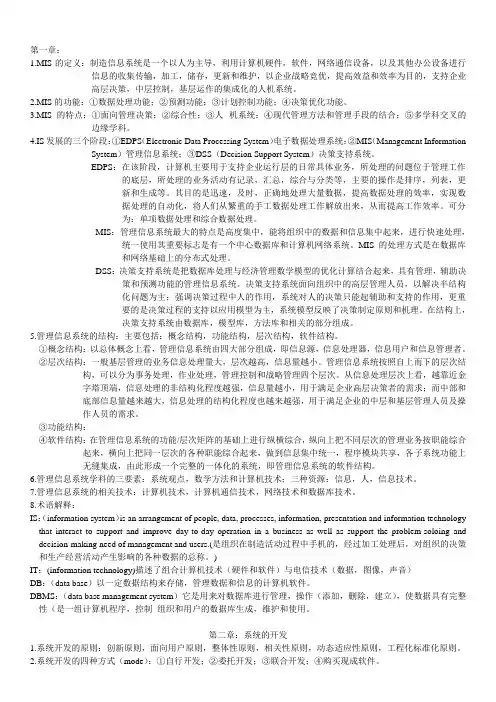
第一章:1.MIS的定义:制造信息系统是一个以人为主导,利用计算机硬件,软件,网络通信设备,以及其他办公设备进行信息的收集传输,加工,储存,更新和维护,以企业战略竞优,提高效益和效率为目的,支持企业高层决策,中层控制,基层运作的集成化的人机系统。
2.MIS的功能:①数据处理功能;②预测功能;③计划控制功能;④决策优化功能。
3.MIS的特点:①面向管理决策;②综合性;③人--机系统;④现代管理方法和管理手段的结合;⑤多学科交叉的边缘学科。
4.IS发展的三个阶段:①EDPS(Electronic Data Processing System)电子数据处理系统;②MIS(Management InformationSystem)管理信息系统;③DSS(Decision Support System)决策支持系统。
EDPS:在该阶段,计算机主要用于支持企业运行层的日常具体业务,所处理的问题位于管理工作的底层,所处理的业务活动有记录,汇总,综合与分类等,主要的操作是排序,列表,更新和生成等。
其目的是迅速,及时,正确地处理大量数据,提高数据处理的效率,实现数据处理的自动化,将人们从繁重的手工数据处理工作解放出来,从而提高工作效率。
可分为:单项数据处理和综合数据处理。
MIS:管理信息系统最大的特点是高度集中,能将组织中的数据和信息集中起来,进行快速处理,统一使用其重要标志是有一个中心数据库和计算机网络系统。
MIS的处理方式是在数据库和网络基础上的分布式处理。
DSS:决策支持系统是把数据库处理与经济管理数学模型的优化计算结合起来,具有管理,辅助决策和预测功能的管理信息系统。
决策支持系统面向组织中的高层管理人员,以解决半结构化问题为主;强调决策过程中人的作用,系统对人的决策只能起辅助和支持的作用,更重要的是决策过程的支持以应用模型为主,系统模型反映了决策制定原则和机理。
在结构上,决策支持系统由数据库,模型库,方法库和相关的部分组成。

《面向对象分析与设计》练习题及参考答案一、思考题:1. How many phases are included in system development? (brief description)2. Describe a system and the components of a system model.3. What two key components distinguish an information system from an automated information system?4. What is systems analysis and design?5. Who are the six stakeholder groups in information systems?6. What are a system designer’s and system builder’s roles in information systems development?7. What is the system analyst role in systems development as it related to the other stakeholders?8. List the six steps of the general problem-solving approach.9. List two types of quality certification applicable to information systems.10. What are legacy systems? Name two types of problems encountered in legacy systems.11. What is ERP? What is electronic commerce?12. Differentiate between management information systems and decision support systems.13. What role dose a data warehouse play in a decision support system?14. List three focuses for an information systems.15. What is the role of the network in information systems?16. 面向过程的系统分析与设计存在的问题是什么?通过什么OO技术来解决?17. 请画图说明面向对象系统的基本构造。