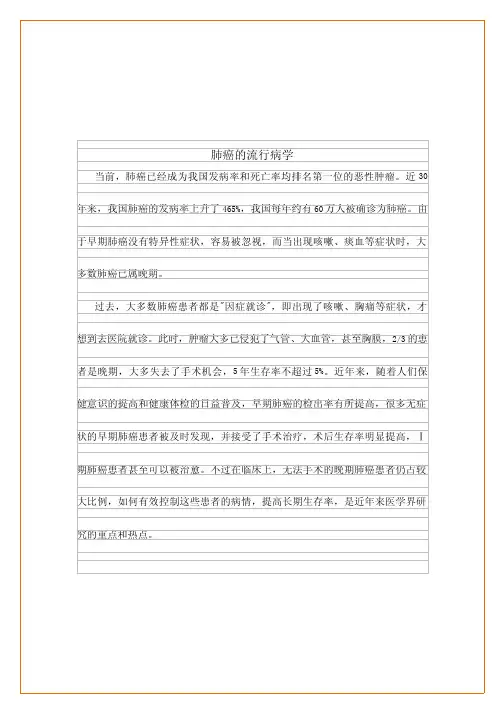
流行病学 19第十九章 恶性肿瘤
- 格式:pdf
- 大小:147.25 KB
- 文档页数:6
Department of Epidemiology
Public Health College of Harbin Medical University 第十九章 教 案 课题 第十九章 恶性肿瘤(Cancer)
授课时间 周次 课次 学时 2 教学大纲要求(教学目的) 熟悉内容:恶性肿瘤的流行病学特征及其防治。
教材分析 (重点、难点) 重点:1. 恶性肿瘤发病和死亡率升高的原因分析 2. 我国恶性肿瘤的流行状况及变动趋势 3. 恶性肿瘤的预防措施。 难点:1. 恶性肿瘤的分子流行病学。 2. 恶性肿瘤的二级预防。
教学方法 双语教学,启发式、研讨式讲授法与提问相结合 案例教学:经典Doll和Hill吸烟与肺癌关系研究案例 教具 多媒体演示 新内容 新知识 不同国家肿瘤发病变动趋势。
思想教育内容 对学生进行道德素质教育及学术思想教育,培养学生实事求是的态度和严谨的脚踏实地的科学作风
双语内容 恶性肿瘤流行病学 Cancer Epidemiology 健康信息系统 health information system,HIS 可疑致癌物 suspected carcinogens 潜在致癌物 potential carcinogens 前癌基因或原癌基因 proto-oncogene 确认致癌物 proved carcinogens 生物标志 biomarker 生物学效应剂量 biological effective dose 易感性标志 markers of susceptibility
要求自学内容 书中小体印刷字体内容。
参考资料 李立明主编《流行病学》 人民卫生出版社 第六版 2007 李立明主编《流行病学》 人民卫生出版社 第五版 2002 《Clinical Epidemiology》,Fletcher, Fletcher, Wagner, Williams and Wilkins,Baltimore Maryland,1982; 《Epidemiology》Third edition, Gordis L. Elsevier Saunders, Philadelphia, PA,2004; 《Epidemiology in medical practice》Fifth edition, Barker DJP, Cooper, Cyrus. Churchill Livingstone (London), 1998
复习题或要点 1.我国主要恶性肿瘤的流行状况。 2.恶性肿瘤的主要危险因素。 3.为什么我国肺癌持续高发?
Department of Epidemiology
Public Health College of Harbin Medical University 教 学 进 程 提问、演示、重点、难点、教具、时间分配、教法等 Cancer encompasses a family of several hundreds of diseases which are
distinguished in humans by site, morphology, clinical behavior and
response to therapy. Whether considered from a biological, a clinical or a
public health point of view, it is the malignant and invasive nature of many
of these diseases that is of dominant importance 第一节 概述(introduction) 一、基本概念(basic concepts) 肿瘤是指生长于某种器官但却与该靶器官不相协调的组织团块的
异常增生。 A tumor or tumour is the name for a swelling or lesion formed by an
abnormal growth of cells (termed neoplastic). A tumor can be benign,
pre-malignant or malignant, whereas cancer is by definition malignant. Cancer (medical term: malignant neoplasm) is a class of diseases in
which a group of cells display uncontrolled growth (division beyond the
normal limits), invasion (intrusion on and destruction of adjacent tissues),
and sometimes metastasis (spread to other locations in the body via lymph
or blood). (一)恶性肿瘤的病理学特点(pathological features of malignant tumors) 1.细胞(cell) 2.分子(molecular) 生物标志(biomarker)指的是能代表生物结构和功能的可识别物
质,对生物标志的测量可发现机体在遗传、细胞和分子水平发生的改变。 A biomarker, or biological marker, is in general a substance used as an
indicator of a biological state. It is a characteristic that is objectively
measured and evaluated as an indicator of normal biological processes,
pathogenic processes, or pharmacologic responses to a therapeutic 导课 1分 4分钟 学讨式教学:讲述之前学生复习有关中肿瘤学的基本概念。 提问: 什么是肿瘤,特点。 ppt显示肿瘤细胞形态等。 5分钟 注意与病理学的学科交叉 Department of Epidemiology
Public Health College of Harbin Medical University intervention. It is used in many scientific fields. 3.肿瘤的病理分期和分级(Pathological staging and grading) (二)恶性肿瘤细胞的生物学特点 (The biological characteristics of cancer cells) 1.基因表达缺陷(gene expression defects) 2.DNA 复制缺陷(DNA replication-defects) 3.癌变过程和影响因素(carcinogenesis process and influencing
factors) 二、恶性肿瘤流行病学研究方法(approaches in cancer epidemiology)
--重点 (一)经典流行病学研究方法 (classical epidemiological research methods) 1.描述流行病学研究(descriptive study) 建立健全的健康信息系统(health information system,HIS) 是完
整描述恶性肿瘤分布和流行趋势的最科学、有效的途径。 2.分析流行病学研究(analytic study) (1)病例对照研究(case-control study) (2)队列研究(cohort study) 3.实验流行病学研究(experimental Epidemiology)
经典案例:Doll和Hill吸烟与肺癌关系研究
启发:都用到了那些经典流行病学研究方法?与现代流行病学研究方法
相比较有哪些优缺点? (二)生物标志和肿瘤流行病学研究 (biomarker and cancer epidemiology)
1.生物标志种类(categories of biomarker)
理论联系实际工作:本教研室胃癌相关幽门螺杆菌生物标志物研究
2.生物标志流行病学研究的方法学问题(methodological issues of 5分钟 重点 5分钟 复习现况调查,监测等概念。 5分钟 5分钟 经典案例分析与启发式教学相结合,分析经典流行病学研究方法与现代方法的关系 2分钟 理论联系实际:本教研室胃癌生物标Department of Epidemiology
Public Health College of Harbin Medical University epidemiological study for biomarker)--难点 第二节 恶性肿瘤的流行特征(Epidemiological characteristics of cancer) 一、恶性肿瘤的分布(distribution of cancer) (一)时间分布(distribution by time ) 造成世界各地大部分恶性肿瘤发病率和死亡率上升趋势的主要原因
是:--重点 1.人口构成和居民健康状况的变化(changes of demographic
composition and population health status) 2.行为方式的变化(changes of behavior) 3.环境的改变(changes of environment) (二)地区分布(geographic distribution) 1.恶性肿瘤在世界范围内的分布(world distribution) 2.同一肿瘤在不同地区的分布(region distribution) 3.恶性肿瘤城乡分布(rural-urban distribution) (三)人群分布(distribution by population) 1. 年龄(age) 2. 性别(sex) 3. 婚育状况(marital status) 4. 种族(race) 5. 职业(occupation) 6. 移民(migration) (四)我国主要恶性肿瘤流行趋势(trend of major cancer in china)
--重点
1. 肺癌(lung cancer) 2.肝癌(liver cancer) 二、 恶性肿瘤的危险因素(risk factors of cancer) (一)行为生活方式(lifestyle and behavior) 1.吸烟、饮酒(smoking and drinking) 志物研究 8分钟 难点 重点 5分钟 ppt. 图表显示恶性肿瘤时间变化特征。 5分钟 问题:举例说明 世界各地大部分恶性肿瘤发病率和死亡率上升趋势的主要原因有哪些? 5分钟 重点 5分钟 ppt 图表是我国肺癌的地理分布和时间变动趋势。