
五年级_改写句子_陈述句改否定句_陈述句改一般疑问句_划线部分提问
- 格式:ppt
- 大小:1.58 MB
- 文档页数:47


1 / 6 人教版五年级下册英语按要求写句子专项针对练习
班级:__________ 姓名:__________
1. 句型转换。
1. I know.(变为否定句)
2. I want to go to the park.(对句子主题部分提问)
2. 句型转换。
[1]I want to eat some mooncakes.(根据句子主题意思提问)
[2]This is Peter and Tony''s bedroom. (根据句子主题意思提问)
[3]Peter''s grandfather lives in Beijing. (根据句子主题意思提问)
[4]We sometimes do the housework for the old people. (改为一般疑问句)
[5]My aunt''s birthday is on the first of August. (改为—般疑问句并肯定回答)
3. 按要求完成句子。
[1]There is a path near here.(改为一般疑问句)
[2]Are there any fish in the river?(做肯定和否定回答)
[3]Is there a forest in the park?(改为陈述句)
[4]There are five books on the desk.(对句子主题意思提问)
2 / 6 [5]I have some food.(改为否定句)
[6]I’m hungry.(改为一般疑问句)
4. 按要求改句子。
[1]Nancy is going to go camping.(改否定)
Nancy ________ going to go camping.
[2]I''ll go and join them.(改否定)
I _______ go ______ join them.
[3]I''m going to get up at 6:30 tomorrow.(改一般疑问句)

1 / 6 五年级英语外研版上学期句型转换完整版
班级:_____________ 姓名:_____________
1. 句型转换。
[1]I want to eat some mooncakes.(根据句子主题意思提问)
[2]This is Peter and Tony''s bedroom. (根据句子主题意思提问)
[3]Peter''s grandfather lives in Beijing. (根据句子主题意思提问)
[4]We sometimes do the housework for the old people. (改为一般疑问句)
[5]My aunt''s birthday is on the first of August. (改为—般疑问句并肯定回答)
2. 按要求完成各题。
1. I go to school at seven twenty.(对句子主题部分提问)
_______do you go to school?
2. 我不会洗衣服,但我愿意试一试(汉译英)
I __________wash the clothes, but let me __________!
3. Can you water the flowers, li Shan?
_______, I________. (做肯定回答)
_______, I ________.(做否定回答)
4. Chocolate is my favorite food.(对句子主题部分提问)
_______ is _______ favorite food?
5. My favorite food is dumplings.(写同义句)
3. 根据提示完成句子。
1.She''ll make a plan.(改为一般疑问句)
2.They like apples.(就句子主题部分提问)
2 / 6
3.We bought twelve eggs.(改为一般疑问句)
一般疑问句否定句特殊疑问句的改法 1 / 9
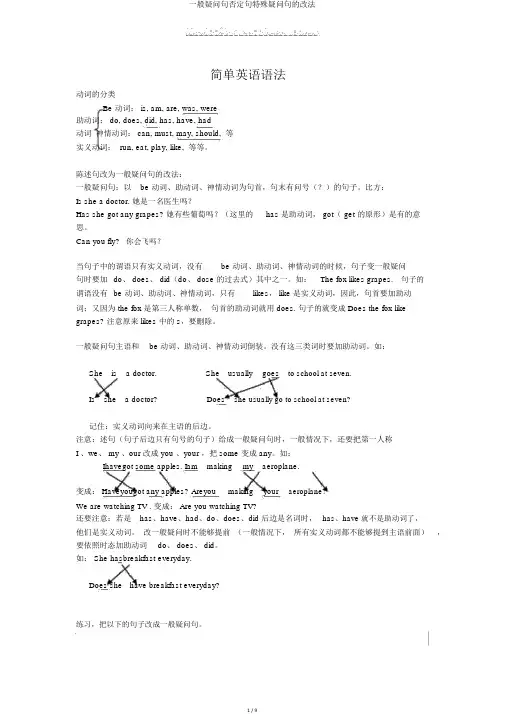
简单英语语法
动词的分类
Be 动词: is, am, are, was, were
助动词: do, does, did, has, have, had
动词 神情动词: can, must, may, should, 等
实义动词: run, eat, play, like, 等等。
陈述句改为一般疑问句的改法:
一般疑问句:以 be 动词、助动词、神情动词为句首,句末有问号(?)的句子。比方:
Is she a doctor. 她是一名医生吗?
Has she got any grapes? 她有些葡萄吗?(这里的 has 是助动词, got( get 的原形)是有的意 思。
Can you fly? 你会飞吗?
当句子中的谓语只有实义动词,没有 be 动词、助动词、神情动词的时候,句子变一般疑问
句时要加 do、 does、 did(do、 dose 的过去式)其中之一。如: The fox likes grapes. 句子的
谓语没有 be 动词、助动词、神情动词,只有 likes, like 是实义动词,因此,句首要加助动
词;又因为 the fox 是第三人称单数, 句首的助动词就用 does. 句子的就变成 Does the fox like
grapes? 注意原来 likes 中的 s,要删除。
一般疑问句主语和 be 动词、助动词、神情动词倒装。没有这三类词时要加助动词。如:
She is a doctor. She usually goes to school at seven.
Is she a doctor? Does she usually go to school at seven?
记住:实义动词向来在主语的后边。 注意:述句(句子后边只有句号的句子)给成一般疑问句时,一般情况下,还要把第一人称

同义句转换
从题型上看,句型转换可分为两大类:
一是按要求改写句子。即按照指定要求将原句改写成其他形式的句子,如肯定句改为否定句,陈述句改为一般疑问句、特殊疑问句、反意疑问句、感叹句,对划线部分提问等。
另一类就是同义句、将近义句的切换,即为建议用相同的句型,相同的语言手段抒发相同的思想。
本期我们先来看看按要求改写句子的具体情况。同义句、近义句的转换我们将在下一期做详细介绍。
按建议重写句子
按要求改写句子的具体分类如下:
一、肯定句改成否定句
1. 改变谓语结构
在系动词be, become, feel, smell等,助动词be, have, do 等以及情态动词can, may, should等后提not.如果句子的谓语中不是以上这些词,而是犯罪行为动词,则适当地将动词的原形,第三人称单数或过去式变成驳斥形式。例如:
he has seen the film before.
→he hasn“t seen the film before.
he will write the book in two months.
→he won“t write the book in two months.
he does his homework in the evening.
→he doesn“t do his homework in the evening.
2. 用含否定意义的词(如never, nothing, nobody, none, neither, little,
few等)。
(1)always / ever →never, and →or.如:
he was always late for school last ter
→he was never late for school last ter