
Unit Three(写作)
- 格式:ppt
- 大小:259.50 KB
- 文档页数:48
Unit 3Reading The many meanings of colour1.personality n.个性;人格eg. Parents’ behaviour will influence the development of a child’s personality She failed in the beauty contest because of lack of personality.Personal a.私人的;个人的;亲自的Eg. Personal affairs; personal problemShe has some personal letters to deal with.The manager paid him a personal call at his flat to discuss the issue with him last night. personally ad.= in person 亲自;就个人而言Personally, I am not in favour of his proposal.The headmaster had each classroom inspected personally.2.fascinating a 迷人的eg. A fascinating smile/ hat/ shop-window / displayfascinate vt.使着迷;是神魂颠倒be fascinated by/ witheg. The little boy was fascinated by/ with different kinds of toys in the toy shop. Fascination n. fascinatingly ad.3.emotional a.感情的;情绪的,易动感情的;感情脆弱的,激起感情的;感人的eg. Emotional problemsan emotional farewell充满感情的送别an emotional person一个情绪化的人emotional music/ language抒情的音乐/语言emotion n. 情感;激动eg. He read the story with emotion.emotionless a. 不露情感的;没有情感的The receptionist answered in an emotionless voice.4.psychologist心理学家psychology n.心理学;心理状态child / educational/ social/ criminal psychologypsychological a. 心理学的;心理的a psychological test/ problem/ warfare/ disorders心理测试/问题/战/ 疾病5.energetic a. 精力充沛的energy n.;energize vt供给。
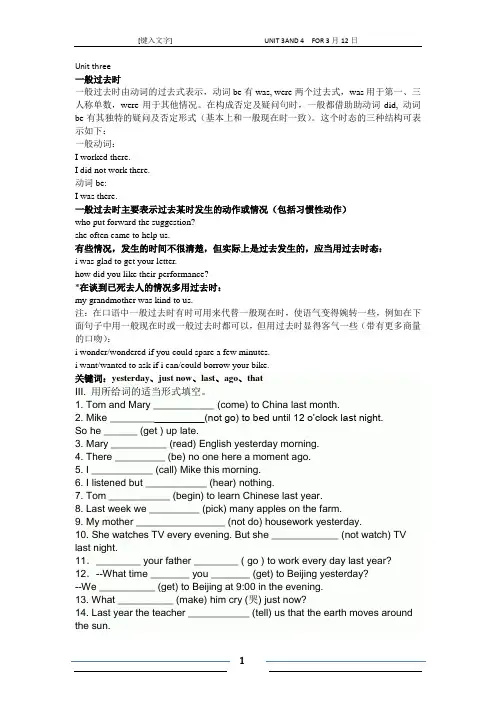
Unit three一般过去时一般过去时由动词的过去式表示,动词be有was, were两个过去式,was用于第一、三人称单数,were用于其他情况。
在构成否定及疑问句时,一般都借助助动词did, 动词be有其独特的疑问及否定形式(基本上和一般现在时一致)。
这个时态的三种结构可表示如下:一般动词:I worked there.I did not work there.动词be:I was there.一般过去时主要表示过去某时发生的动作或情况(包括习惯性动作)who put forward the suggestion?she often came to help us.有些情况,发生的时间不很清楚,但实际上是过去发生的,应当用过去时态:i was glad to get your letter.how did you like their performance?*在谈到已死去人的情况多用过去时:my grandmother was kind to us.注:在口语中一般过去时有时可用来代替一般现在时,使语气变得婉转一些,例如在下面句子中用一般现在时或一般过去时都可以,但用过去时显得客气一些(带有更多商量的口吻):i wonder/wondered if you could spare a few minutes.i want/wanted to ask if i can/could borrow your bike.关键词:yesterday、just now、last、ago、thatIII. 用所给词的适当形式填空。
1. Tom and Mary ___________ (come) to China last month.2. Mike _________________(not go) to bed until 12 o’clock last night.So he ______ (get ) up late.3. Mary __________ (read) English yesterday morning.4. There _________ (be) no one here a moment ago.5. I ___________ (call) Mike this morning.6. I listened but ___________ (hear) nothing.7. Tom ___________ (begin) to learn Chinese last year.8. Last week we _________ (pick) many apples on the farm.9. My mother ________________ (not do) housework yesterday.10. She watches TV every evening. But she ____________ (not watch) TV last night.11.________ your father ________ ( go ) to work every day last year? 12.--What time _______ you _______ (get) to Beijing yesterday?--We __________ (get) to Beijing at 9:00 in the evening.13. What __________ (make) him cry (哭) just now?14. Last year the teacher ___________ (tell) us that the earth moves around the sun.15. There ____________ a telephone call for you just now. (be)16. There __________ not enough people to pick apples that day. ( be)17. There _____________( be not) any hospitals in my hometown (家乡) in 1940.18. There ____________ enough milk at home last week, wasn’t there?19. Eli ____________ to Japan last week. ( move)20. –When _______ you _________ (come) to china? Last year.1. 分词作状语分词在句子中作状语,可以表示时间、条件、原因、结果(补充说明)、让步、伴随等。