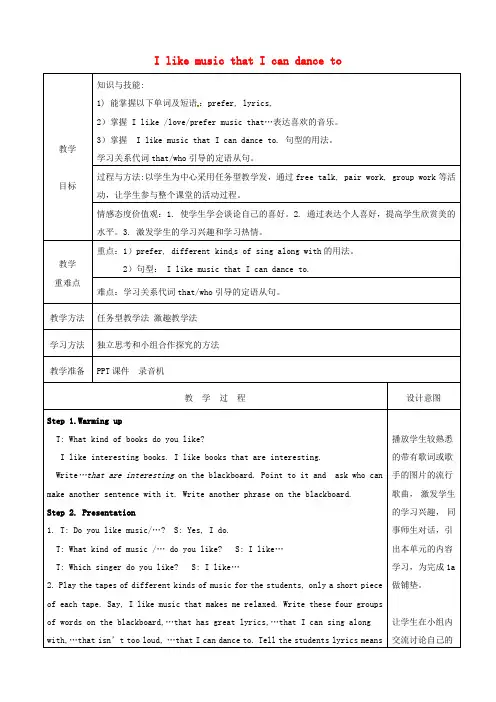
Unit 6 I like music that I can dance toNo.25 the First Period一、预习检测I. Teaching Aims and Demands (教学目的和要求)1. Knowledge Objects(1) Key V ocabulary prefer, lyric(2) Target LanguageWhat kind of music do you like?I like music that I can sing along with.What about you?I prefer music that has great lyrics.2.Ability Objects(1) Train the students to express preferences.(2) Train the students’ listening skill.3. Moral ObjectLet’s enjoy music. It always brings us happiness.Ⅱ. Teaching Key Points(教学重点)1. Key V ocabulary prefer, lyric2. Target LanguageⅢ. Teaching Difficult Points(教学难点)1. Relative clauses with that2. The listening practiceⅥ. Teaching Procedure二、自主学习Step Ⅰ Revision(1) Invite different pairs of students to say the conversations learned in preceding classes with books closed.(2)Check the answers to the exercises of the workbook by asking different students to say their answers to the Class.(3) Dictate some of the key vocabulary words presented in units 1~5.Step Ⅱ 1aThis activity introduces the key vocabulary and trains the students to express preferences with the relative clause.Write…that are red on the blackboard.Point to it and say a sentence with it, I like flowers that are red. Ask who can make another sentence with it. They may say, I like gloves that are red. I like shoes that are red. Write another phrase on the blackboard, which is big. Help the students to make sentences with it.Play the tapes of different kinds of music for the students, only a short piece of each tape. Say, I like music that makes me relaxed. Write these four groups of words on the blackboard, that has great lyrics that I can sing along with, that isn’t too loud, that I can dance to. Tell the students lyrics means the contents of the songs. Ask the students, what kind of music do you like?Say, You can answer with I like music…, I love music…, I prefer music… Explain prefer=like…better to them. Get one of the children to answer the question, then let this child ask the one next to him/her the same question. Set off a chain drill.Ask the students to open their textbooks now. Read the instructions of Activity 1a to the students. Make sure they understand everything.First have them look at the pictures and circle the sentences they agree with. Read each sentence to the class and ask the students to raise their hands to see if they agree. Make a survey to find out how the class feels about each item. Discuss the result of the survey with the class.Get the students to complete the sentence to tell what kind of music they enjoy. Ask some of the students to share their sentences. Write any new words or phrases on the board to help them if necessary.三、合作探究Step Ⅲ 1bThis activity gives students practice in understanding the target language in spoken conversation.Say, we will hear Tony and Betty talking about the kinds of music each one likes. Let’s see the instructions first. Read the instructions to the students. Tell them to tick (√) the right statements while they are listening. Read the three headings bef ore playing the tape.Play the tape the first time and the students only listen. Then play it for a second time. The students tick in the right answer boxes.Cheek the answers.Answers四、训练巩固Step Ⅳ 1cThis activity provides guided oral practice using the target language.Read the instructions to the students.First ask a pair of the students to read the example in the box,S A: What kind of music do you like?S B: I like music that I can sing along with. What about you?S A:I prefer music that has great lyrics.Then get them to work in pairs. Answer the questions with their own preferences.As the students do the practice, move around the classroom and give them some help. Ask several pairs of students to perform their conversations before the class.五、归纳小结Step Ⅴ SummarySay, in this class, first we’ve learned two new key words, prefer and lyrics. Thenwe’ve learned how to express references by talking about music, using relative clause with that.六、布置预习Step Ⅵ HomeworkAsk the students to write three sentences with I like music that…,I love music that …,I prefer music that…教学反思The Second Period一、预习检测I. Teaching Aims and Demands1. Knowledge Objects(1)Key V ocabulary gently(2)Relative Clause with whom2. Ability Objects(1)Train the studen ts’ listening skill.(2) Train the students to use relative clause with who.(3)Train the students to make communications, usingA: Does Xu Fei like the Moderns?B: No, he doesn’t. He prefers…3. Moral ObjectThank the musicians who make our world more wonderful.Ⅵ. Teaching Procedures(教学过程)二、自主学习Step Ⅰ Revision(1) Revise the relative clause with that by asking what kind of music do you like?Help them to answer, I like music that… I love music that… I prefer music that…(2)Check the homework by asking some students to share their sentences with the class.Step Ⅱ 2aThis activity provides listening practice using the target language.Read the instructions to the students and make sure that they know what to do. Go over the four items in the box with the children. Tell them that relative clause with who is used to introduce a person.Give another sample, Amy likes teachers who work hard. Help the students to make some more similar ones.Explain the new key word gentle to the students. Tell them gentle means quiet, careful, not rough or violent using Chinese if necessary.Tell the children that we are going to hear a boy and a girl talking about the music and musicians they like. Play the recording. Students only listen the first time. Play the tape again. Ask the students to circle T for true and F for false.Check the answers.Answers1.T2. F3. T4. T三、合作探究Step Ⅲ 2bThis activity provides listening practice using the target language.Read the instructions to the students first. Then let them have a look at the chart. Read the model sentence to them.Say, we will hear the same recording again. Listen carefully, and find out what Carmen and Xu Fei say and complete the sentences in the chart. Play the recording again. Pause the tape if necessary.Check the answers.AnswersXu Fei:1. I prefer groups that play quiet and gentle songs.3. I like musicians who write their own songs.Carmen:2. I love music that’s really loud and energetic.4. I like musicians who play different kinds of music.Step Ⅳ 2cThis activity provides guided oral practise using the target language.Get two students to read the conversation in the box to the class.S A: Does Xu Fei like the Moderns?S B: No, he doesn’t. He prefers…Read the instructions to the class, and ask another pair to ask and answer, using the information from Activities 2a and 2b to make sure all the students know what to do. Tell them each pair of them should make a conversation using information from Activities 2a and 2b. Ask them to work in pairs. Move around the classroom checking the progress of the pairs and offering help as needed. Ask one or two pairs to say their conversations to the class.四、训练巩固Step Ⅴ Grammar FocusWrite the three sentences on the blackboard first. Circle the words that and who and underline the relative clauses in all the three sentences.Ask, what do the relative clauses with that describe--a person or a thing? Help the student to say out the right answer.Then ask the same question on the relative clauses with whom.Explain that the relative clauses with that describe things and the relative clauses with who are used to describe persons.Tell them who is for people and that is for things.Ask the students to make up more similar sentences.Encourage them to ask questions about relative clause.五、归纳小结Step Ⅵ SummarySay, in this class we’ve done some listening practice on the target language of this unit. We met some more sentences with relative clause, and we did some pair work on asking questions with does and answering with sentences with relative clause.六、布置预习Step Ⅶ Homework(1) Ask the students to write two sentences with relative clause with who.(2) Ask the students to write out a conversation they practiced in Activity 2c.教学反思The Third Period一、预习检测I. Teaching Aims and Demands1. Knowledge Objects(1) Key V ocabulary remind of(2) The sentences with the Attributive Clause.2. Ability Objects(1) Use the sentences with the attributive Clause to express what they like or dislike.(2) Train the students’ communicative competence.Ⅰ. Moral ObjectTry to exchange the opinions on CDs with your friends. It will help you to know more about your friends.Ⅵ. Teaching Procedures二、自主学习Step I Revision(l)Revise the relative clause with that by asking question what kind of music do youlike? Get the students to answer,I like music that…I love music that…I prefer music that…First ask individually, then have the children ask their classmates around them.(2)Revise the relative clause with which by asking question "What kind of musicians does you like? Get the students to answer, I like musicians that… I love musicians that…I prefer musicians that…or I prefer groups that… First ask individually in class, then let them practice in pairs.(3) Revise "Does…like…? No, he doesn’t. He prefers…" Ask ques tions with the real names of the students in our class. Let them ask each other similar questions in pairs.三、合作探究Step Ⅱ 3aThis activity provides reading practice using the target language.Show my favorite CD to the class and say, this is my favorite CD. Its name is "Come on, Join us". I like it because I can do exercises with it. But I don’t like the beginning of it, too loud noise. It reminds me of my middle school time.Give more examples on "remind sb. of sth./sb. ",such as, He reminds me of his brother. This reminds us of what we often did when we were children. Tell the students that remind…of…means cause sb. to think of sth.Write the four questions on the blackboard.(1)What’s the name of your favorite CD?(2)Why do you like this CD?(3)What do you dislike about this CD?(4)What does it remind you of?Get them to discuss in pairs. Before they begin their conversations, show some more CDs to them.Ask a pair of the students to share their conversations with the class. Open your books at page 46. Look at Activity 3a.Read the instructions to the students.Ask the students to read the review by themselves. Encourage them to ask questionson anything that they can’t understand. Explain them, or ask the other students to explain them. After they finish reading the review ask them to match up the parts of the sentences. Point out the sample answer before they begin.Tell them to do as quickly as they can.Say, let’s have a competition to see who will be the first one to finish it. After all of them have finished. Check the answers with the class.Answers1. d2. a3. e4. c5. B四、训练巩固Step Ⅲ 3bThis activity provides oral practice using the target language.Read the instructions to the students.Make sure they know what to do. Give some explanation if necessary.Ask a pair of students to read the model conversation in the box first.S A: What CD did you listen to recently?S B: I listened to one called Heart Strings.S A: What do you think of it?S B: I enjoy it a lot.S A: Why?S B: The singer writes her own songs. I prefer singers who write their own lyrics. Say, Who can make up a similar dialogue now? You can use the questions in Activity 3a to help you. Then choose two children who do well in English to demonstrate another conversation.Now ask the students to make conversations in pairs. Walk around the classroom while the students are talking. Help them as necessary.Step Ⅳ Part 4This activity provides reading, writing, listening and speaking practice using the target language.Show some pictures of the popular singers or groups among the students. Say I likegroups that dance much. I love singers who dance much as they sing. I don’t like musicians who always copy others.Show a CD of very noisy music and say, I can’t stand music that is too noisy.Write the four sentences without relative clauses on the blackboard.Ask several students to complete them orally first. Then let the students open their books and complete the sentences with their own words. Next ask a few students to share their sentences with the class.Say, Stand up and go to ask your classmates questions now. Move around the classroom and ask questions till you find someone who feels the same way you do about each thing.Write down the student’s name in the blank in the right column.When all the students have finished, ask some students to read their list to the class. Next ask a pair of students to read the sample conversation. Then have the students work in pairs. Make up their own conversations.If there is enough time, ask some pairs to say their conversations to the class.五、归纳小结Step Ⅴ SummarySay, In this class, we’ve learned how to use remind…of…We’ve also done a lot of listening, speaking, reading and writing practice using the target language.六、布置预习Step Ⅵ Homework(1) Make up two sentences with remind…of…(2)Finish off the exercises on pages 22~23 of the workbook.教学反思The Fourth Period一、预习检测I. Teaching Aims and Demands1. Knowledge ObjectThe target language.2. Ability Objects(1) Train the students’ listening ability.(2) Train the students’ ability to under stand the target language in spoken conversation.(3)Train students’ ability to use the target language.3. Moral ObjectI have my own favourite things in my life.That’s why I am enjoying the life.Ⅵ. Teaching Procedures二、自主学习Step Ⅰ Revision(1) Check the homework by asking some students to read their sentences with remind…of… Get the students to exchange their exercise books with their partners and correct each other’s.(2)Ask the following questions on CDs, groups, singers and musicians.Help the students to answer with the target language.What’s the name of your favorite CD?Why do you like it?What kind of CDs do you like? Why?What kind of singers do you like?Why?What kind of groups do you like?Why?Then ask the students to make a survey of the students around them and do somenotes. Ask several students to report their results of the survey to the class and help them to say like this.Wang likes CDs that are quiet and gentle.Li Hong prefers musicians who are good-looking.And so on三、合作探究Step Ⅱ Part 1This activity provides speaking and writing practice with the target language.Ask, what’s your favorite band? Let one of the students answer it. Then repeat the questions on favorite book and favorite movie. Write the three questions on the blackboard.Get the students to ask and answer in pairs. Then ask the class to open the books. Look at Section B on page 47, Part 1.Read the instructions to the students. Tell them to complete the chart on their own. Move around the classroom while the children are writing, giving help if necessary. After all of them have finished writing, ask some children to read their answers to the class and share the favorite book with the classmates after class. Collect the answers from different students. Record the resul ts on the board. Discuss what the class’ favorites are and ask students to tell why they like each band, book or movie.Step Ⅲ 2aThis activity provides listening practice using the target language.Read the instructions to the class. Make sure each one knows what to do. First tell the students to have a look at the picture and let them guess what they are talking about. I’ll see who is good at guessing the answers. Say, We will hear two boys, Michael and Ali, talking about some of the things they see in the room. The task of us is to write out the three things that they are talking about.Play the tape the first time. Tell the children just to listen to it carefully and try to get the main idea and not to write.Then play the recording again. Tell them to write down the answers this time.Ask a student to tell the answer of the first line, then ask the others if they agree with him. Do the same with the other two answers. If they got different answers, tell them to listen careful when we do the practice in Activity 2b.Check the answers.Answers1. a jacket2. a book3. a movie poster四、训练巩固Step Ⅳ 2bThis activity gives students practice in understanding and writing the target language. Read the instructions to the students.Make sure each student knows what they should do while they listen to the tape.Ask .the students to have a look at the chart in Activity 2b. There are two columns in it.Tell the children they will write whatMichael likes in the first column and they will write why he likes it in the second column. Go over the contents in the chart with the children.Tell them to note the sample answers.Let them guess the other answers in the first column. Yeah, maybe the same ones with the answers in Activity 1, but we are not sure now. Then tell them to get what writers and movies Michael likes while they are listening. Encourage them to ask questions they may have met.Play the recording and ask the children to fill in the answers. Pause the tape if necessary. Ask several students to tell the answers and see if the others have different ones. Play the tape again if the students need to listen to it again. Correct the answers. If time is enough, play the tape again and the students repeat after it.Answersbook—He likes writers who explain things well.Movie poster—He likes movies that are about Monsters.Step Ⅴ 2cThis activity provides guided oral practice using the target language.Present the dialogue in this activity with a student firstT: I like movies that are romantic.I love Titanic.S: Oh, I don’t. I like movies that have big wars.I really like The Doctor—A Real Soldier.Then ask the children to open the books at page 47. Read the instructions in Activity 2c. Say, We will discuss our favorite things from Activity 1 and say why we like each thing.Ask two students to read the sample conversation. Then ask the students to discuss their favorite bands, books and movies in groups of four. Try to use the sentences with the Attributive clause we have met in this unit to help to make conversations. Walk around in the classroom and offer help if they need. Ask one or two groups to say their conversations to the class.五、归纳小结Step Ⅵ SummarySay, In this class we’ve done lots of listening practice on target language, and we’ve also written and spoken some. Try to use the target language we’ve learned to expr ess your preferences in your daily life六、布置预习Step Ⅶ Homework(1) Write a short article to tell your favorite band, book, movie and clothes.(2) To express your preferences to your classmates or anyone else who knows English.教学反思The Fifth Period一、预习检测Ⅰ.Teaching Aims and Demands1. Knowledge Objects(1) Key V ocabularyYellow river, fisherman, entertainment, feature, wife, wives, photography, exhibition, gallery, known, photographer, display, on display, photograph, interest, show, class, suggest, energy(2) Practice reading articles.(3) Practise writing an article.2. Ability Objects(1) Train the students’ reading skill.(2) Train the students’ writing skill.(3) Train the students’ speaking skill.3. Moral ObjectIf you know where there is a good movie/band, tell your friend and go to enjoy it. Ⅵ. Teaching procedures二、自主学习Step Ⅰ Revision(1) Revise the contents of last class by asking some questions.What kind of clothes do you like?What’s your favorite movie?What kind of writers do you like?etc.Ask some students to give answers.(2) Check homework by asking several students to read their articles to the class. Ask the other students to help them with the mistakes. Then ask the students to work in pairs, exchange their articles and help each other to correct the mistakes. Move around the classroom and offer as much help as possible.Step Ⅱ 3aThis activity provides reading practice using the target language.Show the key vocabulary on the screen by a projector.Read the words and have the students repeat again and again till they can pronounce the words fluently and correctly.Ask the students to turn to page 48, look at Activity 3a on this page. Say, We can see there are three passages in this activity. They are three reviews about a movie, an exhibition and a band. Let's see the first one now. It is about a movie that is named Yellow River Fishermen. What does the reviewer think of the movie?Who made it? What does the reviewer think of the director? Please scan it as quickly as you can and tell me the answers.After about one minute, get all the children stop reading and ask who has got the answers. Choose three children who have put their hands up to show they know the answers to the three questions. Help them to get the proper answers.Then ask the children to reread the reviews more carefully and tell them I will ask some more questions on it in details.Let them read a little longer this time, around three minutes. Then ask the following questions orally and ask different students to reply, providing some help as necessary. 1: Is Yellow River Fishermen Hung Tao’s latest movie?2: Does the reviewer like Hung Tao?3: What has Hung Tao done over the years?4: Does the reviewer think Yellow River Fishermen is the best movie of Hung Tao? 5: What does the reviewer suggest you doing if you are looking for entertainment? 6: Why does the reviewer think it is the worst movie of Hung Tao?7: What good feature does the movie have?Give some explanation on the problems which are hard to understand for the children, such as, entertainment means fun, feature means special part of sb./sth., very different from the others, easy to recognize or remember, and wife is the opposite word of husband, A husband and a wife make up a family. And tell the children the plural form of wife is wives.Now read the instructions to the students.Ask them which sentences we should circle and which ones we should underline. Check the answers with the students.Teach the other two reviews with the same way.AnswersYellow River FishermanCircled: He’s made some great movies.The fisherman’s wife was really funny.Underlined: Yellow River Fisherman is too long and it’s really boring.Amy Kim, PhotographyCircled: Her best loved photos are on display in this exhibition… has something foreveryone…many great photos of people and of the countryside.Underlined: The few city photographs are less successful.Wild and WindyCircled: The band has lots of energy…they play the kind of music that I love to hear…these are musicians who make us h appy.Underlined: Every song is really loud and often you can’t understand the words…the lyrics aren’t very good.Notes1. on display= be on show2. The few city photographs are less successful.=Most of the city photographs are very successful.3.…they don’t interest me as much=…they don’t attract me as much.4.…from a world class photographer=…from one who is among the best photographer in the world.5. suggest= bring an idea into the mind; propose三、合作探究Step Ⅳ 3bThis activity provides reading and writing practice using the target language.Read the instructions to the children first. Ask one of them if he or she knows what we will do to make sure each one knows the tasks of this activity. Look at the chart now. We see two new words in the boxes, pros and cons. Pro means in favor of and con means against. We have to find out the pros and cons of the reviewers in Activity 3a and fill in the blanks with proper sentences. Have a look at the sample answer and try to write out the other answers, using the information from the reviews in Activity 3a. Move around the classroom while the children are writing to see if they can write out the right answers, offering help as needed.Check the answers by asking several students to read their answers to the class. If someone did wrong, let the other students correct his or her answers.Writing the answers on the blackboard as the students read makes it easy for thewhole class to check the answers. Say, let’s revi ew the task. What can we find out? Yes, right, we have got the similar answers with those in Activity 3a.AnswersProsMovie: The fisherman’s wife was funny.Exhibition: There are many great photos of people and of the countryside.Band: They play the kind of music that I love to hear.ConsIt’s too long and it’s really boring.The few city photographs are less successful.Every song is really loud and often you can’t understand the words.Step Ⅴ 3cThis activity provides writing practice using the target language.Read the instructions to the students.Say, Decide what review you will write first, a review of a book, a CD or a movie? Write down the name first. Note to use the capital letters. Let them think it over for a while and ask some ones the names of their articles. Next write a list of questions you plan to answer in your review.e. g. Who wrote the book/made the movie/sang the songs?What kind of people the writer/director/singer is?What do I think of the writer/director/singer?What do I think of the book/movie/songs/What do I like and dislike?What suggestions will I give the readers?etc.These questions will help you to write your passage well. And you can look back at the questions in Activity 3a, Section A, before you begin writing. Use the three reviews as models. As the students are writing the list, move around the classroom to direct them.After they have finished writing the questions, tell them to begin writing.Continue moving around and always offering help when they need.Ask several to read their passages to the class after they all have finished. Get the others to help correct the mistakes while they are reading.Let them exchange their reviews with their partners. Help each other with the errors. Step Ⅵ Part 4This activity provides reading, writing, listening and speaking practice using the target language.Read the instructions to the class. Talk about what is happening in our city next Monday. Ask a question like, What will happen in our city next Monday? Let the students tell the event which is happening, such as, A VIP will visit our city and a new movie will be on show.Tell them to write the sentences in the boxes below Monday. Ask the students to work in groups of four to complete the work. Ask each other questions like, Do you know what will happen in our city next Tuesday? Is there a football match in our city next Saturday? Is Song Zuying coming to sing songs at the biggest theatre in our city next Friday? etc.Tell them to fill in the boxes, using the phrases with relative clause.For example, a football matches which is between Dalian Football Team and our City Team. If they don’t know what will happen, they can invent events they would like to go to.Ask some groups to share the events with the class. Then have the students discuss in groups of four again. Let them discuss what they would prefer to do together this time. Help them to express preferences with the target language. For example:S A: What would you prefer/like/love to do together?S B: Let’s go to see the new movi e that was directed by Zhang Yimou.S C :Why not go to watch the great football match that will be between two famous teams? It’s on Friday evening. We can have a great weekend together.S D: No, we’d better go to…After the discussion, let some groups report the results to the class. Help them to use sentences with relative clause in their reports. Help them to say in correct sentences. They may say like this:。