
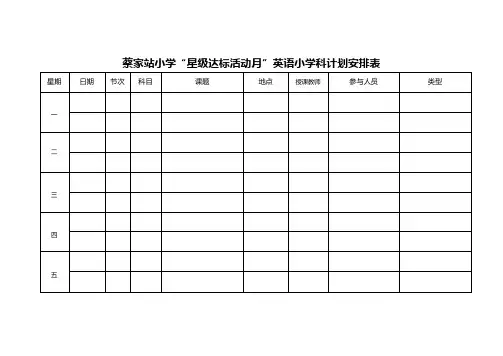
蔡家站小学“星级达标活动月”英语小学科计划安排表
- 格式:doc
- 大小:24.50 KB
- 文档页数:1
编号:YB-JH-0935小学英语教学计划表格(通用版)Frequently formulating work plans can make people’s life, work and study more regular, and develop good habits, which is a habit necessary for success in doing things( 工作计划)部门:_____________________姓名:_____________________日期:_____________________WORD文档/ A4打印/ 可编辑小学英语教学计划表格(通用版)摘要:经常制订工作计划,可以使人的生活、工作和学习比较有规律性,养成良好的习惯,因为习惯了制订工作计划,于是让人变得不拖拉、不懒惰、不推诿、不依赖,养成一种做事成功必须具备的习惯。
本内容可以放心修改调整或直接使用。
一、指导思想本学期我将重点投入到以素质教育为指挥棒的教学宗旨,激发学生学习英语的兴趣,培养他们学习英语的积极态度,使他们建立初步的学习英语的自信心;培养学生一定的语感和良好的语音、语调基础,使他们形成初步运用英语进行简单日常交流和书写,为进一步学习打下基础。
二、学生情况我校五年级的学生已学习了三年的英语,有一定的基础。
他们思维活跃,模仿能力和记忆力较强,所以应针对不同的学生进行分层次教学,会达到预期的效果;四年级学生基本掌握一定的英语日常用语,具备一定的英语基础,因此对他们而言,英语基础知识需要继续深入的渗透,把重点放到听、说、读、写的要求上。
扩大学生对西方国家了解的知识领域,充分发展学生在生活中使用英语的能力和习惯。
三、教学目的、任务1、提升学生学习英语的兴趣,养成良好的朗读书写的习惯;2、发音准确、朗读流利,准确掌握书中的重点内容;3、能够进行简单的日常用语的交流;4、能够用简单的句子进行写作;5、熟练掌握所学歌曲、chant等6、了解西方文化,初步知道课文的文化背景。

小学五年级英语课教学计划进度表第一学期
单元一:Greeting and Introduction
- 第一周:学生自我介绍和问候
- 第二周:研究日常问候语
- 第三周:研究询问和回答问题的基本句型
- 第四周:研究描述家庭成员的形容词
单元二:School Life
- 第五周:研究表达课程和学校设施的名词
- 第六周:研究描述一周内的学校活动
- 第七周:研究描述个人喜好和日常活动
- 第八周:研究表达和解释原因的句型
单元三:Holiday Plans
- 第九周:研究对假期安排进行询问和回答
- 第十周:研究描述假期活动和目的地
- 第十一周:研究使用现在进行时描述计划和安排- 第十二周:研究描述过去发生的事情
第二学期
单元四:Food and Health
- 第十三周:研究描述食物的味道和喜好
- 第十四周:研究描述食物的数量和
- 第十五周:研究表达和解释健康惯
- 第十六周:研究描述日常饮食和锻炼惯
单元五:Transportation
- 第十七周:研究描述不同交通工具
- 第十八周:研究表达交通方式的偏好
- 第十九周:研究描述出行的时间和距离
- 第二十周:研究描述路线和方向
单元六:Hobbies and Leisure
- 第二十一周:研究表达不同爱好和兴趣
- 第二十二周:研究描述喜欢和不喜欢的事物
- 第二十三周:研究描述过去常做的活动
- 第二十四周:研究描述未来计划和打算
以上是小学五年级英语课的教学计划进度表。
根据实际情况,学期进度表可能有所调整。
请密切关注课程安排和教学进度,确保教学目标的达成。


小学生英语学习计划表IntroductionAs an essential tool for learning English, a study plan can help young learners allocate their time systematically and keep track of their progress. This article provides a sample study plan tailored to elementary school students who are eager to improve their English proficiency.GoalsThe first step in designing a study plan is to set specific goals. In general, we suggest that elementary school students focus on the following four language skills: listening, speaking, reading, and writing. Here are some specific goals that students can strive for:1. Listening: Understand simple instructions and conversations related to daily activities.2. Speaking: Communicate basic needs, feelings, and preferences in English.3. Reading: Read and comprehend simple stories and passages with basic vocabulary and sentence structures.4. Writing: Write short sentences and paragraphs with correct spelling and punctuation.ScheduleNow that we have set clear goals for each language skill, we need to decide how much time to allocate to each activity. Here is a proposed weekly schedule that you may find helpful:Monday to Friday:1. Morning (30 minutes): Listen to an English song or podcast while having breakfast.2. Afternoon (60 minutes): Attend an English class or study online with a tutor.3. Evening (30 minutes): Watch an English cartoon or movie with English subtitles.Saturday:1. Morning (60 minutes): Review grammar and vocabulary with worksheets or flashcards.2. Afternoon (60 minutes): Practice speaking with a conversation partner or group.Sunday:1. Morning (60 minutes): Read a children's storybook or newspaper article and answer comprehension questions.2. Afternoon (60 minutes): Write a short paragraph or essay on a topic of interest with guidance from a teacher or parent.MaterialsTo achieve the goals identified above, students will need to use a variety of materials such as textbooks, workbooks, dictionaries, and multimedia resources. Here are some suggested materials that can aid your learning:1. Textbooks: Oxford Discover, Let's Go, Happy House, and Big English.2. Workbooks: English Time, Grammar Friends, and Fun for Starters.3. Dictionaries: Oxford Learner's Dictionary,Merriam-Webster's Elementary Dictionary, and Longman Dictionary of Contemporary English for Kids.4. Multimedia resources: YouTube, Kahoot, Quizlet, and Duolingo.Tracking ProgressTo make sure your study plan is effective, you need to monitor your progress regularly and adjust your strategies accordingly. Here are some ways to track your progress:1. Keep a journal or record book to note down the new words and phrases you learn each day, the difficulties you encounter, and the achievements you make.2. Take quizzes or tests regularly to evaluate your understanding of English grammar, vocabulary, and reading comprehension.3. Seek feedback from teachers, parents, or peers on your speaking and writing skills, and improve your weaknesses based on the feedback.ConclusionIn conclusion, a study plan is an essential tool for elementary school students who are learning English. By setting clear goals, allocating time systematically, using appropriate materials, and tracking progress regularly, young learners can achieve their language targets and enjoy the benefits of language proficiency.。