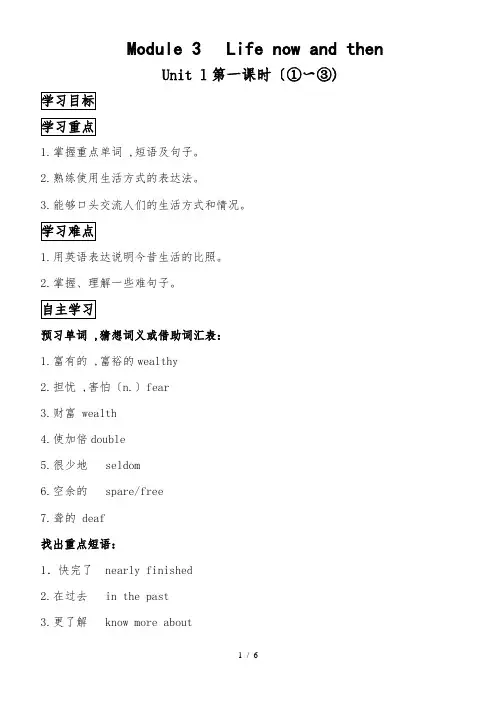
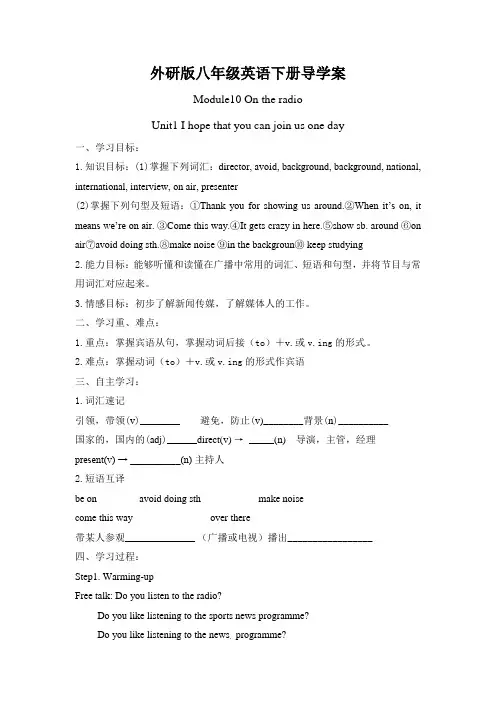
八年级英语Module3 Now and Then导学案
- 格式:doc
- 大小:62.00 KB
- 文档页数:2
复习学案
课前复习:复习Module 3 单词、短语,同桌交流检查。
一、复习目标
1.掌握重点词汇和短语。
2.通过回顾听力素材,进一步提升学生听力能力。
3. 掌握比较级和最高级的变化规则和用法
4.能对周围的人和事物进行比较,形成自己的观点。
二、复习过程 Believe yourself!
(一)Listening practice听句子,选择适当的答语。每个句子读两遍。
1. A. 10 yuan. B. Yes, I’ll take it. C. No, thank you.
2. A. I don’t think so. B. Last month. C. I like it very much.
3. A. Really? Wonderful! B. I go to school at seven. C. It’s time to go to school
4. A. No, he isn’t. B. I’m sorry to hear that. C. Because he is ill.
5. A. She is better now. B. She likes dancing. C. She is tall and pretty.
(二)课文重现
基础知识回顾 Revise the words and phrases in this module quickly.
1 … 的角色_____________ 8.做运动 ______________
2 …的数量______________ 9. 公共交通 ____________
3.一生 ______________ 10.制造污染 ____________
4.听说 ______________ 11.说到,提到 ____________
5. 生长,长大___________ 12.结婚 _____________
6. 成千上万的人_________ 13.从…跌落 ____________
7.预防疾病 _____________ 14.过… 的生活____________
Revise Unit1 and Unit 2 by yourself. Compare life today and that in the past in
groups.
Fill in the table.
In the past Now
Family smaller
Parents’ jobs
Both of them go out to work.
Lifestyle eat ready-made food
Marriage
About the city less traffic
(三)基础知识
跟踪训练
1. 树木能够防止土壤流失。
Trees can ________ soil(土壤) __________ running away.
2. 他们是去年结婚的。
They _______ _________ last year.
3. There are __ students on the playground, the number of girls ____ about 40.
A. a number of; is B. the number of; is
C. a number of; are D. the number of; are
4. The box is _____ heavy. He can’t carry it.
A. too much B. too many C. much too D. many too
复习形容词、副词的比较级和最高级。
跟踪训练
1.Which is (heavy), the elephant , the pig or the duck?
2.I think English is as (important) as math.
3.Do the girls get up (early) than the boys? No, they don't.
4. She studies (hard) in our class.
5.In our city, it's hot in July, but it's even ________(hot) in August.
跟踪训练(中考连接)
6.(11福建晋江)--The cake is too expensive. Would you like to show me a
_______one? --Sure. Here you are.
A. cheap B. cheaper C. cheapest
7.(11山西)It is_____ to teach a kid the way to solve a problem than tell him the solution
directly.
A. helpful B. more helpful C. the most helpful
8. (11吉林通化)Taking buses in Beijing is______than taking a taxi.
A. more cheap B. much cheaper C. a little cheap D. less cheaper
9. (11年上海)Listening is just as________as speaking in language learning.
A. important B. more important C. most important D. the most important
10.(11陕西省)The ______friends you have, the ______you will be.
A. more; happy B. many; happy C. more; happier
D. many; happier
Long ago, people did not need money. They lived on wild animals, fruits and other
plants.
As time passed, people learned to raise animals and crops. Sometimes, families
produced more than they needed, so they started to trade with other families. Later, people
began to use money as a way of exchange. However, it was not the kind of money we use
today. They used shells, rice, salt, large stones, etc.
During the 600s B.C, people began using coins as money. They soon found that
coins were easier to carry than goods and lasted a long time. Later, countries began to
make their won coins.
(一)根据短文内容简要回答问题.
1. Why did people start to trade?
_________________________________________________________
将短文中划线的句子译成汉语.
2. _________________________________________________________
就我们学校过去和现在的变化,写一篇5至10句话的小文章。
________________________________________________________________________
________________________________________________________________________
________________________________________________________________________
________________________________________________________________________
________________________________________________________________________
________________________________________________________________________
当堂检测、升华提高
一、写出下列形容词或副词的比较级。
1.fast __________ rge_________ 3.big_________
4.happy __________ 5.difficult __________
二、写出下列形容词或副词的最高级。
6.important ____________ 7.dry ___________
8.hot __________ 9.wide __________ 10.hard ___________
三根据汉语意思完成句子
1.我将尽我的最大努力赶上别人。
I will _______ _______ _______ ______ catch up with others.
2. 过去人们因疾病和饥饿过着困难的生活。
The people in the past _____ ___ _______ ______ because of diseases and hunger.
3. 树木能够阻止土壤流失。
Trees can __________ soil(土壤)__________running away.
4. 他从树上跌落,伤了双脚。