九上Unit9Whenwasitinvented单元导学案
- 格式:pdf
- 大小:42.92 KB
- 文档页数:11
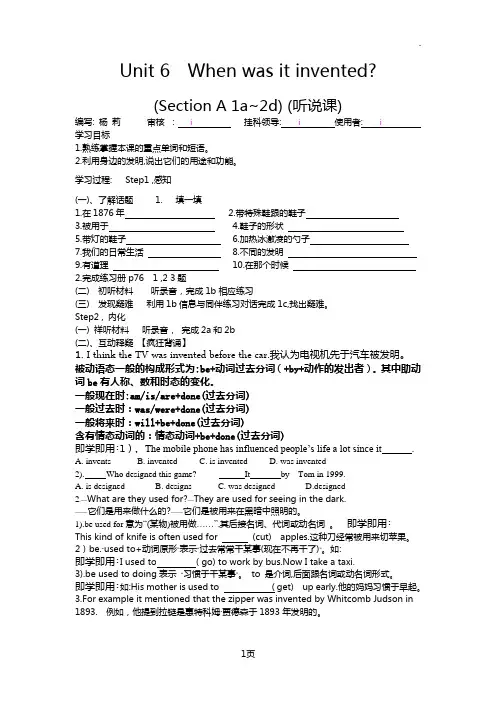
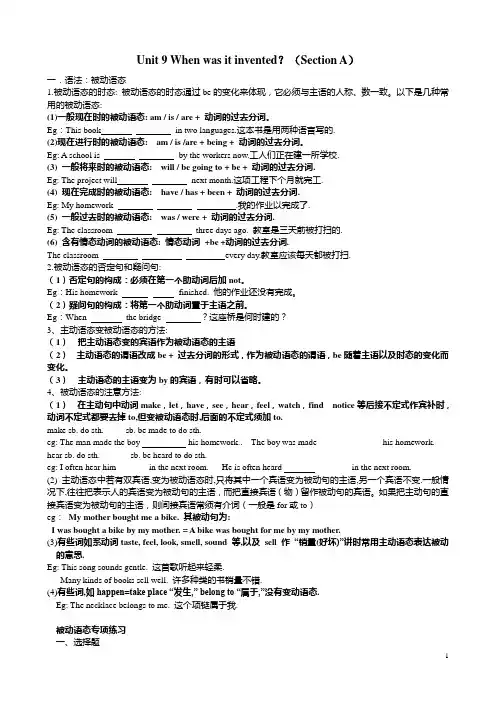
Unit 9 When was it invented?
班级____________ 小组____________ 姓名____________ 评价____________
【教学目标】了解主动语态和被动语态,主动语态表示主语是动作的执行者, 被动语态表示主
语是动作的承受者;被动语态的构成“助动词be+及物动词的过去分词”。
【学习重点】一般现在时的被动语态
【重点句型】When was it invented? It was invented in 1885.
When were electric slippers invented? They were invented last year.
Who were they invented by? They were invented by Julie Thompson.
What are they used for? They’re used for seeing in the dark
第一课时Section A(1a—2c)
【教学目标】了解一般过去时的被动语态及特殊疑问句。
【学习重点】一般过去时的被动语态
词汇invent; calculator; be used for; scoop; adjustable; heel; battery; operate; slipper; heat
【探究案】
1. invent;find;find out; discover
invent意为“发明”,指通过劳动运用聪明才智“发明/创造”出以前从未存在过的新事物。
Who invented the telephone?是谁发明电话的?
He invented a new teaching method.他发明了一种新的教学方法。
find意为“找到、发现”,指找到或发现自己所需要的东西或丢失的东西,着重指找到的结果。
We've found oil under the South Sea.我们已在南海发现了石油。
They finally found a way.他们终于找到了办法。
意为“发现”,表示“偶然”或“经过努力”发现客观存在的事物、真理或错误,即指发现原来客观
存在但不为人所知的事物,也可表示发现已为人所知的事物的新的性质或用途。
Columbus discovered America in1492.哥伦布1492年发现了美洲。
We soon discovered the truth.我们很快就弄清了真相。
find out指经过研究或询问查明某事或真相。
I've found you out at last.我终于把你揭露了。
Please find out when the ship sails for New York.请打听一下那艘船什么时候开往纽约。
Please find out what time the delegation will come.请查一查代表团什么时候来。
【跟踪训练】
1.Edison ____the electric lamp.
2.I lost my necklace last night.I haven’t ____it.3.Who ____America first?
4.Can you ____what time the train leaves?
2. be used by的意思是“由(被)…使用” , “used to加不定式”表示过去常常干某事现在不在干了。
例如: I used to go to work by bus. Now I take a taxi. She used to be very shy.
“be used to doing”表示习惯于干某事
▲ be used for意为“(某物)被用做……”其后接名词、代词或动名词。如:
(1)This kind of bamboo can be used for water pipes . 这种竹子可用作水管。
(2)A knife can be used for cutting bread . 刀可用来切面包。
be used to do sth. 也可表示“(某物)被用做……”,但其后接动词原形。如:
(3)A hammer is used to drive nails . 锤子是用来敲钉子的。
提示:be used as相当于be used for的用法。如:
(4)The girl is being used as a servant in the house . 这个女孩在家里被当做佣人使唤着。
【训练案】单项选择
( ) 1 The People's Republic of China __ on October 1, 1949.
A. found B. was founded C. is founded D. was found
( ) 2 English ____ in Canada.
A. speaks B. are spoken C. is speaking D. is spoken
( ) 3 This English song __ by the girls after class.
A. often sings B. often sang C. is often sang D. is often sung
( ) 4 This kind of car___ in Japan.
A, makes B. made C. is making D. is made
( ) 5 New computers ___ all over the world.
A. is used B. are using C. are used D. have used
用所给词的适当形式填空
1. Edison was a great ___________ (invent) and he invented more than one than one thousand
______________ (invent).
2. The old people should _______________(speak) to politely.
3. A stamp is used for _________________(send) letters.
4. ----Who _________ (save) her father?
---He_______________(save) by that policeman.
5. The teacher’s office _______________________(clean) by us yesterday.
【课后反思】Unit 9 When was it invented?
班级____________ 小组____________ 姓名____________ 评价____________
第二课时(Section A 3a-4)
【教学目标】熟练掌握被动语态用法,学会用被动语态表达对发明事物的认识和看法。
【学习重点】1.熟练运用一般过去时的被动语态。
2 词汇Light bulb; microwave; oven
【预习指导及使用说明】
1.课前热身。2.合作探究。3.检测
【预习案】
1. hear和listen to: hear只是强调听见了,指声音传进了耳朵。listen to的意思是集中注意力,
尽量听清楚。
例如:Suddenly I heard a strange noise.我突然听到一个奇怪的声响。
I can hear you.我能听到你说话。Listen to me please.请听我说。
I heard them talking in next room, but I didn‘t really listen to what they were saying.
我听到他们在隔壁房间里说话,但我实在没注意听他们说什么。
当谈到听音乐、无线电广播、演讲、讲课等时,要用hear。
Did you hear Jack‘s talk on Tuesday? 你听了星期二杰克的演讲吗?
但是可以说:I spent the night listening to records. 我听了一晚上的唱片。(不是公开演出)
注意:hear一词一般不用于进行时。不说I am hearing或I was hearing,而用can或could。例
如:I can hear somebody coming.我能听见有人来了。
【探究案】被动语态
语态是动词的一种形式,它表示主语和谓语的关系。语态有两种:主动语态和被动语态。
如果主语是动作的执行者,或者是说动作是由主语完成的,要用主动语态;如果主语是动作的
承受者,或者是说动作不是由主语而是由其他人完成的,则用被动语态。
拓展: 被动语态各时态构成表
TENSE 主动语态被动语态
一般现在时be+V.\V.s am\is\are+V(p.p)
一般将来时will\be going to+V. will be +V(p.p)
现在进行时am\is\are+V.ing am\is\are+being+V(p.p)
一般过去时①was\were ②V-ed was\were+V(p.p)
现在完成时have\has+V.p.p have\has+been+V(p.p)
过去完成时had+V.p.p had+been+V(p.p)
过去进行时was\were+V-ing was\were+being+V(p.p)
情态动词情态动词+V. 情态动词+be+V(p.p)
3. 感官动词或使役动词使用省略to的动词不定式,主动语态中不带to,但变为被动语态时,
须加上to。
例:make somebody do something→ somebody+ be +made to do something
see somebody do something→ somebody +be +seen to do something
1. A girl saw my wallet drop when she passed by. →My wallet was seen to drop by a girl when she
passed by.
2. The boss made the little boy do heavy work .→The little boy was made to do heavy work by the
boss.
【达标检测】一、同义句转换
1. People speak English in many countries. English _____ _______ _____ ____in many countries.
2. We built this bridge last year. This bridge _______ _______ _______ ______ last year.
3. The tiger in the zoo frightened the little girl.