
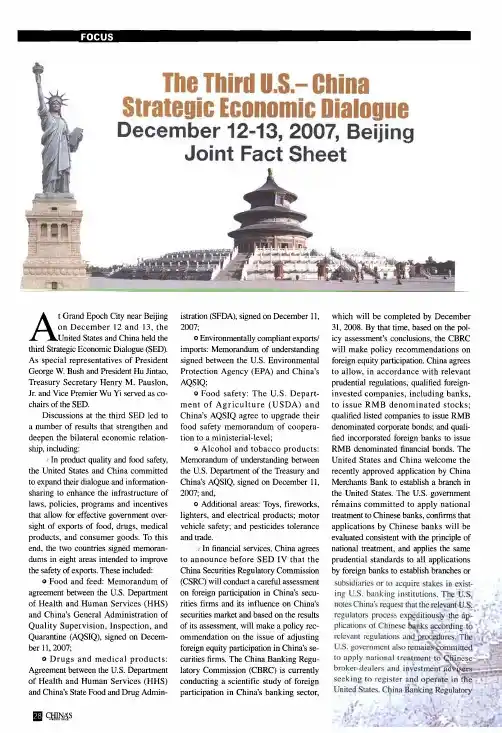
The Third U.S.-China Strategic Economic Dialogue December 12-13, 2007, Beijing Joint Fact Sheet
- 格式:pdf
- 大小:255.29 KB
- 文档页数:2
《中华人民共和国和美利坚合众国联合公报》(《上海公报》)(英文版)(一九七二年二月二十八日)Joint Communique of the United States of America and the People's Republic of ChinaFebruary 28, 1972President Richard Nixon of the United States of America visited the People's Republic of China at the invitation of Premier Chou En-lai of the People's Republic of China from February 21 to February 28, 1972. Accompanying the President were Mrs. Nixon, U.S. Secretary of State William Rogers, Assistant to the President Dr. Henry Kissinger, and other American officials.President Nixon met with Chairman Mao Tsetung of the Communist Party of China on February 21. The two leaders had a serious and frank exchange of views on Sino-U.S. relations and world affairs.During the visit, extensive, earnest and frank discussions were held between President Nixon and Premier Chou En-lai on the normalization of relations between the United States of America and the People's Republic of China, as well as on other matters of interest to both sides. In addition, Secretary of State William Rogers and Foreign Minister Chi Peng-fei held talks in the same spirit.President Nixon and his party visited Peking and viewed cultural, industrial and agricultural sites, and they also toured Hangchow and Shanghai where, continuing discussions with Chinese leaders, they viewed similar places of interest.The leaders of the People's Republic of China and the United States of America found it beneficial to have this opportunity, after so many years without contact, to present candidly to one another their views on a variety of issues. They reviewed the in- ternational situation in which important changes and great upheavals are taking place and expounded their respective positions and attitudes.The Chinese side stated: Wherever there is op- pression, there is resistance. Countries want inde- pendence, nations wan liberation and the people want revolution--this has become the irresistible trend of history. All nations, big or small, should be equal: big nations should not bully the small and strong nations should not bully the weak. China will never be a superpower and it opposes hegemony and power politics of any kind. The Chinese side stated that it firmly supports the struggles of all the oppressed people and nations for freedom and liberation and that the people of all countries have the right to choose their social systems according their own wishes and the right to safeguard the independence, sovereignty and territorial integrity of their own countries andoppose foreign aggression, interference, control and subversion. All foreign troops should be withdrawn to their own countries. The Chinese side expressed its firm support to the peoples of Viet Nam, Laos and Cambodia in their efforts for the attainment of their goal and its firm support to the seven-point proposal of the Provisional Revolutionary Government of the Republic of South Viet Nam and the elaboration of February this year on the two key problems in the proposal, and to the Joint Declaration of the Summit Conference of the Indochinese Peoples. It firmly supports the eight-point program for the peaceful unification of Korea put forward by the Government of the Democratic People's Republic of Korea on April 12, 1971, and the stand for the abolition of the "U.N. Commission for the Unification and Rehabilitation of Korea". It firmly opposes the revival and outward expansion of Japanese militarism and firmly supports the Japanese people's desire to build an independent, democratic, peaceful and neutral Japan. It firmly maintains that India and Pakistan should, in accor- dance with the United Nations resolutions on the Indo- Pakistan question, immediately withdraw all their forces to their respective territories and to their own sides of the ceasefire line in Jammu and Kashmir and firmly supports the Pakistan Government and people in their struggle to preserve their independence and sovereignty and the people of Jammu and Kashmir in their struggle for the right of self-determination.The U.S. side stated: Peace in Asia and peace in the world requires efforts both to reduce immediate tensions and to eliminate the basic causes of con- flict. The United States will work for a just and secure peace: just, because it fulfills the aspira- tions of peoples and nations for freedom and progress; secure, because it removes the danger of foreign ag- gression. The United States supports individual free- dom and social progress for all the peoples of the world, free of outside pressure or intervention. The United States believes that the effort to reduce ten- sions is served by improving communication between countries that have different ideologies so as to lessen the risks of confrontation through accident, miscalculation or misunderstanding. Countries should treat each other with mutual respect and be willing to compete peacefully, letting performance be the ulti- mate judge. No country should claim infallibility and each country should be prepared to re-examine its own attitudes for the common good. The United States stressed that the peoples of Indochina should be al- lowed to determine their destiny without outside in- tervention; its constant primary objective has been a negotiated solution; the eight-point proposal put forward by the Republic of Viet Nam and the United States on January 27, 1972 represents a basis for the attainment of that objective; in the absence of a negotiated settlement the United States envisages the ultimate withdrawal of all U.S. forces from the region consistent with the aim of self-determination for each country of Indochina. The United States will maintain its close ties with and support for the Republic of Korea; the United States will support efforts of the Republic of Korea to seek a relaxation of tension and increased communication in the Korean peninsula. The United States places the highest value on its friendly relations with Japan; it will continue to develop the existing close bonds. Consistent with the United Nations Security Council Resolution of december 21, 1971, the United States favors the continuation of the ceasefire between India and Pakistan and the withdraw- al of all military forces to within their own territo- ries and to their own sides of the ceasefire line in Jammu and Kashmir; the United States supports the right of the peoples of South Asia to shape their own future in peace, free of military threat, and without having the area become the subject of great power rivalry.There are essential differences between China and the United States in their social systems and foreign policies. However, the two sides agreed that coun- tries, regardless of their social systems, should conduct their relations on the principles of respect for the sovereignty and territorial integrity of all states, non-aggression against other states, non-in- terference in the internal affairs of other states, equality and mutual benefit, and peaceful coexistence. International disputes should be settled on this basis, without resorting to the use or threat of force. The United States and the People's Republic of China are prepared to apply these principles to their mutual relations.With these principles of international relations in mind the two sides stated that:progress toward the normalization of relations between China and the United States is in the inter- ests of all countriesboth wish to reduce the danger of international military conflictneither should seek hegemony in the Asia-Pacif- ic region and each is opposed to efforts by any other country or group of countries to establish such hege- monyneither is prepared to negotiate on behalf of any third party or to enter into agreements or under- standings with the other directed at other states.Both sides are of the view that it would be against the interests of the peoples of the world for any major country to collude with another against other countries, or for major countries to divide up the world into spheres of interest.The two sides reviewed the long-standing serious disputes between China and the United States. The Chinese side reaffirmed its position: the Taiwan question is the crucial question obstructing the nor- malization of relations between China and the United States; the Government of the People's Republic of China is the sole legal government of China; Taiwan is a province of China which has long been returned to the motherland; the liberation of Taiwan is China's internal affair in which no other country has the right to interfere; and all U.S. forces and military installations must be withdrawn from Taiwan. The Chinese Government firmly opposes any activities which aim at the creation of "one China, one Taiwan", "one China, two governments", "two Chinas", an "independent Taiwan" or advocate that "the status of Taiwan remains to be determined".The U.S. side declared: The United States ac- knowledges that all Chinese on either side of the Taiwan Strait maintain there is but one China and that Taiwan is a part of China. The United States Govern- ment does not challenge that position. It reaffirms its interest in a peaceful settlement of the Taiwan question by the Chinese themselves. With this pros- pect in mind, it affirms the ultimate objective of the withdrawal of all U.S. forces and military installa- tions from Taiwan. In the meantime, it will progres- sively reduce its forces and military installations on Taiwan as the tension in the area diminishes. The two sides agreed that it is desirable to broaden the understanding between the two peoples. To this end, they discussed specific areas in such fields as science, technology, culture, sports and journal- ism, in which people-to-people contacts and exchanges would be mutually beneficial. Each side undertakes to facilitate the further development of such contacts and exchanges.Both sides view bilateral trade as another area from which mutual benefit can be derived, andagreed that economic relations based on equality and mutual benefit are in the interest of the peoples of the two countries. They agree to facilitate the progressive development of trade between their two countries.The two sides agreed that they will stay in con- tact through various channels, including the sending of a senior U.S. representative to Peking from time to time for concrete consultations to further the normal- ization of relations between the two countries and continue to exchange views on issues of common inter- est.The two sides expressed the hope that the gains achieved during this visit would open up new prospects for the relations between the two countries. They believe that the normalization of relations between the two countries is not only in the interest of the Chinese and American peoples but also contributes to the relaxation of tension in Asia and the world.President Nixon, Mrs. Nixon and the American party expressed their appreciation for the gracious hospitality shown them by the Government and people of the People's Republic of China.中华人民共和国和美利坚合众国联合公报(1972/2/28)(一九七二年二月二十八日)应中华人民共和国总理周恩来的邀请,美利坚合众国总统理查德·尼克松自一九七二年二月二十一日至二月二十八日访问了中华人民共和国。

校园英语 / 大视野The Unpredictable Sino-U.S. Relationship Television School Journalism and Communication Faculty Communication University of China/Ruining Hu【Abstract】The Sino-United States (U.S.) relationship is one of the most important bilateral relationships in the world, as the U.S. is the most powerful state while China grows rapidly and ranks as the second largest economic entity. The puzzling relationship makes it hard to define the connection between the U.S. and China, whether they are friends or foes. The past 38 years since China and the U.S. first established diplomatic relations has witnessed ups and downs. The following paper will mainly introduce the two countries’ cooperation and tensions in trade, military and international organizations.【Key words】Sino-U.S. relationship; Diplomacy; International relationsSection 1: Tradea) CooperationThe cooperation between the two states are frequent, especially regarding trade contacts. Up to 2016, China was the U.S.’ s second largest trading partner, the third biggest export market, and the largest source market of the U.S. imports. On the other hand, the U.S. was China’s second largest trading partner, its biggest export market, and fifth largest source of imports (Sun 46). Additionally, in order to keep the U.S. interest rate low and help the exports of China’s products, “China purchased the U.S. government debt, reaching $1.185 trillion, which is 30% of the $3.948 trillion in Treasury bills, notes, and bonds held by foreign countries” (Amadeo, “U.S. Debt to China: How Much Does It Own?”).b) TensionAlthough the bilateral commercial cooperation is increasingly closer, there are inevitable factors that cause economic tension between these two countries. The main reason of this is China’s incomplete transition to a free market economy after notably liberalizing its economy and trade within the last three decades. The U.S authorities also express concerns on China’s alleged widespread cyber economic espionage, the loose management of intellectual property rights and excessive protection of the government-funded industries (Morrison 439).The lack of strategic mutual trust is the key factor that restricts further development of the Sino-U.S. trade cooperation. The United States purposely designed the “Trans-Pacific Strategic Partnership Agreement” (TPP) excluding China from the U.S.-led Asia-Pacific region trade framework.Section 2: Militarya) CooperationFor a long time, the Sino-U.S. military relationship has been the most fragile part in this diplomatic relation. In November 2013, the Chinese and American troops first held the humanitarian joint military exercise for disaster reduction in Hawaii, which was the first time for Chinese armed forces to step on the U.S. continent. In 2014, Chinese President Xi Jinping arrived at Sunnylands, the Californian estate, to have a two-day summit with Barack Obama. During the summit, President Xi proposed constructing a new military relationship (Liu 18).b) Tensions1. Taiwan CrisisThe issue of Taiwan is high on the agenda in Sino-US relations. It is the significant aspect of the relationship which has the potential to turn the overall relationship into confrontation (Shepperd 44). In 1949, the Kuomintang (KMT), supported by the American government, was defeated in China’s Civil War by the communist party and withdrew to Taiwan. Since then, Taiwan was governed separately from the mainland. However, the U.S. continued to help Taiwan to win independence in military and economy. On January 1979, the U.S. government officially normalized the relationship with PRC, breaking relation with Taiwan. Nevertheless, in April in the same year, according to the Taiwan Relations Act(TRA) passed by the U.S. Congress, aiming at standardizing the relation between the U.S. and China, the U.S. government would provide Taiwan with weapons for self-defense in case PRC conquered Taiwan violently (Office of the Historian). However, continuous actions taken by the U.S. government severely damaged Chinese national spirit, causing tension between the two countries. For example, the Obama administration sold 1.83 billion dollars of arms to Taiwan in 2015, just before the Taiwanese presidential election.2. South China Sea DisputeChina, Vietnam, the Philippines, Taiwan, Malaysia and Brunei all have competing claims over territory in the South China Sea for centuries, but the tension has increased in recent years with super powers’ involvement. The U.S. also plays an important role in this issue, supporting the countries which have disputes over the South China Sea (“Why is the South China Sea contentious?”). By intervening in this controversy, the U.S. shows its military power in this geopolitically important region, keeping its global leadership position and suppressing China.Entering the 21st century, the fundamental interests of U.S. in Asia-Pacific region haven’t changed. In February 2009, the Obama administration announced that it would pursue- 253 -- 254-校园英语 / 大视野access to the Treaty of Amity and Cooperation(TAC) with the founding members of the Association of Southeast Asian Nations (ASEAN), seen as the U.S.’s commitment and engagement in Southeast Asia (Manyin, Garcia and Morrison 3).3. Senkaku Islands DisputeThe territorial disputes of the Senkaku islands have been a high priority for the governments of Japan and China. The interference by the U.S., a close ally of Japan, aggravated the disputes and caused the Sino-U.S. relationship to take a drastic turn for the worse. Barack Obama declared at the start of a tour of Asia, “The U.S. is duty-bound to come to Japan ’s aid in the event of a conflict with China over a group of disputed islands in the East China Sea.” This tour aimed at reassuring Washington ’s allies, facing threats to stability from North Korea and an increasingly assertive China (McCurry and Branigan, “Obama says US will defend Japan in island dispute with China ”).Section 3: International organizations a) CooperationChina and the U.S. are both members of Asian Development Bank (ADB), the U.S. being the nonregional member, Association of Southeast Asian Nations (ASEAN), both countries being dialogue partners, Group of Twenty (G20), International Atomic Energy Agency (IAEA), International Monetary Fund (IMF), United Nations (UN), World Trade Organization (WTO). These two countries mainly cooperate within the framework of the United Nations (Central Intelligence Agency).b) TensionHowever, tensions exist within multilateral development banks. Built by great powers, multilateral institutes aim at serving and benefiting the founders. The ADB has received much criticism since its establishment. As one of the nonregional member, the U.S. is considered to have long-term leadership and manipulation over ADB. Considering national benefits, the U.S largely ignore the demand of minor shareholders, for instance, humanitarian and development demand of Canada, Denmark and Norway. As the latecomer, China joined the ADB in 1986 and only has 5.44% voting right, Japan and the US having 12.76% voting right respectively. The unfair distribution of voting right has caused tension between the U.S. and China, meanwhile largely restraining the ADB from functioning effectively (Pang and He 8).ConclusionAlthough the Sino-US relationship have once been troublesome, their contemporary relations remain stable without obvious hostility. During this period, the two countries have close ties in military and trade, working together in many international institutions to maintain world peace and prosperity. Facingopportunities and challenges, the China-U.S. relationship affects the wellbeing of many countries. This paper merely summarizes the interaction between these two countries in certain fields. Further research is required to make more accurate judgment about the contemporary relations of these two states.References:[1]Amadeo,Kimberly.“U.S.Debt to China:How Much Does It Own?” The Balance,22 Oct.2016,/u-s-debt-to-china-how-much-does-it-own-3306355.[2]Central Intelligence Agency,“North America:United States.” The World Factbook,3 Nov.2016,/library/publications/resources/the-world-factbook/geos/us.html.[3]Liu,Feitao.“Sino - US Cooperation and Competition in the Context of New Power Relations.” Peace and Development,vol.5,2015,pp.12-24.[4]Manyin,M.,Garcia,M.,Morrison,Wayne.“U.S.Accession to the Association of Southeast Asian Nations ’ Treaty of Amity and Cooperation.”Congressional Research Service,13 July 2009,Report no.R40583,/sgp/crs/row/R40583.pdf.[5]McCurry,Justin and Branigan,Tania.“Obama says US will defend Japan in island dispute with China.” The Guardian,24 April 2014,/world/2014/apr/24/obama-in-japan-backs-status- quo-in-island-dispute-with-china.[6]Morrison,Wayne.China-US trade issues,Current Politics and Economics of Northern and Western Asia,vol.20,no.3,2011,pp.409-461.[7]Office of the historian,United States Department of State,“The August 17,1982 U.S.-China Communiqué on Arms Sales to Taiwan.” /milestones/1981-1988/china-communique.[8]Pang,Xun,and He,Yikun.“Power Versus Institution -How Does the Unite States Manipulate and Control Regional Development Banks.” World Economics and Politics,V ol.9,2015,pp.4-30.[9]Shepperd,Taryn.Sino-US Relations and The Role of Emotion in State Action. Palgrave Macmillan,23 January,2013.[10]Sun,Lipeng.“Sino-U.S.Trade Ties:Steady Progress in Cooperation.” China Today,1 July 2016,pp.46-49.[11]“Why is the South China Sea contentious?” BBC news,12 July,2016,/news/world-asia-pacific-13748349.About the author: Name: Hu ,Ruining Date of Birth: April, 1996Birth Place: Hubei ProvinceResearch Direction: International Journalism and Communication。

美国财政部长盖特纳北京大学演讲中英文全文The United States and China, Cooperating for Recovery and GrowthThe United States and China, Cooperating for Recovery and GrowthTreasury Secretary Timothy F. GeithnerSpeech at Peking University - Beijing, ChinaIt is a pleasure to be back in China and to join you here today at this great university.I first came to China, and to Peking University, in the summer of 1981 as a college student studying Mandarin. I was here with a small group of graduate and undergraduate students from across the United States.I returned the next summer to Beijing Normal Univ ersity.We studied reasonably hard, and had the privilege of working with many talented professors, some of whom are here today. As we explored this city and traveled through Eastern China, we had the chance not just tounderstand more about your history and your aspirations, but also to begin to see the United States through your eyes.Over the decades since, we have seen the beginnings of one of the most extraordinary economic transformations in history. China is thriving. Economic reform has brought exceptionally rapid and sustained growth in incomes. China¡¯s emergence as a major economic force more fully integrated into the world economy has brought substantial benefits to the United States and to economies around the wor ld.In recognition of our mutual interest in a positive, cooperative, and comprehensive relationship, President Hu Jintao and President Obama agreed in April to establish the Strategic and Economic Dialogue. Secretary Clinton and I will host Vice Premier Wang and State Councilor Dai in Washington this summer for our first meeting. I have the privilege of beginning the economic discussions with a series of meetings in Beijing today and tomorrow.These meetings will give us a chance to discussthe risks and challenges on the economic front, to examine some of the longer term challenges we both face in laying the foundation for a more balanced and sustainable recovery, and to explore our common interest in international financial reform.Current Challenges and RisksThe world economy is going through the most challenging economic and financial stress in generations.The International Monetary Fund predicts that the world economy will shrink this year for the first time in more than six decades. The collapse of world trade is likely to be the worst since the end of World War II. The lost output, compared to the world economys potential growth in a normal year, could be between three and four trillion dollars.In the face of this challenge, China and the United States are working together to help shape a strong global strategy to contain the crisis and to lay the foundation for recovery. And these efforts, the combined effect of forceful policy actions here inChina, in the United States, and in other major economies, have helped slow the pace of deteriorat ion in growth, repair the financial system, and improve confidence.& nbsp;In fact, what distinguishes the current crisis is not just its global scale and its acute severity, but the size and speed of the global response.At the G-20 Leaders meeting in London in April, we agreed on an unprecedented program of coordinated policy actions to support growth, to stabilize and repair the financial system, to restore the flow of credit essential for trade and investment, to mobilize financial resources for emerging market economies through the international financial institutions, and to keep markets open for trade and investment.That historic accord on a strategy for recovery was made possible in part by the policy actions already begun in China and the United States.China moved quickly as the crisis intensified with a very forceful program of investments and financial measures to strengthen domestic demand.In the United States, in the first weeks of the new Administration, we put in place a comprehensive program of tax incentives and investments ¨C the largest peace time recovery effort since World War II - to help arrest the sharp fall in private demand. Alongside these fiscal measures, we acted to ease the housing crisis. And we have put in place a series of initiatives to bring more capital into the banking system and to restart the credit markets.These actions have been reinforced by similar actions in countries around the world.In contrast to the global crisis of the 1930s and to the major economic crises of the postwar period, the leaders of the world acted together. They acted quickly. They took steps to provide assistance to the most vulnerable economies, even as they faced exceptional financial needs at home. They worked to keep their markets open, rather than r etreating into self-defeating measures of discrimination and protect ion.And they have committed to make sure this programof initiatives is sustained until the foundation for recovery is firmly established, a commitment the IMF will monitor closely, and that we will be able to uate together when the G-20 Leaders meet again in the United States this fall.We are starting to see some initial signs of improvement. The global recession seems to be losing force. In the United States, the pace of decline in economic activity has slowed. Households are saving more, but consumer confidence has improved, and spending is starting to recover. House prices are falling at a slower pace and the inventory of unsold homes has come down significantly. Orders for goods and services are somewhat stronger. The pace of deterioration in the labor market has slowed, and new claims for unemployment insurance have started to come down a bit.&nb sp;The financial system is starting to heal. The clarity and disclosure provided by our capital assessment of major banks has helped improve market confidence in them, making it possible for banks thatneeded capital to raise it from private investors and to borrow without guarantees. The securities markets, including the asset backed securities markets that essentially stopped functioning late last year, have started to come back. The cost of credit has fallen substantially for businesses and for families as spreads and risk premia have narrowed.These are important signs of stability, and assurance that we will succeed in averting financial collapse and global deflation, but they represent only the first steps in laying the foundation for recovery. The process of repair and adjustment is going to take time. ;China, despite your own manifest challenges a s a developing country, you are in an enviably strong position. But in most economies, the recession is still powerful and dangerous. Business and households in the United States, as in many countries, are still experiencing the most challenging economic and financial pressures in decades.The plant closures, and company restructuringsthat the recession is causing are painful, and this process is not yet over. The fallout from these events has been brutally indiscriminant, affecting those with little or no responsibility for the events that now buffet them, as well as on some who played key roles in bringing about our troubles.The extent of the damage to financial systems entails significant risk that the supply of credit will be constrained for some time. The constraints on banks in many major economies will make it hard for them to compensate fully for the damage done to the basic machi nery of the securitization markets, including the loss of confidence in credit ratings. After a long period where financial institutions took on too much risk, we still face the possibility that banks and investors may take too little risk, even as the underlying economic conditions start to improve.And, after a long period of falling saving and substantial growth in household borrowing relative to GDP, consumer spending in the United States will be restrained for some time relative to what is typicallythe case in recoveries.These are necessary adjustments. They will entail a longer, slower process of recovery, with a very different pattern of future growth across countries than we have seen in the past several recoveries.Laying the Foundation for Future GrowthAs we address this immediate financial and economic crisis, it is important that we also lay the foundations for more balanced, sustained growth of the global economy once this recovery is firmly established.A successful transition to a more balanced and stable global economy will require very substantial changes to economic policy and financial regulation around the world. But some of the most important of those changes will have to come in the United States and China. How successful we are in Washington and Beijing will be critically important to the economic fortunes of the rest of the world. The effectiveness of policies will depend in part on Chinas, and the effectiveness of yours on ours.Although the United States and China start from very different positions, many of our domestic challenges are similar. In the United States, we are working to reform our health care system, to improve the quality of education, to rebuild our infrastructure, and to improve energy efficiency. These reforms are essential to boosting the productive capacity of our economy. These challenges are at the center of your reform priorities, too.We are both working to reform our financial systems. In the United States, our challenge is to create a more stable and more resilient financial system, with stronger protections for consumer and investors. As we work to strengthen and redesign regulation to achieve these objectives, our challenge is to preserve the core strengths of our financial system, which are its exceptional capacity to adapt and innovate and to channel capital for investment in new technologies and innovative companies. You have the benefit of being able to learn from our shortcomings, which have proved so damaging in the present crisis, as well as f rom our strengths.Our common chall enge is to recognize that a more balanced and sustainable global recovery will require changes in the composition of growth in our two economies. Because of this, our policies have to be directed at very different outcomes.In the United States, saving rates will have to increase, and the purchases of consumers cannot be as dominant a driver of growth as they have been in the past.In China, as your leadership has recognized, growth that is sustainable growth will require a very substantial shift from external to domestic demand, from an investment and export intensive driven growth, to growth led by consumption. Strengthening domestic demand will also strengthen Chinas ability to weather fluctuations in global supply and demand.If we are successful on these respective paths, public and private saving in the United States will increase as recovery strengthens, and as this happens, our current account deficit will come down. And in China, domestic demand will rise at a faster rate than overallGDP, led by a gradual shift to higher rates of consumption.Globally, recovery will have come more from a shift by high saving economies to stronger domestic demand and less from the American consumer.The policy framework for a successful transition to this outcome is starting to take shape.In the United States, we are putting in place the foundations for restoring fiscal sustainability.The President in his initial budget to Congress made it clear that, as soon as recovery is firmly established, we are going to have to bring our fiscal deficit down to a level that is sustainable over the medium term. This will mean bringing the imbalance between our fiscal resources and expenditures down to the point - roughly three percent of GDP -- wh ere the overall level of public debt to GDP is definitively on a dow nward path. The temporary investments and tax incentives we put in place in the Recovery Act to strengthen private demand will have to expire, discretionary spending will have to fall back to a moremodest level relative to GDP, and we will have to be very disciplined in limiting future commitments through the reintroduction of budget disciplines, such as pay-as-you go rules.The President also looks forward to working with Congress to further reduce our long-run fiscal deficit.And, critical to our long-term fiscal health, we have to put in place comprehensive health care reform that will bring down the growth in health care costs, costs that are the principal driver of our long run fiscal deficit.The President has also proposed steps to encourage private saving, including through automatic enrollment in retirement savings accounts.。

CHINA KEYWORDSEditor’s Note:The third volume of Xi Jinping: The Governance of China has been published by the Foreign Lan-guages Press in both Chinese and English. The newly-published volume is a collection of 92 articles,including speeches, conversations, instructions, and letters of Xi, general secretary of the CommunistParty of China Central Committee, between October 18, 2017 and January 13, 2020.The third volume records the practices of the CPC Central Committee with Comrade Xi Jinping atthe core in uniting and leading the whole Party and Chinese people of all ethnic groups to make newand major progresses in various undertakings of the Party and country since the 19th CPC NationalCongress. It is an authoritative work that fully and systematically reflects Xi Jinping Thought on So-cialism with Chinese Characteristics for a New Era.To help our readers better understand the key points of the book, our column, by zooming in on aspecific topic for each issue, presents bilingual excerpts of the book. Echoing our special reports of thisissue, the column focuses on “eco-environmental protection.”remain immune from such challenges.China has become an important participant, contribu-tor, and leader in promoting a global eco-civilization. Weadvocate jointly building a clean and beautiful world thatrespects nature and favors green development.– From the speech at the National Conference onEco-Environmental ProtectionMay 18, 2018无序开发、粗暴掠夺,人类定会遭到大自然的无情报19January 2021。