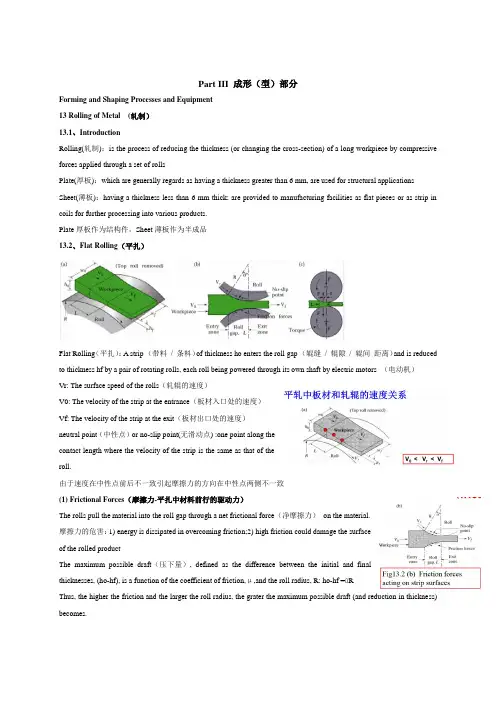
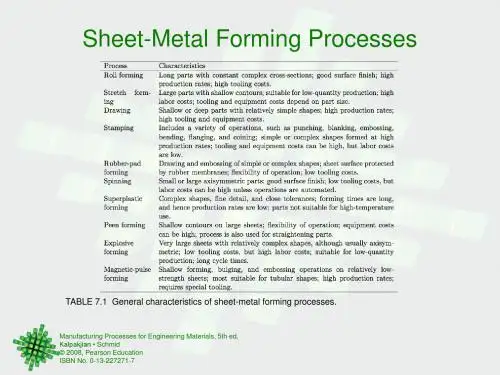
Part III 成形(型)部分Forming and Shaping Processes and Equipment13 Rolling of Metal (轧制)13.1、IntroductionRolling(轧制):is the process of reducing the thickness (or changing the cross-section) of a long workpiece by compressive forces applied through a set of rollsPlate(厚板):which are generally regards as having a thickness greater than 6 mm, are used for structural applications Sheet(薄板):having a thickness less than 6 mm thick; are provided to manufacturing facilities as flat pieces or as strip in coils for further processing into various products.Plate厚板作为结构件,Sheet薄板作为半成品13.2、Flat Rolling(平扎)Flat Rolling(平扎):A strip (带料/ 条料)of thickness ho enters the roll gap (辊缝/ 辊隙/ 辊间距离)and is reduced to thickness hf by a pair of rotating rolls, each roll being powered through its own shaft by electric motors (电动机)Vr: The surface speed of the rolls(轧辊的速度)V0: The velocity of the strip at the entrance(板材入口处的速度)Vf: The velocity of the strip at the exit(板材出口处的速度)neutral point(中性点)or no-slip point(无滑动点) :one point along thecontact length where the velocity of the strip is the same as that of theroll.由于速度在中性点前后不一致引起摩擦力的方向在中性点两侧不一致(1) Frictional Forces(摩擦力-平扎中材料前行的驱动力)The rolls pull the material into the roll gap through a net frictional force(净摩擦力)on the material.摩擦力的危害:1) energy is dissipated in overcoming friction;2) high friction could damage the surfaceof the rolled productThe maximum possible draft(压下量), defined as the difference between the initial and finalthicknesses, (ho-hf), is a function of the coefficient of friction,μ,and the roll radius, R: ho-hf =ūRThus, the higher the friction and the larger the roll radius, the grater the maximum possible draft (and reduction in thickness) becomes.(2) Roll Force(轧制力):F= L W Yavg减少轧制力的措施:1)reducing friction; 2)using smaller-diameter rolls ;3)taking smaller reductions per pass;4)rolling at elevated temperatures(3)Spreading现象:对于有高宽厚比的厚板或者薄板的轧制,材料的宽度在轧制过程中基本保持不变,但对于宽厚比较小的厚板或薄板的轧制,材料的宽度在轧制的过程中增加的现象叫做Spreading现象;从左图中Top view俯视图可以看出轧制后宽度变大13.3、Flat Rolling Practice(平扎工艺)(1)Hot rolling(热轧) and Cold rolling(冷轧):Hot rolling: carried out above the recrystallization temperature(再结晶温度) of the metal.The initial breaking down of an ingot or of a continuously cast slab is done by hot rolling. (为什么要用热轧对铸件进行初始的压碎?)1)reduce grain size in metals; 2)breaking up of brittle grain boundaries and the closing up of internal defects, especially porosity;3)improve strength and ductilityCold rolling: carried out at room temperatureCompared to hot rolling, Cold rolling produces sheet and strip with1) much better surface finish (because of lack of scale); 2) much better dimensional tolerances; 3) much better mechanical properties ( because of strain hardening).(2)Cast structure(铸造结构) and Wrought structure(锻造结构):cast structure:1) typically dendritic (树枝状的);2) includes coarse(粗糙的) and nonuniform(不均匀的)grains;3) usually brittle (易碎的) and porous(多孔的)wrought structure:1) finer grains size(细小的晶粒尺寸);2) enhanced strength and ductility(增强的强度和延展性)(3)The product of the hot rolling(热轧产品):Slab :a slab is usually rectangular in cross-section. slabs are rolled into plates and sheets later.Slab通常是具有长方形截面的厚板或者薄板Bloom:Bloom usually has a square cross-section, at least 150mm on the side. Blooms are processed further, by shaping rolling, into structure shapes, such as I-beams and railroad rails.Bloom通常是具有边长大于150mm的正方形截面的结构件,例如I字梁或者铁轨Billets:billets are usually square, with a cross-section area smaller than blooms; they are later rolled into various shapes, such as round rods and bars by the use of shaped rolls.Billets通常是具有边长小于150mm的正方形截面的圆棒或者方棒(4)Scale(热轧中的氧化皮):Scale is conditioned by various means. Such as:1)use of a torch(火炬)or scaring (火焰表面清理);2) by pickling with acids (acid etching酸洗) ;3) by such mechanical means as blasting with water (水爆);4) grinding(研磨)(5)Packing rolling(叠板轧制):Pack rolling is a flat-rolling operation in which two or more layers of metal are rolled together; this process can improve productivity (记住Packing rolling的目的在于提高生产效率)(6)Defects in Rolled Plates and Sheets(轧制过程中的缺陷):Undesirable(不利)- Degrade surface appearance(降低表面外观); Adversely affect the strength(影响强度)Sheet metal defects include:1) scale(绣皮)rust(氧化皮)scratches(擦伤). gouges(槽)pits(坑)2) Cracks (裂纹)—May be caused by impurities and inclusions4) Alligatoring ( 皱裂,鳄纹)——complex phenomenon图(a)是波浪形边缘;图(b)是中心裂纹;图(c)是拉链式边缘裂纹;图(d)是皱裂13.5、Shape-Rolling OperationsStraight and long structure shapes, such as solid bars,channels, I-beams, and railroad rails, are rolled by passing the stock (原料) through a set of specially designed rolls(特制的轧辊)—型轧与平轧的主要区别在于型轧使用特制的轧辊(1) Ring rolling(圆环轧制):In the ring-rolling process, a thick ring is expanded into a large diameter ring with a reduced cross-section. The ring is placed between two rolls, one of which is driven ,and its thickness is reduced by bringing the rolls closer together as they rotate.Since the volume of the ring remains constant during deformation, the reduction in thickness is compensated (补偿)by an increase in the ring’s diameter.The advantages of this process are 1)short production times, 2)material saving, 3)close dimensional tolerances(精确的尺寸公差)4)favorable(良好的)grain flow(晶粒流线)in the product.(2)Thread-Rolling(螺纹轧制):The thread rolling process is a cold-forming process by which straight or tapered threads are formed on round rods by passing them between dies.The thread-rolling process has advantages such as 1)without any loss of material (scrap) ;2) with a good strength (due to cold working);3)The surface finish is very smooth;4)induces(诱发)compressive residual stresses(残余压应力)on the workpiece surfaces;5)at high rates of production;6) Thread rolling is superior( 更好的)to the other methods of manufacturing threadsFigure 13.16 (a) Features of a machined or rolledthread. (b) Grain flow in machined and rolled threads.Unlike machining, which cuts through the grains ofthe metal, the rolling of threads causes improvedstrength, because of cold working and favorable grainflow.机加工螺纹内部组织被切断,而轧制螺纹由于冷成型加工而保持良好的晶粒流线Review:1. Rolling is the process of reducing the thickness (or changing the cross-section) of a long workpiece by forces applied through a set of rolls. The rolls pull the material into the roll gap through forces on the material.a) compressive b) tensile c) shear d) frictional2. Which one is NOT the characteristic of a cast structure?a) dendritic b) finer grains size c) brittle d) porous3. Which one is the characteristic of a wrough structure?a) dendritic b) finer grains size c) brittle d) porous4.Which one of the following is NOT the product of the hot rolling process?a) billet b) ingot c) slab d) bloom5. Although friction is necessary for rolling materials, energy is dissipated in overcoming friction; thus, increasing friction means increasing forces and power requirements. Furthermore, high friction could damage the surface of the rolled product.A compromise has to be made, one which includes low coefficients of friction by using effective lubrication. ( )6.In the flat rolling products, sheets are generally regarded as having a thickness greater then 6mm. ( )SUMMARY1、Rolling is the process of reducing the thickness or changing the cross-section of a long workpiece by compressive forces applied through a set of rolls.In addition to flat rolling, shape rolling is used to make products with various cross-sections.Products made by rolling include: plate, sheet, foil, rod, seamless pipe(无缝钢管), and tubing; shaped-rolled products,such as I-beams and structural shapes; and bars of various cross-section.Other rolling operation include ring rolling and thread rolling.2、Rolling may be carried out at room temperature (cold rolling) or at elevated temperatures (hot rolling).The process involves several material and process variables, including roll diameter (relative to material thickness),reduction per pass, speed, lubrication, and temperature.3、Continuous casting and rolling of ferrous and of nonferrous metals(黑色和有色金属)into semifinished products have become a common practice because of its economic benefits.Question:1、What is the definition of the rolling?2、How to classify rolling process?3、What is the flat rolling?4、What is the difference between a plate and a sheet?5、Give some examples of the application of the plates and sheets.6、Explain the relationship of the velocity between the strip and rolls.7、Explain the advantages and disadvantages of the friction during the rolling.8、Define (a) roll gap, (b) neutral point, ( c )draft9、Describe the difference between a bloom, a slab , and a billet.10、List the defects commonly observed after flat rolling11、What is the hot rolling and cold rolling?12、What is the difference between cast structure and wrought structure?13、What is the difference between hot rolling and cold rolling??14、What is scale?15、How to remove the scale ?16、What is the shape rolling?17、Make a list of some parts that can be made by shape rolling.18、Describe types of products that can be made by thread rolling19、What is the advantages of the rolling process ?14 Forging of Metal(锻造)14.1 、Introduction(1)Forging is a process in which a workpiece is shaped (formed) by compressive forces applied through various dies(模具) and tools(工具). Most forgings, however, require a set of dies and such equipment as a press (压力机) or a forging hammer(锻锤).Characteristics of forged part: Metal flow and grain structure can be controlled, Forged parts have good strength and toughness. They can be used reliably for stressed and critical(关键的) application.Typical forged products: Bolts(螺栓)、Rivets(铆钉)、Connecting rods(连杆)、Gears(齿轮)、Shaft(轴)、Hand tool(手工具)、Structural components(结构组件)铸造件(Casting)有不可避免的缺陷,如晶粒粗大、结构疏松、具有多孔,其组织和性能均较差切削件(Maching)的内部晶粒大小和结构不改变,且其金属纤维组织被切断了,使得零件强度下降锻造件(Forging)在经受了塑性变形和再结晶,粗大的树枝状结晶组织被破碎,疏松和孔隙被压实、焊合,内部组织和性能都得到了提高(2)Classification of ForgingA、depending on temperature–cold forging(冷锻):at room temperature–hot forging(热锻):above recrystallization temperature–warm forging(温锻):between room temperature and recrystallization temperatureB、depending on tools–Open-Die Forging(自由锻造)–Impression-Die Forging(模锻)–Closed-Die Forging (闭式模锻)–Preicison Forging(精密锻造)(3)Comparison of Cold Forging to Hot ForgingCold forging: 1) requires greater forces, 2) workpiece materials must have sufficient ductility at room temperature.3) Cold-forged parts have good surface finish and dimensional accuracy.Hot forging: 1)Hot forging requires smaller forces, 2)but it produces dimensional accuracy and surface finish that are not as good14.2 、Open-Die Forging(1)Open-die forging is the simplest forging process. It can be depicted(描述)by a solid workpiece placed between two flat dies and reduced in height by compressing it. Open-die forging is also called upsetting(顶锻,镦粗)or flat- die forging(平模锻造)(2)Barrel(鼓形现象产生原因及减小措施):Friction(摩擦的原因):Barreling is caused primarily by frictional force at the die-workpiece interfaces that oppose the outward flow of the materials at these interfaces.措施:Barreling caused by friction can be minimized if an effective lubricant is used.使用润滑剂Temperature difference(温度差的原因):Barreling can also occur in upsetting hot workpiece between cold dies. The material at and near interfaces cools rapidly, while the rest of the workpiece remains relatively hot. Thus, the material at the ends of the workpiece has higher resistance to deformation than the material at its center. the central portion of the workpiece expands laterally to a greater extent than do its ends.措施:Barreling from thermal effects can be reduced or eliminated by using heated dies.加热模具(3)Cogging (开坯或者拔长), also called drawing out, isbasically an open-die forging operation in which the thickness of abar is reduced by successive(连续的)forging steps at specificintervals(时间间隔). Because the contact area per stroke is small, along section of a bar can be reduced in thickness without requiringlarge forces or machinery.14.3 、Impression Die (开模锻)and Closed-Die Forging(闭模锻)(1)In impression-die forging, the workpiece acquires the shape of the die cavities (impressions) while being forged between two shaped dies(Fig. 14.6).Flash(飞边)的作用:Because the thin flash cools rapidly and has higher frictional resistance than die cavity, it subjects the material in the die cavity to high pressures, thereby encouraging the filling of the die cavity.连杆的开模锻过程:1) Preparing blan(备料):(a) cutting or cropping from anextruded or drawn bar stock.(从一根挤出或者拉伸棒料上剪切) (b) a preform in operations such as powder metallurgy.用粉末冶金之类的操作方法预成形) (c) casting.(铸造)(d) a preform blank in aprior forging operation.(用预锻造操作预成形坯料)2)Preforming processes(预成形):Preforming processes, suchas fullering(压槽)and edging(切边,修边)(Fig. 14.7band c), are used to distribute the material into various regionsof the blank.fullering-排料,edging-聚料In fullering, material is distributed away from an area. Inedging, material is gathered into a localized area3) blocking(粗模锻):After preform processes, the part is thenformed into the rough shape of a connecting rod by a processcalled blocking (粗模锻), using blocker dies.4)finishing forging(精模锻)5)trimming operation(剪切)(2)Closed-die forging(闭式模锻):The example shown in Figs. 14.6 and 14.7 are also referred to as closed-die forgings. However, in true closed-die or flashless forging, flash does not form and the workpiece completely fills the die cavity. Accurate control of the volume of material and proper die design are essential in order to obtain a closed –die forging of the desired dimensions and tolerances: Undersize(不足的) blanks prevent the complete filling of the die cavity; conversely, oversize(过多的) blanks generate excessive pressures and may cause dies to fail prematurely or to jam.(3)闭式模锻应用之一精密锻造(Precision Forging )Forging generally require additional finishing operations, such as heat treating(热处理), to modify properties, and then machining(机加工)to obtain accurate finished dimension. These operations can be minimized by precision forging, which is an important example of the trend toward net-shape or near-net shape forming(净成形或近净成形)processes. This trend significantly reduces the number of operations required, and hence the manufacturing cost to make the final product.特点:1) Precision forging produces parts having greater accuracies than those from impression-die forging and requiring much less machining. 2) The process requires higher capacity equipment, because of the greater forces required to obtain fine details on the part. 3) Precision forging requires special and more complex dies, precision control of th e billet’s volume and shape, accurate positioning of the billets in the die cavity, and hence higher investment. .4) Less material is wasted, and much less subsequent machining is required, because the part is closer to the final desired shape应用:1)Because of the relatively low forging loads and temperatures that they require, aluminum and magnesium alloys are particularly suitable for precision forging; 2) Typical precision-forged products are gears , connecting rods, housings, and turbine blades.3) The choice between conventional forging and precision forging requires an economic analysis, particularly in regard to the production volume.(4)闭式模锻工艺应用之二—压印(Coining)Coining essentially is a closed-die forging process typically used in minting coins,medallions and jewelry. The pressures required can be as high as five or six times the strength of the material. Lubricants cannot be applied in coining.14.4、Related Forging OperationsHeading(镦头) is essentially an upsetting operation, usually performed at the end of round rod or wire in order to produce a larger cross-section. The typical parts are the Bolts(螺钉), screws(螺杆), rivets(铆钉), nails(钉子), and other fasteners (紧固件).Piercing(冲孔) is a process of indenting (压窝)the surface of a workpiece with a punch (but not breaking through) in order to produce a cavity or an impression14.7 、Die Materials and Lubrication(锻造材料要求和润滑剂的作用)(1)General requirements for die materials therefore are: 1) strength and toughness at elevated temperature;2) hardenability(淬硬性)and ability to harden uniformly; 3) resistance to abrasive wear, because of the presence of scale in hot forging.(2)Lubricants 1)greatly influence friction and wear, they affect the forces required and the flow of the metal in die cavities;2)They can act as a thermal barrier between the hot workpiece and the relatively cool dies, slowing the rate of cooling of the workpiece and improving metal flow. 3) Lubricants serve as a parting agent (脱模剂)which inhibits(抑制)the forging form sticking to the dies and helps in its release from the die.14.8 、ForgeabilityForgeability is generally defined as the capability of a material to undergo deformation without cracking.锻造性通常被定义为一种材料经受变形而不开裂的能力Review1 Forging is a process in which the workpiece is shaped by forces applied through various dies and tools. In the impression-die forging, some of the material flows outward and forms a _____, which has a significant role in the flow of material in impression-die forging.2. and are used to distribute the material into various regions of the forging workpiece.3、Pack rolling is a flat-rolling operation in which two or more layers of metal are rolled together; this process improves .3、flat rolling, or simply rolling, where the rolled products are flat and .4、Which process is was first used to make jewelry, coins, and various implements by hammering metal with tools made of stone before 4000B.C.A. StampingB. RollingC. ForgingD. Extrusion5. Which operation in the following options is not forging processes?A. pancakingB. PiercingC. punchD. Heading1.The die surfaces in open-die forging always is flat. [ ].2.In plastic forming process, the volume of workpiece maintains constant. [ ]3.Barreling is caused primarily by frictional force at the die- workpiece interfaces that oppose the outward flow of the materials at these interfaces. [ ]4.The flash is excess metal that is subsequently trimmed off, so it is necessary to avoid flash in forging process. [ ] 5.In impression-die forging, the workpiece acquires the shape of the die cavities, while being forged between two shaped dies. ()SUMMARY1)Forging is carried out by compressive forces applied through a set of dies.2)Forging is capable of producing a wide variety of structural parts with favorable characteristics such as strength, toughness, dimensional accuracy, and reliability in service.3)The forging process can be carried out at room, warm, or high temperatures (above the recrystallization temperature).4)Workpiece material behavior during deformation, friction, heat transfer, and material-flow characteristics in the die cavity are important considerations.Question1、What is forging process ?2、What is the difference between rolling and forging ??3、What do the typical forged products include?4、What are the advantages of the forging parts ??5、What is the difference between cast parts, cutting parts and forging parts ?6、How to decide the production method of a component ?7、How to distinguish cold forging and hot forging ?8、What is the difference between cold forging and hot forging?9、What is the open-die forging ?Review and Question10、What is the difference between ideal forging and actual forging ?11、How is the barreling caused in forging ?12、How to minimize the barreling?13、What is the cogging operation ?14、What is the difference between open-die forging and impression-die forging ?15、What is the flash ? 16、How to form the flash ? 17、What is the significance of the flash? 18、What does the complete forging process include?19、How is the blank to be forged prepared ?20、How is the blank to be forged prepared ?21、What is the result of Preforming processes ?22、What is the difference between fullering and edging?23、What do the conditions include which are essential in order to obtain a closed-die forging of the desired dimensions and tolerances ?24、What is the net-shape forging or near-net shape ?25、Why is the trend in forging toward greater precision forging ?26、Describe the Characteristic of the Precision Forging.27、What is Heading operation ?28、What is the typical products of heading operation ?29、Describe the Characteristic of Heading 30、What is piercing ? 31、What are general requirements for die materials ? 32、How to select the proper die materials ? 33、What is the significance of lubrication to the forging process ? 34、How to Apply lubricants in forging ? 35、What is the forgeability ? 36、How to quantify forgeability of materials ? 37、What do the Forging defects include ? 38、What is the difference between piercing and punching ? 39、Explain the difference between fullering, edging, and blocking ?15 Extrusion and Drawing Metals (挤压和拉拔)15.1 、IntroductionExtrusion is a process where a billet(generally round) is forced through a die, in a manner similar to squeezing toothpaste from a tube.Extrusion is a semicontinuous(半连续)process.Parts have constant cross-section.类型一:型材类Typical products made by extrusion are railings for sliding doors, tubing having various cross-section, structural and architectural shapes, and door and window frames.类型二:重要零部件Extrusion is often combined with forging operations, in which case it is generally known as cold extrusion (冷挤压). It has numerous important applications, including fasteners and components for automobiles, bicycles, motorcycles, heavy machinery, and transportation equipment.15.2 、The Extrusion Process(1)Direct Extrusio(直接挤压,正挤压)Direct also is called forward extrusion,a round billet is placed in a chamber(container) (容器/料筒)and forcedthrough a die opening by ahydraulically-driven(液压驱动)ram(冲击) or pressing stem(压力阀杆).The direction the metal flows issame with that the pressing stem moves toward.(棒料金属流动方向和压力阀杆运动方向一致)(2)Indirect Extrusion(间接挤压,反挤压)In indirect extrusion (reverse, inverted,or backward extrusion), the die movestoward the billet. Unlike in directextrusion, there is no friction toovercome along the container walls.(反挤压的摩擦力小)The direction the metal flow is oppositeto that the pressing stem moves toward.(棒料金属流动方向和压力阀杆运动方向相反)(3)Hydrostatic Extrusion(静水压挤压)In hydrostatic extrusion the billet is smallerin diameter than the chamber, which isfilled with a fluid, and the pressure istransmitted to the billet by a ram. Unlike indirect extrusion, there is no friction toovercome along the container walls.(静水压挤压无摩擦力,可提高材料的塑形)特点:The pressure required for extrusion is supplied through and incompressible fluid medium surrounding the billetUsually carried at room temperature, typically using vegetable oils as the fluidBrittle materials are extruded generally by this methodIt increases ductility of the materialIt has complex nature of the tooling(4) lateral Extrusion(侧向挤压/轴向挤压)Another type of extrusion is lateral, or side extrusion.15.3、Important parameters of extrusion process(挤压工艺中的重要工艺参数)1) The die angle, α(模具角)2) Extrusion Ratio(挤压比):the ratio of thecross-sectional area of the billet to the cross-sectional areaof extruded product. Ao/Af3) extrusion speed(挤压速度)4) billet temperature(棒料温度)5) lubrication(润滑剂的使用)(6) CCD-Circumscribing-circle diameter (外接圆直径),abbreviated CCD, is a parameter describing the shape ofthe extruded product. It is the diameter of the smallestcircle into which the extruded cross-section will fit .Thusthe CCD for a square cross-section is its diagonal(对角线)dimension(7)Shape Factor (形状因子):The shape factor is used to describe the complexity of an extrusion.The complexity of an extrusion is a function of the ratio of the perimeter(周长)of the extruded product to its cross-sectional area, known as the shape factor. Obviously, a solid round extrusion has the smallest shape factor.(周长与截面积之比,圆形的形状因子最简单)(8)Extrusion Force(挤压力):F = AokIn(Ao/Af) (k-extrusion constant ,Ao, Af billet and extruded product areas)(9)摩擦力对挤压变形的影响:(a)Flow pattern obtained at low friction,or in indirect extrusion;(b)Flow Pattern obtained at high friction at the billet-chamber interfaces; (c)Flow Pattern obtained at high friction, or with cooling of the outer regions of the billet in the chamber15.3 、Hot ExtrusionExtrusion is carried out at elevated temperatures-for metals and alloys that do not have sufficient ductility at room temperature, or in order to reduce the forces required.热挤压中的常见问题及对策:Question 1: die wear can be excessive,and cooling of the hot billet in the chamber can be a problem which results in highly nonuniform deformation(模具磨损厉害)Method1:Using extrusion dies preheated to reduce cooling of the billet and to prolong die life, as is done in hot forging operations.Question 2: The billet may develop an oxide film (氧化膜unless heated in an inert-atmosphere(惰性气氛).(产生氧化皮)Method2: Using the dummy block(挤压垫)made a little smaller in diameter than the container and placed ahead of the ram to avoid the formation of oxide films on the hot extruded product.15.4 、Cold ExtrusionCombination of operations, such as direct and indirect extrusion and forging.Advantages:Improved mechanical properties;Good control of dimensional tolerances ;Improved surface finish ;Elimination of the need for billet heating;15.5 、The Drawing Process(拉拔)In this process the cross section of a round rod or wire is typically reduced or changed by pulling it through a die15.6 、Drawing PracticeBundle drawing-捆绑拉拔-目的提高生产效率Review1. Compared to casting and machining, forging can produce parts with .a. low costb. good surface finishc. tight dimensional tolerancesd. good strength and toughness2. Which one of the following does NOT describe the characteristic of upsetting?a. Lubrication is important for high quality.b. The billet is reduced in height by compressive forces applied through two flat dies.c. The workpiece is deformed uniformly in actual operations.d. The forged part may develop a barrel shape.3. In _____________ extrusion, the die moves toward the billet, and the direction of metal flowing is opposite to that of the pressing stem moving.a. directb. indirectc. hydrostaticd. lateralSUMMARYExtrusion is the process of forcing a billet through a die, to reduce its cross-section or to produce a wide range of solid or hollow cross- sections.The process is generally carried out at elevated temperatures, to reduce forces and to improve the ductility of the material. Important factors in extrusion are die design, extrusion ratio, billet temperature, lubrication, and extrusion speed.Although the term cold extrusion applies to extrusion at room temperature, it is also the name for a process which is combination of extrusion and forging operations.Cold extrusion is capable of economically producing discrete parts in various shapes, with good mechanical properties and dimensional tolerances.Rod, wire, and tube drawing basically involve the process of pulling the material through a die (or a set of dies in tandem). Although the cross-section of most drawn products are round, other shapes can also be drawn.Drawing tubular products, to reduce either their diameter or their thickness, usually requires internal mandrels.The die design, the reduction in cross-sectional area per pass, and the selection of die materials and lubricants are all important parameters in obtaining drawn products of high quality and of good surface finish.Both external defects and internal defects (chevron cracking) can develop both in extrusion and in drawing; their minimization depends principally on the die angle, the reduction per pass, and the quality of the workpiece material.16 Sheet-Metal Forming Processes (板材成形/ 冲压)板料成形(sheet metal forming)是利用安装在压力机上的冲模对金属板材施加压力,使金属产生分离或者塑性变形从而获得所需要的零件的一种加工法.因为它们一般是在常温下进行的,所以称之为冷冲压(cold stamping)16.1. Introduction板材成形的特点:Compared to those made by casting and by forging, sheet-metal parts offer the many advantages. 1)High production efficiency;2)Saving rough material;3)Easy to implement mechanization and automatization;4)Low cost in mass production;5)light weight;6)versatile shape板料成形的分类:Shearing deformation(剪切变形) and Plasticdeformation(成形工艺)16.2. Shearing(1)The sheet is cut by subjecting sheet metal to shear stresses,typically ones developed between a punch(凸模) and a die(凹模) . Shearing usually starts with the formation of cracks onboth the top and bottom edges of the workpiece (A ,B, C andD in Fig. 16.2a). These cracks eventually meet each other andseparation occurs.(2)剪切边的特征:1)In fact , the sheared edges are not smooth, and they are notperpendicular to the plane of the sheet.。