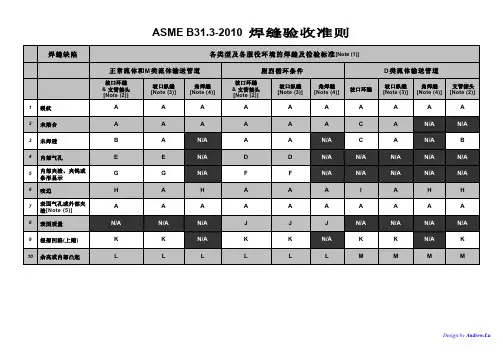
Pb-free Visual Acceptance Criteria
- 格式:pdf
- 大小:1.19 MB
- 文档页数:23

tion as constituted for administration are not included in the individual monographs on sterile dry solids or liquid concentrates. However, in the interest of assuring the quality of injection preparations as they are actually administered, the following non-destructive tests are provided for demonstrating the suitability of constituted solutions when they are prepared just prior to use.Completeness and Clarity of Solution—Constitute the solution as directed in the labeling supplied by the manufacturer for the sterile dry dosage form.A:The solid dissolves completely, leaving no visible residue as undissolved matter.B:The constituted solution is not significantly less clear than an equal volume of the diluent or of Purified Water contained in a similar vessel and examined similarly.Particulate Matter—Constitute the solution as directed in the labeling supplied by the manufacturer for the sterile dry dos-age form: the solution is essentially free from particles of foreign matter that can be observed on visual inspection.á1ñ INJECTIONS AND IMPLANTED DRUG PRODUCTS(PARENTERALS)—PRODUCT QUALITY TESTS(Chapter to become official May 1, 2016)(Current chapter name is á1ñ Injections)INTRODUCTIONParenteral drug products include both injections and implanted drug products that are injected through the skin or other external boundary tissue, or implanted within the body to allow the direct administration of the active drug substance(s) into blood vessels, organs, tissues, or lesions. Injections may exist as either immediate- or extended-release dosage forms. Implan-ted parenteral drug products are long-acting dosage forms that provide continuous release of the active drug substance(s) of-ten for periods of months to years. For systemic delivery, they may be placed subcutaneously; for local delivery, they may be placed in a specific region of the body. Routes of administration for parenteral drug products include intravenous, intraventric-ular, intra-arterial, intra-articular, subcutaneous, intramuscular, intrathecal, intracisternal, and intraocular.Parenteral dosage forms include solutions, suspensions, emulsions, sterile powders for solutions and suspensions (including liposomes), implants (including microparticles), and products that consist of both a drug and a device such as drug-eluting stents. The reader is directed to Pharmaceutical Dosage Forms á1151ñ1 and to the later sections of this chapter for additional descriptions of dosage forms that fall into the general category of parenteral drug products. Nomenclature á1121ñ1 provides information on nomenclature used to establish USP names and monograph titles for parenteral drug products.Chapter á1ñ provides a framework to support the revision and the development of individual monographs, and is not meant to replace individual monographs. Chapter á1ñ provides lists of common product quality test requirements in a concise and a coherent fashion. The chapter is divided into four main sections: (1) universal product quality tests that are applicable to pa-rental dosage forms; (2) specific product quality tests, which are tests that should be considered in addition to Universal Tests;(3) product quality tests for specific dosage forms, which lists all the applicable tests (Universal and Specific) for the specific dosage form; and (4) product performance tests.If a monograph exists, it will reference á1ñ or indicated chapter parts. If a specific drug product monograph is missing (not in existence), the general chapters provide the quality tests that can be used by manufacturers until the dosage form monograph is developed by USP.The Pharmacopeial definitions for sterile preparations for parenteral use may not apply to some biologics because of their special nature and licensing requirements (see Biologics á1041ñ1). However, some biological finished drug products containing “Injection” in the monograph title must meet the requirements of á1ñ or indicated chapter subparts, where it is specified in the monograph.Drug Product Quality and Drug Product Performance TestsProcedures and acceptance criteria for testing parenteral drug products are divided into two categories: (1) those that assess product quality attributes, e.g., identification, sterility, and particulate matter, and are contained in this chapter and (2) those that assess product performance, e.g., in vitro release of the drug substance from the drug product. Whereas quality tests as-sess the integrity of the dosage form, the performance tests assess performance (bioavailability) after the product has been administered to the patient. A product performance test, i.e., drug release test for suspensions, emulsions, powder for suspen-sion (including microparticles and liposomes), and drug-eluting stents, should be carried out using appropriate test proce-dures.1All listed chapters above á1000ñare for information purposes only; they may be helpful but are not mandatory.Change to read:PRODUCT QUALITY TESTS COMMON TO PARENTERAL DOSAGE FORMSUniversal TestsUniversal tests are listed below and are applicable to parenteral dosage forms.Description: A qualitative description of the dosage form should be provided. The acceptance criteria should include the fi-nal acceptable appearance. If color changes during storage, a quantitative or a semiquantitative procedure may be appropri-ate. This section specifies the content or the label claim of the article (see Labeling á7ñ). Additional information about common-ly used terms and definitions can be found in Nomenclature á1121ñ1.Identification:Identification tests are discussed in General Notices and Requirements 5.40. Identification tests should establish the identity of the drug or drugs present in the article and should discriminate between compounds of closely related structure that are likely to be present. The most conclusive test for identity is the IR absorption spectrum (see Atomic Absorption Spec-troscopy á852ñ, Fluorescence Spectroscopy á853ñ, Mind-Infrared Spectroscopy á854ñ, Near-Infrared Spectroscopy á856ñ, Ultraviolet-Visible Spectroscopy á857ñ,(CN 1-May-2016) and Spectrophotometric Identification Tests á197ñ). If no suitable IR spectrum can be ob-tained, other analytical methods can be used. Near-infrared or Raman spectrophotometric methods also could be acceptable for the sole identification of the drug product formulation (see Near-Infrared Spectrophotometry á1119ñ1 and Raman Spectrosco-py á1120ñ1). Identification solely by a single chromatographic retention time is not regarded as specific. However, the use of two chromatographic procedures in which the separation is based either on different principles or a combination of tests in asingle procedure can be acceptable (see Chromatography á621ñ and Thin-Layer Chromatographic Identification Test á201ñ). Addi-tional information regarding identification tests can be found in Identification Tests—General á191ñ and Mass Spectrometryá736ñ.Assay: A specific and stability-indicating test should be used to determine the strength (content) of the drug product. In ca-ses where the use of a nonspecific assay is justified, other supporting analytical procedures should be used to achieve overallspecificity. A specific procedure should be used when there is evidence of excipient interference with the nonspecific assay.Impurities:Tests for Impurities are discussed in General Notices and Requirements 5.60. All articles should be tested to ensure that they meet the requirements.Foreign and particulate matter:Articles intended for parenteral administration should be prepared in a manner designed to exclude particulate matter as defined in Subvisible Particulate Matter in Therapeutic Protein Injections á787ñ, Particulate Matter in Injections á788ñ, and Particulate Matter in Ophthalmic Solutions á789ñ, as well as excluding other foreign matter as appropriate for the dosage form. Each final container of all parenteral preparations should be inspected to the extent possible for the pres-ence of observable foreign and particulate matter (hereafter termed visible particulates) in its contents. The inspection process should be designed and qualified to ensure that every lot of all parenteral preparations is essentially free from visible particu-lates, as defined in Visible Particulates in Injections á790ñ. Qualification of the inspection process should be performed with refer-ence to particulates in the visible range and those particulates that might emanate from the manufacturing or filling process.Every container in which the contents show evidence of visible particulates must be rejected. The inspection for visible particu-lates may take place during examination for other critical defects such as cracked or defective containers or seals or when char-acterizing the appearance of a lyophilized product.When the nature of the contents or the container–closure system permits only limited inspection of the total contents, the 100% inspection of a lot should be supplemented with the inspection of constituted (e.g., dried) or withdrawn (e.g., from a dark amber container) contents of a sample of containers from the lot.Large-volume injections for single-dose infusion, small-volume injections, and pharmacy bulk packages (PBP) are subject to the light obscuration or microscopic procedures and limits for subvisible particulate matter set forth in á788ñ, unless otherwise specified in the chapter or in the individual monograph. An article packaged as both a large-volume and a small-volume injec-tion meets the requirements set forth for small-volume injections where the container is labeled as containing 100 mL or less.It meets the requirements set forth for large-volume injections for single-dose infusion where the container is labeled as con-taining more than 100 mL.Sterility:The sterility of all drug products intended for parenteral administration should be confirmed by the use of methods described in Sterility Tests á71ñ or by an approved alternative method.Bacterial endotoxins:All articles intended for parenteral administration should be prepared in a manner designed to limit bacterial endotoxins as defined in Bacterial Endotoxins Test á85ñ or Pyrogen Test á151ñ.Container content:Container contents should be determined when appropriate (see the proposed general test chapterContainer Content for Injections á697ñ).Leachables and extractables:The packaging system should not interact physically or chemically with the preparation to al-ter its strength, quality, or purity beyond the official or established requirements. The packaging system should meet the re-quirements in Elastomeric Closures for Injections á381ñ, Packaging and Storage Requirements á659ñ, Containers—Glass á660ñ,Plastic Packaging Systems and their Materials of Construction á661ñ(CN 1-May-2016), Plastic Materials of Construction á661.1ñ, andPlastic Packaging Systems for Pharmaceutical Use á661.2ñ. Further information regarding packaging systems testing may be found in Assessment of Extractables Associated with Pharmaceutical Packaging/Delivery Systems á1663ñ and Assessment of Drug Product Leachables Associated with Pharmaceutical Packaging/Delivery Systems á1664ñ.Container closure integrity:The packaging system should be closed or sealed in such a manner as to prevent contamina-tion or loss of contents. Validation of container integrity must demonstrate no penetration of microbial contamination or gain or loss of any chemical or physical parameter deemed necessary to protect the product (see Sterile Product Packaging—Integrity Evaluation á1207ñ).Labeling:All articles intended for parenteral administration should meet the labeling requirements defined in Labeling á7ñ).Specific TestsIn addition to the universal tests listed above, the following specific tests may be considered on a case-by-case basis and, when appropriate, are referenced in the USP–NF monograph.Physicochemical properties:These include such properties as Osmolality and Osmolarity á785ñ, pH á791ñ, Specific Gravityá841ñ, and Viscosity—Capillary Methods á911ñ.Uniformity of dosage units:This test is applicable for parenteral drug products and dosage forms packaged in single-unit containers. It includes both the mass of the dosage form and the content of the active substance in the dosage form (see Uniformity of Dosage Units á905ñ).Vehicles and added substances:There are other vehicles, both aqueous and nonaqueous, beyond those that are discussed below. All vehicles should be suitable for their intended use and not impact drug product quality.Aqueous vehicles—Aqueous vehicles must meet the requirements of Pyrogen Test á151ñ or Bacterial Endotoxins Test á85ñ, which-ever is specified in the monograph. Water for Injection is generally used as the vehicle. Sodium chloride or dextrose may be added to render the resulting solution isotonic, and Sodium Chloride Injection or Ringer's Injection may be used in whole or in part instead of Water for Injection.Nonaqueous vehicles—Fixed oils are classified under Nonaqueous vehicles. Fixed oils used as vehicles are of vegetable origin and are odorless. They meet the requirements in the test for Solid Paraffin in the Mineral Oil monograph with the cooling bath maintained at 10°.Also meet the requirements of the following tests:•Saponification Value (see Fats and Fixed Oils á401ñ): Between 185 and 200•Iodine Value (see á401ñ): Between 79 and 141•Unsaponifiable Matter (see á401ñ): NMT 1.5%•Acid Value (see á401ñ): NMT 0.2•Peroxide Value (see á401ñ): NMT 5.0•Water, Method Ic (from Water Determination á921ñ): NMT 0.1%•Limit of Copper, Iron, Lead, and Nickel: [N OTE—The test for nickel is not required if the oil has not been subjected to hydro-genation, or a nickel catalyst has not been used in processing.] Proceed as directed in Fats and Fixed Oils á401ñ, Trace Met-als or Elemental Impurities—Procedures á233ñ. Meet the requirements in Elemental Impurities—Limits á232ñ.Synthetic mono- or diglycerides of fatty acids may be used provided they are liquid and remain clear when cooled to 10° and have a Iodine Value of NMT 140.Added substances—Suitable substances may be added to preparations in order to increase stability or usefulness unless they are proscribed in the monograph. No coloring agent may be added to a preparation solely for the purpose of coloring the finished preparation (see General Notices and Requirements 5.20 and Antimicrobial Effectiveness Testing á51ñ).Observe special care in the choice and use of added substances in preparations with volumes that exceed 5 mL. The follow-ing limits prevail unless otherwise directed:•Mercury and cationic surface-active agents: NMT 0.01%•Chlorobutanol, cresol, phenol, and similar substances: NMT 0.5%•Sulfur dioxide or an equivalent amount of sulfite, bisulfite, or metabisulfite of potassium or sodium: NMT 0.2% Antimicrobial preservative:Antimicrobial agents must be added to preparations intended for injection that are packaged in multiple-dose containers unless one of the following conditions prevails: (1) there are different directions in the individual monograph; (2) the substance contains a radionuclide with a physical half-life of less than 24 h; or (3) the active ingredients are themselves antimicrobial. Substances must meet the requirements of Antimicrobial Effectiveness Testing á51ñ and Antimicrobi-al Agents—Content á341ñ.Water content:The water content of freeze-dried (lyophilized) products should be determined when appropriate (see Water Determination á921ñ).Biological reactivity:Implantable and combination drug products (drug/device) that contain a polymeric material should meet the requirements of Biological Reactivity Tests, In Vivo á88ñ.Globule size distribution:Emulsions should meet the requirements of Globule Size Distribution in Lipid Injectable Emulsionsá729ñ.Aluminum content:Large-volume parenterals used to make total parenteral nutrition therapy (TPN) are limited to 25 m g/L. Small-volume parenterals and pharmacy bulk packages used to make TPN must state on the immediate container label the maximum level of aluminum at expiry if the maximum level exceeds 25 m g/L.Completeness and clarity of solutions:The following tests are performed to demonstrate suitability of constituted solutions prepared before administration. Constitute the solution as directed in the labeling supplied by the manufacturer:•The solid dissolves completely, leaving no undissolved matter.•The constituted solution is not significantly less clear than an equal volume of the diluent or of Purified Water contained in a similar vessel and examined similarly. Protein solutions may exhibit an inherent opalescence.The constituted solution is free from particulate matter that can be observed on visual inspection (see Visible Particulates in Injections á790ñ).PRODUCT QUALITY TESTS FOR SPECIFIC PARENTERAL DOSAGE FORMSProduct quality tests for the specific dosage forms are listed below. Specific chapter(s) referenced for the test can be found in the Universal Tests and Specific Tests sections. When there is no compendial test available, a validated procedure with accept-ance criteria should be used.SolutionsA solution is a clear, homogeneous liquid dosage form that contains one or more chemical substances (e.g., drug substances or excipients) dissolved in a solvent (aqueous or nonaqueous) or a mixture of mutually miscible solvents. Solutions intended for parenteral administration (e.g., by injection or for irrigation) must be sterile and biocompatible with the intended adminis-tration site. This includes consideration of factors such as tonicity, pH, pyrogenicity, extraneous particulate matter, and physi-cochemical compatibility, among others.Unless otherwise justified, the following tests are required for solutions for injection:•Universal Tests•Specific Tests—Physicochemical Properties: Specific Gravity, Viscosity, pH, Osmolarity and Osmolality—Antimicrobial Preservatives Sterile Powders for SolutionSterile powders for solutions (also referred to as sterile powders for injection) consist of drug substances and other compo-nents as dry-formulation ingredients to ensure the chemical and physical stability of the presentation within a final-use con-tainer. Companion sterile diluent or diluent compartments may be provided to facilitate constitution to the desired final vol-ume.The sterile article for injection may be presented in several forms: lyophilized powder intended for final solution, powdered solids intended for final solution, or dry solids that form viscous liquids upon constitution.The description should include a section that deals with ease of dispersion and reconstitution. The dosage form is a homoge-neous solid that is readily constituted to the final form with the specified diluent, and dispersion is completed with gentle agi-tation.Unless otherwise justified, the following tests apply to sterile powders for injection:•Universal Tests•Specific Tests—Physicochemical Properties: Specific Gravity, Viscosity, pH, Osmolarity and OsmolalityThe following applies to constituted solutions:•Uniformity of Dosage Units á905ñ: To ensure the consistency of dosage units, each unit in a batch should have a drug sub-stance content within a narrow range around the label claim. Dosage units are defined as dosage forms that contain a single dose or a part of a dose of drug substance in each unit. For liquid dosage forms analysts should conduct the assay on an amount of well-mixed constituted material that is removed from an individual container under conditions of normal use, should express the results as delivered dose, and should calculate the acceptance value.•Loss on Drying á731ñ: The procedure set forth in this chapter determines the amount of volatile matter of any kind that is driven off under the conditions specified.•Water Determination á921ñ: Water or solvent content may have important effects on reconstitution and stability. For arti-cles that require water or solvent content control, analysts should perform one of the following methods or a suitable re-placement.•Appearance : Analysts should assess the level of and the unit variation for the following parameters:—Color of Cake: Varies within target parameters—Texture and Homogeneity of Cake: Varies within target parameters—Presence of Foreign Material: All units with visible foreign material must be rejected—Particle Size and Distribution (Dry Powder): Evaluation of the powder solids for proper solid form and crystallinity is a measure of process control and consistency.•Particle Size Distribution Estimation by Analytical Sieving á786ñ: This chapter can be used for loose powders.Crystallinity:The crystallinity of a material can be characterized to determine compliance with the crystallinity requirementwhere stated in the individual monograph of a drug substance.•Optical Microscopy á776ñ: Crystallinity can be characterized by polarized light microscopy for qualitative evaluation of the size, shape, and crystallinity of solids. Unless otherwise specified in the individual monograph, analysts should mount a solid specimen in mineral oil on a clean glass slide or cover slip and should examine the mixture using a polarizing micro-scope: The particles show birefringence (interference colors) and extinction positions when the microscope stage is re-volved.Vehicles and diluents:Guidelines for constitution and suspension of dry powders are found in the specific monographs. If there is a specific packaged diluent for use with a particular product that is not included in a monograph, then the final article is prepared with that diluent.SuspensionsParenteral suspensions are liquid dosage forms that contain solid particles in a state of uniform dispersion. Suspensions for parenteral administration must be sterile and compatible with the administration site. Consideration should be given to pH and pyrogenicity, and appropriate limits should be identified. Physical stability evaluations of parenteral suspension prepara-tions should include evaluations to confirm that the particle size range of suspended matter does not change with time and to confirm that the solids in the preparation can be readily resuspended to yield a uniform preparation.In addition to the tests for injectable solutions, the following tests are required for suspensions for injection unless otherwise justified:•Universal Tests•Specific Tests—Physicochemical Properties: pH—Uniformity of Dosage Units—Antimicrobial PreservativesLiposomesLiposomes are unique drug products with unique properties that can be either solutions or suspensions. Liposomes are aqueous dispersions of amphiphilic lipids and have low water solubility. They are organized as a bilayer sheet that encloses an internal aqueous compartment and are known as lipid bilayer vesicles. Liposomes can have a single lipid bilayer (unilamellar vesicle) or can have an onion-like multilayered structure (multilamellar vesicle). The amphiphilic lipids comprise a hydrated head group at the water interface of the bilayer attached to a hydrophobic group that forms the interior of the bilayer by asso-ciation with the hydrophobic group of lipids from the opposite leaflet of the bilayer. The physical properties of the liposome and its bilayer can vary widely and depend on lipid composition, aqueous composition, and temperature relative to the acyl components' phase transition points. Because of the central aqueous compartment, a simple test for the presence of liposomes in a lipid dispersion is to determine the presence of an entrapped aqueous phase.A liposome drug product consists of the drug substance, liposome components, and other inactive but critical ingredients such as an aqueous dispersion unless the contents are a lyophilized product.Unless otherwise justified, the following tests are required for liposomes:•Universal Tests•Specific Tests—Physicochemical Properties: pH—Lipid and Fatty Acid Composition, including degree of unsaturation and positional specificity in acyl side chains and critical degradation products such as lysolipids2—Particle Size2—Particle Size Distribution of Liposomal Vesicles2—Lamellarity2—Phospholipid Composition2—Percent Free vs. Percent Encapsulated Lipids2—Free Drug vs. Encapsulated Drug—Ionic Strength and Osmotic Strength2Sterile Powders for SuspensionSterile powders for suspensions consist of drug substances and other components as dry-formulation ingredients to ensure the chemical and physical stability of the presentation within a final-use container. Companion sterile diluent or diluent com-partments may be provided to facilitate constitution to the desired final volume.The sterile article for injection may be presented in several forms: lyophilized powder intended for final suspension, pow-dered solids intended for final suspension, and microparticles that retain their integrity and are delivered as a sterile suspen-sion. The description should include a section that deals with ease of dispersion and reconstitution. The dosage form is a ho-2No compendial test available; a validated procedure with acceptance criteria should be used.mogeneous solid that is readily constituted to the final form with the specified diluent, and dispersion is completed with gentle agitation.Unless otherwise justified, the following tests apply to sterile powders for injection:•Universal Tests•Specific Tests•Bacterial Endotoxins—Physicochemical Properties: pH, Osmolarity and OsmolalityThe following applies to constituted suspensions:•Uniformity of Dosage Units á905ñ: To ensure the consistency of dosage units, each unit in a batch should have a drug sub-stance content within a narrow range around the label claim. Dosage units are defined as dosage forms that contain a single dose or a part of a dose of drug substance in each unit. For liquid dosage forms, analysts should conduct the assay on an amount of well-mixed constituted material that is removed from an individual container under conditions of normal use, should express the results as delivered dose, and should calculate the acceptance value.•Loss on Drying á731ñ: The procedure set forth in this chapter determines the amount of volatile matter of any kind that is driven off under the conditions specified.•Water Determination á921ñ: Water or solvent content may have important effects on reconstitution and stability. For arti-cles that require water or solvent content control, analysts should perform one of the following methods or a suitable re-placement.•Appearance : Analysts should assess the level of and the unit variation for the following parameters:—Color of Cake: Varies within target parameters—Texture and Homogeneity of Cake: Varies within target parameters—Presence of Foreign Material: All units with visible foreign material must be rejected—Particle Size and Distribution (Dry Powder): Evaluation of the powder solids for proper solid form and crystallinity is ameasure of process control and consistency.•Particle Size Distribution Estimation by Analytical Sieving á786ñ: This chapter can be used for loose powders.Crystallinity:The crystallinity of a material can be characterized to determine compliance with the crystallinity requirement where stated in the individual monograph of a drug substance.•Optical Microscopy á776ñ: Crystallinity can be characterized by polarized light microscopy for qualitative evaluation of thesize, shape, and crystallinity of solids. Unless otherwise specified in the individual monograph, analysts should mount a solid specimen in mineral oil on a clean glass slide or cover slip and should examine the mixture using a polarizing micro-scope: The particles show birefringence (interference colors) and extinction positions when the microscope stage is re-volved.Vehicles and diluents:Guidelines for constitution and suspension of dry powders are found in the specific monographs. If there is a specific packaged diluent for use with a particular product that is not included in a monograph, then the final article is prepared with that diluent.Microparticles:Some microparticles are provided as a sterile powder to be reconstituted as a suspension before injection.Major microparticle preparations are for reconstitution as a suspension for injection. For quality test requirements, please refer to Implants .EmulsionsEmulsions for parenteral dosage forms are liquid preparations of drug substances dissolved or dispersed in a suitable emul-sion medium. Oil-in-water or water-in-oil emulsions typically entrap the drug substance.Emulsions typically are white, turbid, homogeneous liquid dosage forms that contain one or more chemical substances (e.g.,drug substances and excipients) dissolved in a solvent (aqueous or nonaqueous) or mixture of mutually miscible solvents.Emulsions intended for intravenous administration must be sterile and must be compatible with the intended administration site.Unless otherwise justified, the following tests are required for emulsions for injection:•Universal Tests•Specific Tests—Physicochemical Properties: pH, Osmolarity and Osmolality—Globule Size Distribution—Amount of Fat Globules (lipids)2—Percent Free vs. Percent Encapsulated Lipids 2—Free Drug vs. Encapsulated DrugImplantsImplants for extended release consist of a matrix of drug substance and polymeric excipient that may or may not have an outer rate-controlling membrane. The polymeric excipient must be biocompatible but may or may not be bioresorbable.Some implants are made from medical-grade metal with an osmotic pump inside that effects the extended release of the drug。

AEC-Q200 REV DJune 1, 2010STRESS TEST QUALIFICATIONFORPASSIVE COMPONENTSAutomotive Electronics CouncilComponent Technical CommitteeComponent Technical CommitteeAcknowledgementAny Document involving a complex technology brings together experience and skills from many sources. The Automotive Electronics Council would especially like to thank the technical committee members that provided input for this document and recognize the following co-authors:Sustaining MembersRobert Hulka, Jr. Delphi (765)451-8079 robert.s.hulka.jr@Bob Knoell Visteon (734)710-7687 rknoell@Ken Kirby Jr. Visteon (734)710-7689 kkirby10@Ron Haberl Visteon (734)710-7691 rhaberl@Hadi Mehrooz Continental (256)464-1481 hadi.mehrooz@Jason Larson ContinentalTom Mitchell Autoliv (248)223-8165 thomas.mitchell@Gary Fisher JCI (616)394-6356 gary.b.fisher@Technical MembersSteve Maloy TDK (770)487-1460 steve.maloy@Patrick Neyman Tyco pneyman@Andy Mahard Vishay (847)862-0223 andy.mahard@Dave Richardson Vishay (770)887-2021 david.richardson@Ted Krueger Vishay +(886) 2-2914-2601 ted.krueger@Roger Roberts VishayMary Carter-Berrios Kemet (650)361-2256 marycarterberrios@Daniel Vanderstraeten AMIS +32 (/55) .33.23.30 daniel.vanderstraeten@Nick Lycoudes Freescale (480)413-3343 nick.lycoudes@Jeff Jarvis AMRDEC (256)842-0160 jeff.jarvis@Lanney McHargue Murata (770)319-5159 lmchargue@Chris Reynolds AVX (843)444-2868 creynolds@Component Technical CommitteeNOTICEAEC documents contain material that has been prepared, reviewed, and approved through the AEC Technical Committee.AEC documents are designed to serve the automotive electronics industry through eliminating misunderstandings between manufacturers and purchasers, facilitating interchangeability and improvement of products, and assisting the purchaser in selecting and obtaining with minimum delay the proper product for use by those other than AEC members, whether the standard is to be used either domestically or internationally.AEC documents are adopted without regard to whether or not their adoption may involve patents or articles, materials, or processes. By such action AEC does not assume any liability to any patent owner, nor does it assume any obligation whatever to parties adopting the AEC documents. The information included in AEC documents represents a sound approach to product specification and application, principally from the automotive electronics system manufacturer viewpoint. No claims to be in conformance with this document shall be made unless all requirements stated in the document are met.Inquiries, comments, and suggestions relative to the content of this AEC document should be addressed to the AEC Technical Committee on the link .Published by the Automotive Electronics Council.This document may be downloaded free of charge, however AEC retains the copyright on this material. By downloading this file, the individual agrees not to charge for or resell the resulting material.Printed in the U.S.A.All rights reservedCopyright © 2010 by the Automotive Electronics Council. This document may be freely reprinted with this copyright notice. This document cannot be changed without approval from the AEC Component Technical Committee.Component Technical CommitteeTable of ContentsSection Title Page(s) 1.0 Scope 61.1 Description 61.2 Reference Documents 72.0 General Requirements 8-103.0 Qualification and Requalification 11-124.0 Qualification Tests 12-13Table 1 - Qualification Sample Size Requirements 14-15Table 2 - Table of Methods Referenced Tantalum and Ceramic Capacitors 16-17Table 2A - Ceramic/Tantalum Process Change Qualification guidelines for the Selected Test 18Table 2B - Acceptance Criteria for Ceramic COG SMD Capacitors 19Table 2C - Acceptance Criteria for Ceramic X7R and X5R SMD Capacitors 20Table 2D - Acceptance Criteria for Ceramic Tantalum and Niobium Oxide Capacitors 21Table 3 - Table of Methods Referenced Aluminum Electrolytic Capacitors 22-23Table 3A - Electrolytic Capacitor Process Change Qualification Guidelines for the Selected Test 24Table 4 - Table Methods Referenced Film Capacitors 25-26Table 4A - Film Capacitor Process Change Qualification Guidelines for the Selection of Test 27Table 5 - Table of Methods Referenced Magnetics (Inductors/Transformers) 28-29Table 5A - Inductive Products Process Change Qualification Guidelines for the selection of Test 30Table 6 - Table of Methods Referenced Networks (R-C/C/R) 31-32Table 6A/7A - Networks and Resistors Process Change Qualification Guidelines for Selection of Test 33Table 7 - Table of Methods Reference Resistors 34-35Table 7B - Acceptance Criteria for Carbon Film Leaded Fixed Resistors 36Table 7C - Acceptance Criteria for Metal Film Leaded Fixed Resistors 37Table 7D - Acceptance Criteria for Metal Oxide Leaded Fixed Resistors 38Table 7E - Acceptance Criteria for Wire Wound Leaded Fixed Resistors 39Table 7F - Acceptance Criteria for SMD Chip Resistors 40Table 8 - Table of Methods Referenced Thermistors 41-42Table 8A - Thermistor Process Change Qualification Guideline for the Selection of Test 43Table 9 - Table of Methods Referenced Trimmer Capacitors/Resistors 44-45Table 9A - Trimmers Capacitors/Resistors Process Change Qualification Guidelines for the 46Selection of TestTable 10 - Table of Methods Referenced Varistors 47-48Table 10A - Varistors Process Change Qualification Guidelines for the Selection of Test 49Table 11 - Table of Methods Referenced Quartz Crystals 50-51Table 11A - Quartz Crystal Process change Qualification guidelines for the Selection of Test 52Table 11B - Acceptance Criteria for Quartz Crystals 53Table 12 - Table of Methods Referenced Ceramic Resonators 54-55Table 12A - Ceramic Resonator Process Change Qualification Guidelines for the Selection of Test 56Table 12B - Acceptance Criteria for Ceramic Resonators 57Table 13 - Table of Methods Referenced Ferrite EMI Suppressors/Filters 58-59Table 13A - Ferrite EMI Suppressors/Filters Process Change Qualification /Guideline for the Selection of Test 60Table 14 - Table of Methods Referenced Polymeric Resettable Fuses 61-62Table 14A - Polymeric Resettable Fuses Process Change Qualification /Guideline for the Selection of Test 63Component Technical CommitteeTable of Contents - ContinuedSection Title Page(s) Appendix 1 - Definition of a Qualification Family 64-66Appendix 2 - Certificate of Design, Construction and Qualification (CDCQ) 67Appendix 3 - Qualification Test Plan Format - Example 68-69Appendix 4 - Data Presentation Format and Content - Example 70Production Part Approval – Parametric Verification Summary – Example 71Revision History 71-74Attachment 1 - AEC – Q200-001 - Flame Retardance -Attachment 2 - AEC – Q200-002 - Human Body Model Electrostatic Discharge Test -Attachment 3 - AEC – Q200-003 - Beam Load (Break Strength) Test -Attachment 4 - AEC – Q200-004 - Resettable Fuse Test -Attachment 5 - AEC – Q200-005 - Board Flex / Terminal Bond Strength Test -Attachment 6 - AEC – Q200-006 - Terminal Strength Surface Mount / Shear Stress Test -Attachment 7 - AEC – Q200-007 - Voltage Surge Test -AEC-Q005 Pb-Free Requirements -STRESS TEST QUALIFICATIONFOR PASSIVE ELECTRICAL DEVICES1.0 SCOPE1.1 DescriptionThis specification defines the minimum stress test driven qualification requirements and references test conditions for qualification of passive electrical devices. This document does not relieve the supplier of their responsibility to meet their own company's internal qualification program or meeting any additional requirements needed by their customers. In this document, "user" is defined as all companies that adhere to this document. The user is responsible to confirm and validate all qualification and assessment data that substantiates conformance to this document.1.1.1 Definition of Stress-Test QualificationStress-Test “Qualification” is defined as successful completion of test requirements outlined in this document. The minimum temperature range required for each passive electrical component type is listed below (maximum capability) as well as example applications typical of each grade (application specific):TEMPERATURERANGE GRADEMINIMUM MAXIMUMPASSIVE COMPONENT TYPEMaximum capability unless otherwisespecified and qualifiedTYPICAL/EXAMPLEAPPLICATION0 -50°C +150°C Flat chip ceramic resistors, X8Rceramic capacitorsAll automotive1 -40°C +125°C Capacitor Networks, Resistors,Inductors, Transformers, Thermistors,Resonators, Crystals and Varistors, allother ceramic and tantalum capacitorsMost underhood2 -40°C +105°C Aluminum Electrolytic capacitors Passengercompartment hot spots3 -40°C +85°C Film capacitors, Ferrites, R/R-CNetworks and Trimmer capacitors Most passenger compartment4 0°C +70°C Non-automotiveQualification of the noted device type to its minimum temperature grade allows the supplier to claim the part as "AEC qualified" to that grade and all lesser grades. Qualification to temperatures less than the minimum specified above would allow the supplier to claim the part as "AEC qualified" at the lower grade only.Determining the temperature grade of a passive component type or an application not mentioned above should be agreed to between the supplier and user.1.1.2 Approval for Use in an Application“Approval” is defined as user approval for use of the part being qualified in the intended application along with any applicable supplements and compliance to any applicable user packaging specification. The user’s method of approval is beyond the scope of this document.1.2 Reference DocumentsCurrent revision of the referenced documents will be in effect at the date of agreement to the qualification plan. Subsequent qualification plans will automatically use updated revisions of these referenced documents.1.2.1 Military/EIA1. EIA-469 Destructive Physical Analysis (DPA)2. MIL-STD-202 Test Methods for Electronic and Electrical Parts3. EIA-198 Ceramic Dielectric Capacitors Classes I,II,III,IV4. EIA-535 Tantalum Capacitors5. J-STD-002 Solderability Spec6. JESD22 JEDEC Standard7. MIL-PRF-27 Test Methods for Inductors/Transformers8. JESD201 Environmental Requirements for Tin Whisker Susceptibility of Tin andTin Alloy Surface Finishes9. JESD22-A121 Test Method for Measuring Whisker Growth on Tin and Tin AlloySurface Finishes1.2.2 Industrial1. UL-STD-94 Test for Flammability of Plastic Materials2. ISO-7637-1 Road Vehicle Electrical Disturbance3. IEC ISO/DIS10605 ESD Human Body Model (modify Q200-002)4. iNEMI Recommendations for Pb-free Termination Plating1.2.3 AEC1. AEC-Q200-001 Flame Retardance Test2. AEC-Q200-002 ESD (Human Body Model) Test3. AEC-Q200-003 Beam Load (Break Strength) Test4. AEC-Q200-004 Polymeric Resettable Fuse Test5. AEC-Q200-005 Flame Retardance Test6. AEC-Q200-006 Measurement Methods for Resettable Fuses7. AEC-Q200-007 Voltage Surge Test8. AEC-Q005 Pb-Free Test Requirements1.3 Glossary of Terms/Abbreviations1. AEC AUTOMOTIVE ELECTRONIC COUNCIL2. ESD ELECTROSTATIC DISCHARGE3. FIT FAILURE IN TIME4. DWV DIELECTRIC WITHSTANDING VOLTAGE5. 8D DISCIPLINED APPROACH FOR PROBLEM SOLVING PROCESS2.0 GENERAL REQUIREMENTS2.1 ObjectiveThe objective of this document is to ensure the device to be qualified meet the qualification requirements detailed in Tables 2 - 14.2.2 Precedence of RequirementsIn the event of conflict in the requirements of this specification and those of any other documents, the following order of precedence applies:1. The purchase order2. The user’s individual device specification3. This document4. The reference documents in Section 1.2 of this document5. The supplier's data sheetFor the device to be considered a qualified part, the purchase order and/or individual device specification cannot waive or detract from the requirements of this document.2.3The Use of Generic Data to Satisfy Qualification and Requalification RequirementsGeneric data is relevant data that the supplier can use as a substitute for part-specific data per the family rules outlined in Appendix 1.Appendix 1 defines the criteria by which components are grouped into a qualification family for the purpose of considering the data from all family members to be equal and generically acceptable to the qualification of the device in question.With proper attention to these qualification family guidelines, information applicable to other devices in the family can be accumulated. This information can be used to demonstrate generic reliability of a device family and minimize the need for device-specific qualification test programs. This can be achieved through qualification of a range of devices representing the “four corners” of the qualification family (e.g. maximum value / temperature extremes / rated voltage). The supplier needs to define what constitutes four corners for a given device family(e.g., mid/low/hi C value, hi/low V for capacitors, case size for resistors and other large partfamilies and communicate that to the user as part of the qualification reporting. These corners need to account for different materials (e.g., X7R capacitors with several different dielectrics, thicknesses, number of layers, K of powder). This determination can be complicated by the number of relevant variables that may need to be considered for a given part family (e.g., the worst case board flex may not necessarily be the highest CV value).Sources of generic data can come from certified test labs, internal supplier's qualifications, user-specific qualifications and supplier's in-process monitors. The generic data to be submitted must meet or exceed the test conditions specified in Tables 2-14. End-point test temperature must address worst case temperature extremes and designed product life for the applications.The user(s) will be the final authority on the acceptance of generic data in lieu of specific device test data (to include temperature ranges of the devices.)2.3.1 Wearout Reliability Tests (End of Life Testing)Testing for the failure mechanisms specific to each component technology should be available to the user whenever a new technology or material relevant to the appropriate wearout failure mechanism is to be qualified. The data, test method, calculations, and internal criteria need not be demonstrated or performed on the qualification of every new device, but should be available to the user upon request.Note: This information may be subject to a confidentiality agreement, since it contains proprietary information of the supplier.2.4 Test Samples2.4.1 Lot RequirementsLot requirements are designated in Table 1, herein.2.4.2 Production RequirementsAll qualification parts shall be produced on tooling and processes at the manufacturing site that will be used to support part deliveries at projected production volumes.2.4.3 Reusability of Test SamplesDevices used for nondestructive qualification tests may be used to populate other qualification tests. Devices that have been used for destructive qualification tests may not be used any further except for engineering analysis.2.4.4 Sample Size RequirementsSample sizes used for qualification testing and/or generic data submission must be consistent with the specified minimum sample sizes and acceptance criteria in Table 1. If the supplier elects to submit generic data for qualification, the specific test conditions and results must be reported. Existing applicable generic data shall first be used to satisfy these requirements and those of Section 2.3 for each test required in Table 1. Such generic data shall not be more than2 years old. Part specific qualification testing shall be performed if the generic data does notsatisfy these requirements. Dip-fixturing of parts during reliability testing is prohibited when stress-testing a large number of components.2.4.5 Pre and Post Stress Test RequirementsPre- and post-stress electrical tests are performed at nominal (room) temperature only unlessotherwise stated in the additional requirements section of the applicable test. Any extremeendpoint test temperatures (e.g., minimum and maximum designed operational per section1.1.1 or the device datasheet) are specified in the "Additional Requirements" column Tables 2-13 for each test.For qualifications to applications in higher grade environments, the specific value of temperature must address the temperature extremes and designed product life for the application for at least one lot of data (generic or part specific) submitted per test. For example, if the supplier designsa device intended solely for use in a Grade 3 environment (e.g. -40°C to +85°C), his endpointtest temperature extremes need only address those application limits for the applicable stress tests requiring electrical testing to the designed operational temperature extremes. Qualification to applications in higher grade environments (e.g. -40°C to +125°C for Grade 1) will require testing of at least one lot using these additional endpoint test temperature extremes. All endpoint test conditions must include all user specifications for any given family.2.5 Definition of Test Failure After StressingTest failures are defined as those devices not meeting the user’s individual device specification, post-test criteria specific to the test or the supplier's data sheet, in order of significance as defined in Section 2.2. Any device that shows external physical damage attributable to the environmental test is also considered a failed device. If the cause of failure is agreed (by the manufacturer and the user) to be due to mishandling or ESD, the failure shall be discounted, but reported as part of the data submission. Suppliers must describe their parametric fail criteria for each stress test as part of the qualification data submission to the user for approval. A listing of suggested parameters for each component type is included after each component type test table. The specific listing of failure criteria for each component type and parameter in this document is beyond its scope.2.6Criteria for Passing QualificationPassing all appropriate qualification tests specified in Tables 1 and 2-14, either by performing the test (acceptance of zero failures using the specified minimum sample size) on the specific part or demonstrating acceptable family generic data (using the family definition guidelines defined in Appendix 1 and the total required lot and sample sizes), qualifies the device per this document.Passing the acceptance criteria of all the tests in Table 1 and the conditions in Tables 2-14 qualify the device per this document. When the number of failures for any given test in Table 1 exceeds the acceptance criteria using the procedure herein, the device shall not be qualified until the root cause of the failure(s) is (are) determined and the corrective and preventive actions are implemented and confirmed to be effective in an 8D or other acceptable user format. New samples or data may be requested to verify the corrective and prevented action.Any unique reliability test or conditions requested by the user and not specified in this document shall be agreed upon between the supplier and user requesting the test, and will not preclude a device from passing stress-test qualification as defined by this document.2.7 Alternative Testing RequirementsAny deviation from the test requirements, listed in Table 1 and the test conditions listed in Tables 2-14, must be approved by the users through supporting data presented by the supplier demonstrating equivalency. These deviations will be clearly reported when the results of the qualification are submitted to the user for approval.3.0 QUALIFICATION AND REQUALIFICATION3.1 Qualification of a New DeviceRequirements for qualification of a new device are listed in Table 1, with the corresponding testconditions listed in Tables 2-14. For each qualification, the supplier must present data for ALL ofthese tests, whether it is stress test results on the device to be qualified or acceptable genericfamily data. A review is to be made of other parts in the same generic family to ensure thatthere are no common failure mechanisms in that family. Justification for the use of generic data,whenever it is used, must be demonstrated by the supplier and approved by the user.For each part qualification, the supplier must present a Certificate of Design, Construction andQualification data see Appendix 2.3.2 Qualification of a Lead (Pb) – Free DeviceAdded requirements needed to address the special quality and reliability issues that arise whenlead (Pb) free processing is utilized is specified in AEC-Q005 Pb-Free Requirements. Materialsused in lead-free processing include the termination plating and the board attachment (solder).These new materials usually require higher board attach temperatures to yield acceptablesolder joint quality and reliability. These higher temperatures will likely adversely affect themoisture sensitivity level of plastic packaged semiconductors. As a result, new, more robustmold compounds may be required. If an encapsulation material change is required to provideadequate robustness for Pb-free processing of the device, the supplier should refer to theprocess change qualification requirements in this specification. Preconditioning should be runat the Pb-free reflow temperatures described in AEC-Q005 Pb-Free Requirements beforeenvironmental stress tests.3.3 Requalification of a DeviceRequalification of a device shall be required when the supplier makes a change to the productand/or process that impact the form, fit, function, quality and reliability of the device.3.3.1 Process Change NotificationThe supplier shall submit a projection to the users of all forecasted process changes. Thisprojection of implemented changes shall be submitted at least 6 months in advance.Information required for submission to the user will include the following as a minimum:1. Benefit to the user (value, time and quality).2. For each user part numbers involved in the change, the following information is required:a) Supplier part numberb) An estimated date of the last production lot of unchanged parts.c) An estimated final order date and final ship date of unchanged parts.d) The first projected shipment date and date code of changed parts.3. A detailed description of the change in terms of the materials, processes,visual/electrical/mechanical characteristics, rating, circuit design, internal element layoutand size, as applicable.4. Technical data and rationale to support the proposed changes.5. An electrical characterization comparison (between the new and original product) ofall significant electrical parameters over temperature extremes which could be affectedby the change. Changes in median and dispersion performances shall be noted eventhough conformance to specification limits is still guaranteed. This is needed to evaluateany adverse impact on specific end customer applications.6. The supplier shall submit an updated Certificate of Design, Construction and Qualificationalong with information required by this section (section 3.2.1) plus any changes impactingAppendix 2 information as originally submitted.7. The results of completed supplier Requalification tests of the changed device(s).Items 1 through 5 are background information needed up front to evaluate the impact of the change on supply and reliability and to come to agreement on a qualification plan acceptable to the supplier and user. Items 5, 6 and 7 must be submitted prior to any final approval to implement any change on the user's product. No change shall be implemented without prior approval of the users.3.3.2 Changes Requiring RequalificationAs a minimum, any change to the product, as defined in Appendix 1, requires performing the applicable tests listed in Tables 1 and 2-14. Table 2A-14A will be used as a guide for determining which tests need to be performed or whether equivalent generic data can be submitted for that test. This table is a superset of tests that the supplier and user should use asa baseline for discussion of tests that are required for the qualification in question. It is thesupplier's responsibility to present rationale for why any of these tests need not be performed or whether any of the tests can be supplemented with generic data. Original test data from the old process (if it exists and is applicable) can be used as a baseline for comparative data analysis.At a minimum, electrical characterization test #19 should be performed on a comparative basis.An agreement between the supplier and the user(s) with justification for performing or not performing any recommended test shall occur before the implementation of a Requalification plan.3.3.3 Criteria for Passing RequalificationIt is the responsibility of each user to review the data, change notices, and supporting documentation to either qualify or not qualify the change based on the results of the tests performed. All criteria requirements described in 2.6 apply.3.3.4 User ApprovalA change may not affect a part's qualification status, but may affect it's performance in anapplication. Individual user authorization of a process change will be required for that user's particular application(s), and this method of authorization is outside the scope of this document.4.0 QUALIFICATION TESTS4.1 General TestsTest details are given in Tables 1-14. Not all tests apply to all devices. For example, certain tests apply only to hermetically packaged devices, others apply only to SMD large can devices, and so on. The applicable tests for the particular device type are indicated in the "Note" column of Table 1 and the "Additional Requirements" in Tables 2-14. The "Additional Requirements"column of Tables 2-14 also serves to highlight test requirements that supersede those described in the referenced test.4.2 Device Specific TestsThe following tests must be performed on the specific device to be qualified for all devices.Generic data is not allowed for these tests. Device specific data, if it exists, is acceptable.1. Electrostatic Discharge (ESD) - All product.2. Electrical Characterization - The supplier must demonstrate that the part is capable ofmeeting parametric limits detailed in the individual user device specification. This data mustbe taken from at least three lots of the required sample size over the specified temperaturerange.3. Additional Environmental Testing may be required because of the user's experience withthe supplier.4.3 Data Submission FormatData summary shall be submitted as defined in Appendix 4. Raw data and histograms shall besubmitted upon request by the individual user. All data and documents (e.g justification fornon-performed test, etc.) shall be maintained by the supplier in accordance with QS-9000 requirements.。