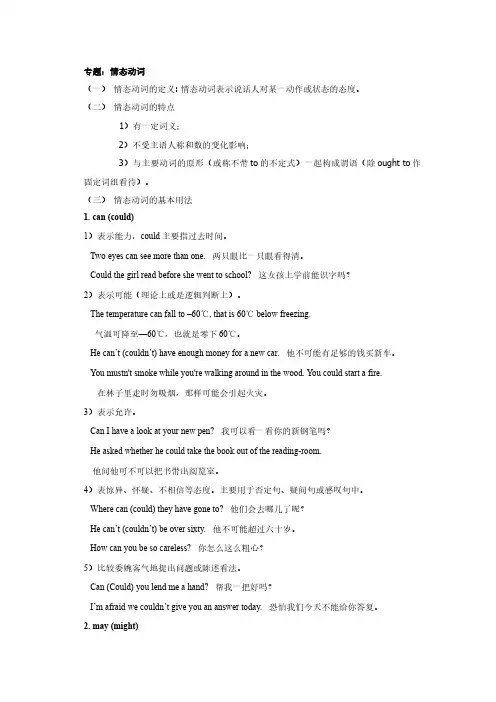
情态动词
- 格式:doc
- 大小:48.00 KB
- 文档页数:4
情态动词(两课时)
表示推测的情态动词
第一课时
【熟读深思】
熟读下列句子,细心体会表示推测的各个情态动词的语气和用法。
1,You must know Diana surely. 你准会认识戴安娜。
2,You msut be joking. 你准是在说笑话。
3,He must have arrived already. 他肯定已经到了。
4,What can he mean? 他可能是什么意思呢?
5,What could have becomew of him now? 他现在可能怎么样了呢?
6,He can’t be more than thirty. 他不可能在三十以上。
7,This project could create 5,000 new jobs. 这项新工程可能给5千人带来新工作。
8,Living in a big city can be very lonely. 在大城市里生活有时会很孤寂。
9,He might not be in England. 他可能不在英国。
10,If you look at the moon, you may/ might have many questions to ask. 如果你看看月亮,或许会有许多问题要问。
【归纳总结】
常用的表示推测的情态动词由强到弱依次有must, can, could ,may , might等。其中,could,
might不一定是can ,may的过去式,只是语气比can, may更弱。使用时注意以下几点:
1,must只用于肯定句,表示有把握的推测,可译作“一定会,准会”。
2,can一般不用于肯定句,可译作“可能”;但证据稍弱的could可用于肯定句;表示“有时也会”时也可用于肯定句。
3,may不用于疑问句,表示没有把握的推测,常译作“或许,可能”。
4,用于肯定句;must一定,准会;could, may, might可能,也许。
5,用于否定句:can’t , couldn’t不可能;may/ might not可能不。
6,若对现在或未来情况的推测,后接动词原形。
7,表示对此刻正在进行的动作进行推测,后接be doing。如must be doing sth.一定在做某事。
8,表示对过去情况的推测,后接have done。如:
msut have done一定已经
can/could have done可能已经
may/might have done或许已经
此外,should , ought to (按理应当),would , will(很可能)等也可表示推测,语气都较肯定,且由左至右依次增强,但msut 较稍弱。
1),He should arrive soon. 他可能很快就到了。
2),The train should have already left. 火车大概已经走了。
3),I think he would accept the invitation.我想他会接受邀请的。
4),This will be the house you’re looking for. 这大概就是你找的那所房子了。
单句填空用适当的情态动词填空。
【灵活运用】
1. It _____ have been Tom that parked the car here, as he is the only one with a car. (2009上海卷)
2. The traffic is heavy this day; I ______ arrive a bit late, so could you save me a place? (2009辽宁卷)
3. —Good morning. I’ve got an appointment with Miss Smith in the Personnel Department. —Ah, good morning. You ______ be Mrs. Peters. (2010北京卷)
4. ―You ________ have a wrong number,‖ she said. ―There’s no one of that name here.‖ (2010浙江卷)
5. She ________ not have left school, for her bike is still here. (2008年天津)
6. You ________ not be hungry already—you had lunch only two hours ago! (2008年浙江)
7. —I can’t find my purse anywhere.
—You _______ have lost it while shopping. (2008年重庆)
8. — She looks very happy. She ______ have passed the exam.
— I guess so. It’s not difficult after all. (2007年江苏)
9. -Excuse me. Is this the right way to the Summer Palace?
-Sorry, I am not sure. It ______ be. (2004年湖北)
10. -When can I come for the photos? I need them tomorrow afternoon.
-They ______ be ready by 12:00. (全国)
表示责备与后悔的情态动词
第二课时
【熟读深思】
熟读下列句子,细心体会下列情态动词的语气和用法。
1,You needn’t have mentioned it. 你本来不必提起这件事。
2,You might have been more diligent. 你本来可以更用功些。
3,She could have applied for that job, but she didn’t . 她本来可以申请这份工作的,但她没有。
4,I ought to / should have helped her, but I never could. 我本应该帮助她的,但从未这样做。
5,You oughtn’t to /shouldn’t have told himabout it.你本不该把这件事告诉他的。
【归纳总结】
表示轻微的责备或后悔的情态动词有:
1,needn’t have done本不必做某事(但做了)
2,could/ might have done本可以做某事(却没做)
3,ought to / should have done本应该做某事(但没做)
oughtn’t to/ shouldn’t have done本不该做(但做了)
注意:此用法不可用can/may
【灵活运用】
. 一、单句填空用适当的情态动词填空。
1.He did not regret saying what he did but felt that he _________ have expressed it differently.
(2009江苏卷)
2. I _________ not have watched that movie- it’ll give me horrible dreams. (2010山东卷)
3. Mark ________ not have hurried. After driving at top speed, he arrived half an hour early.
(2010天津卷)
4. —Sorry, Professor Smith. I didn’t finish the assignment yesterday.
—Oh, you ________ have done it as yesterday was the deadline. (2010上海卷)
5. —I’m sorry. I _______ not have shouted at you the other day.
—Forget it. I was a bit out of control myself. (2008年江苏)
6. What a pity. Considering his ability and experience, he ________ have done better. (2008年江西)
7. —Catherine, I have cleaned the room for you.
—Thanks. You _____ not have done it. I could manage it myself.(福建) 8. He paid for a seat, when he _______ have entered free.(山东)
情态动词的基本用法
【熟读深思】
熟读下列句子,细心体会下列情态动词的语气和用法。
1, He could (=was able to) swim when he was five.他五岁时就会游泳了。
2, In the past 50 years or so, scientists have been able to ―see‖ farther and farther into the sky.在过去50年时,科学家们已经能够往天空看得更远。(不用can)
3, He worked very hard and was able to pass that examination.他学习非常努力所以能够通过那场考试。(不用can)
4. – May / Might / Can /Could I have the television on?我可以开电视看吗?
- Yes, you can/ may.可以。(不用could或might)
5, I must write a letter to the head teacher.我非得给校长写信不可。
6, You have to wear uniform on duty, don’t you ?你在值班时必须穿制服,是吗(指制约束)
7, Yesterday morning I had to call on a friend.明天早上我必须要去探访一个朋友。(过去式不用must)
8, If it should rain tomorrow , don’t expect me.万一明天下雨,就不要等我了。
9, It’s strange that he should be late.真奇怪,他竟会迟到。
10, You ought to/ should work harder than that.你应该更努力地工作。
11, I ought to go and see my mother in hospital tomorrow, but I don’t think we will.按理我应当在明天去看看住院的母亲,但我认为我们不会去。(强调客观)