
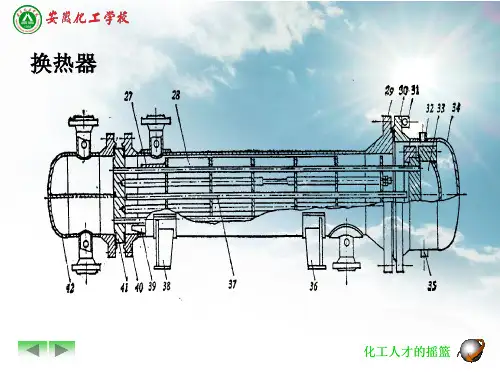
填料函式换热器
- 格式:ppt
- 大小:1.23 MB
- 文档页数:40

固定管板式换热器的结构设计摘要换热器是化工、石油、动力、冶金、交通、国防等工业部门重要工艺设备之一,其正确的设置,性能的改善关系各部门有关工艺的合理性、经济性以及能源的有效利用与节约,对国民经济有着十分重要的影响。
换热器的型式繁多,不同的使用场合使用目的不同。
其中常用结构为管壳式,因其结构简单、造价低廉、选材广泛、清洗方便、适应性强,在各工业部门应用最为广泛。
固定管板式换热器是管壳式换热器的一种典型结构,也是目前应用比较广泛的一种换热器。
这类换热器具有结构简单、紧凑、可靠性高、适应性广的特点,并且生产成本低、选用的材料范围广、换热表面的清洗比较方便。
固定管板式换热器能承受较高的操作压力和温度,因此在高温高压和大型换热器中,其占有绝对优势。
固定管板式换热器主要由壳体、换热管束、管板、前端管箱(又称顶盖或封头)和后端结构等部件组成。
管束安装在壳体内,两端固定在管板上。
管箱和后端结构分别与壳体两端的法兰用螺栓相连,检修或清洗时便于拆卸。
换热器设计的优劣最终要看是否适用、经济、安全、运行灵活可靠、检修清理方便等等。
一个传热效率高、紧凑、成本低、安全可靠的换热器的产生,要求在设计时精心考虑各种问题.准确的热力设计和计算,还要进行强度校核和符合要求的工艺制造水平。
关键词:换热器;固定管板式换热器;结构;设计The Structural Design of Fixed Tube Plate Heat ExchangerAuthor : Chen Hui -juanTutor : Li HuiAbstractHeat exchanger is one of the most important equipments which is used in the fields of chemical, oil, power, metallurgy, transportation, national defense industry. Its right setting and the improvements of performance play an important role in the rationality o technology, economy, energy utilization and saving, which has a very important impact on the national economy.The type of heat exchanger is various, the different use occasions and the purpose is are commonly used for the tube shell type structure, because of its simple structure, low cost and wide selection, easy to clean, strong adaptability, themost widely used in various industry departments.Fixed tube plate heat exchanger is a kind of typical structure of tube and shell heat exchanger, also is a kind of heat exchanger is applied more widely. This kind of heat exchanger has simple and compact structure, high reliability, the characteristics of wide adaptability, and the production of low cost, wide range of selection of materials, heat exchange surface cleaning more convenient. Fixed tube plate heat exchanger can operate under high pressure and temperature, therefore, the heat exchanger in high temperature and high pressure and large in its possession of absolute advantage. Fixed tube plate heat exchanger is mainly composed of shell, heat exchange tube bundle, tube plate, the front tube box (also known as the roof or head) and the back-end structure parts. Tube bundle is installed on both ends of casing, which is fixed on the tube plate. Tube box and the back-end respectively connected to theflange bolts at the ends of the shell structure, maintenance or cleaning for easy disassembly. The merits of the heat exchanger design ultimately depends on whether applicable, economic, safe, flexible and reliable running, convenient maintenance cleaning, etc. A high heat transfer efficiency, compact, low cost, safe and reliable production of heat exchanger, requires carefully considered in the design of all sorts of problems. The accurate thermal design and calculation, but also for intensity and conform to the requirement of process manufacturing level.Keywords: Heat exchanger,Fixed tube plate heat exchanger, Structure,Design目录1 绪论.......................................... 错误!未定义书签。

中南大学化工原理课程设计2010年01月22日目录一、设计题目及原始数据(任务书) (3)二、设计要求 (3)三、列环式换热器形式及特点的简述 (3)四、论述列管式换热器形式的选择及流体流动空间的选择 (8)五、换热过程中的有关计算(热负荷、壳层数、总传热系数、传热面积、压强降等等) (10)①物性数据的确定 (14)②总传热系数的计算 (14)③传热面积的计算 (16)④工艺结构尺寸的计算 (16)⑤换热器的核算 (18)六、设计结果概要表(主要设备尺寸、衡算结果等等) (22)七、主体设备计算及其说明 (22)八、主体设备装置图的绘制 (33)九、课程设计的收获及感想 (33)十、附表及设计过程中主要符号说明 (37)十一、参考文献 (40)一、设计题目及原始数据(任务书)1、生产能力:17×104吨/年煤油2、设备形式:列管式换热器3、设计条件:煤油:入口温度140o C,出口温度40 o C冷却介质:自来水,入口温度30o C,出口温度40 o C允许压强降:不大于105Pa每年按330天计,每天24小时连续运行二、设计要求1、选择适宜的列管式换热器并进行核算2、要进行工艺计算3、要进行主体设备的设计(主要设备尺寸、横算结果等)4、编写设计任务书5、进行设备结构图的绘制(用420*594图纸绘制装置图一张:一主视图,一俯视图。
一剖面图,两个局部放大图。
设备技术要求、主要参数、接管表、部件明细表、标题栏。
)三、列环式换热器形式及特点的简述换热器概述换热器是将热流体的部分热量传递给冷流体的设备,以实现不同温度流体间的热能传递,又称热交换器。
换热器是实现化工生产过程中热量交换和传递不可缺少的设备。
在换热器中,至少有两种温度不同的流体,一种流体温度较高,放出热量;另一种流体则温度较低,吸收热量。
在工程实践中有时也会存在两种以上的流体参加换热,但它的基本原理与前一种情形并无本质上的区别。

换热器的结构管壳式换热器就是具有换热管和壳体的一种换热设备,换热管与管板连接,再用壳体固定。
按其结构型式,主要分为:固定管板式换热器、浮头式换热器、U形管式换热器、填料函式换热器、方形壳体翅片管换热器等。
详细结构如下:固定管板式换热器:固定管板式换热器结构如上图所示,换热器的两端管板采用焊接方法与壳体连接固定。
换热管可为光管或低翅管。
其结构简单,制造成本低,能得到较小的壳体内径,管程可分成多样,壳程也可用纵向隔板分成多程,规格范围广,故在工程中广泛应用。
其缺点是壳侧不便清洗,只能采用化学方法清洗,检修困难,对于较脏或对材料有腐蚀性的介质不能走壳程。
壳体与换热管温差应力较大,当温差应力很大时,可以设置单波或多波膨胀节减小温差应力浮头式换热器浮头式换热器结构如图所示,其一端管板与壳体固定,而另一端的管板可以在壳体内自由浮动。
壳体和管束对热膨胀是自由的,故当两种介质的温差较大时,管束与壳体之间不会产生温差应力。
浮头端设计成可拆结构,使管束可以容易地插入或抽出,这样为检修和清洗提供了方便。
这种形式的换热器特别适用于壳体与换热管温差应力较大,而且要求壳程与管程都要进行清洗的工况。
浮头式换热器的缺点是结构复杂,价格较贵,而且浮头端小盖在操作时无法知道泄漏情况, 所以装配时一定要注意密封性能U形管式换热器上图为双壳程U形管式换热器。
U形管式换热器是将换热管弯成U形,管子两端固定在同一块管板上。
由于换热管可以自由伸缩,所以壳体与换热管无温差应力。
因U形管式换热器仅有一块管板,所以结构较简单,管束可从壳体内抽出,壳侧便于清洗,但管内清洗稍困难,所以管内介质必须清洁且不易结垢。
U形管式换热器一般用于高温高压情况下,尤其是壳体与换热管金属壁温差较大时。
壳程可设置纵向隔板,将壳程分为两程(如图中所示)。
填料函式换热器上图为填料函式双管程双壳程换热器,填料函式换热器的换热管束可以自由滑动,壳侧介质靠填料密封。
对于一些壳体与管束温差较大,腐蚀严重而需经常更换管束的换热器,可采用填料函式换热器。