外研版七年级英语下册知识点归纳及练习
- 格式:docx
- 大小:43.27 KB
- 文档页数:27
MODULE1 一、词汇。 1. listen 听(强调动作) hear 听见(强调结果) I listened carefully but I heard nothing. 我仔细听但什么也没听到 2.on a (school) trip 3. have a good time = enjoy oneself 4. take pictures = take photos 5. lie in the sun躺在阳光下 lie on the beach 躺在沙滩上 躺下【动】She is lying on her back. 她正仰卧着。 位于【动】London lies on the River Thames 伦敦位于泰晤士河畔 说谎【动】You are lying to him! 你在对他说谎。 eg: Look! The boy ________on the bed and reading a book. A. is lying B. lying C. lies D. lie 6. send sb. a postcard 寄给某人一张明信片 send sth. to sb. = send sb. sth. 7. anyway 无论如何 (转移话题) 8. buy some presents 买礼物 buy sth. for sb. = buy sb. sth. 9. enjoy sth. 喜欢某物 enjoy oneself = have a good/ great time 玩的开心 enjoy/ like doing sth. 喜欢做某事 10. at this moment=now 此时此刻 (现在进行时) 11. leave work 下班 be at work 上班 He is at work. = He is working 12. wait for buses 等公共汽车 run for trains 赶乘火车(地铁) 13. have afternoon tea 喝下午茶 14. watch a ballet 看芭蕾 see friends 看望朋友 get dressed = dress oneself 穿衣;打扮 eg: The boy can’t dress himself. 15. call home 给家里打电话 call sb. = give sb. a call= phone sb. 二、语法。 现在进行时(一) 1、 基本用法: 1) 表示(说话瞬间)正在进行或发生的动作。 2) 也可以表示当前一段时间内的活动或现阶段正在进行的动作。 2、结构:be (am/is/are) + V-ing eg: I am watching TV now. They’re playing football. 3、 动词-ing 的形式变化规律: 规则 示例 一般情况下,动词后直接加-ing working, buying, visiting, talking, saying 以不发音的e结尾的动词,去掉e,再加-ing taking, having, leaving, driving, writing 以辅音字母+元音字母+辅音字母结尾的重读闭音节,双写末尾辅音字母,然后加-ing stopping, shopping, sitting, getting
特殊变化 lie—lying 4、 现在进行时的否定和疑问形式结构 肯定 否定 疑问 I am writing a letter. I am not writing a letter. Am I writing a letter? She/He is listeningto music. She/He is not listeningto music. Is she/he listeningto music?
We are enjoying our trip. We aren’t enjoying our trip. Are we enjoying our trip? They are talking to each other. They are not(aren’t) talking to each other. Are they talking to each other? 相关练习题。 1、写出下列动词的现在分词: play________ run__________ swim _________ make__________ go_________ like________ write________ ski___________ read________ have_________ sing ________ dance_________ put_________ see________ buy _________ love__________ live_______ take_________ come ________ get_________ stop_________ sit ________ begin________ shop___________ 2 、用所给的动词的正确形式填空: 1.The boy __________________ ( draw)a picture now. 2. Listen .Some girls _______________ ( sing)in the classroom . 3. My mother _________________ ( cook )some nice food now. 4. What _____ you ______ ( do ) now? 5. Look . They _______________( have) an English lesson . 6.They ____________(not ,water) the flowers now. 7.Look! the girls ________________(dance )in the classroom . 8.What is our granddaughter doing? She _________(listen ) to music. 9. It’s 5 o’clock now. We _____________(have)supper now 10.______Helen____________(wash )clothes? Yes ,she is 2、句型转换: (1)They are doing housework .(分别改成一般疑问句和否定句) (2)The students are cleaning the classroom . ( 改一般疑问句并作肯定和否定回答) (3)I’m playing the football in the playground .(改为否定句) (4)Tom is reading books in his study . (改为一般疑问句)
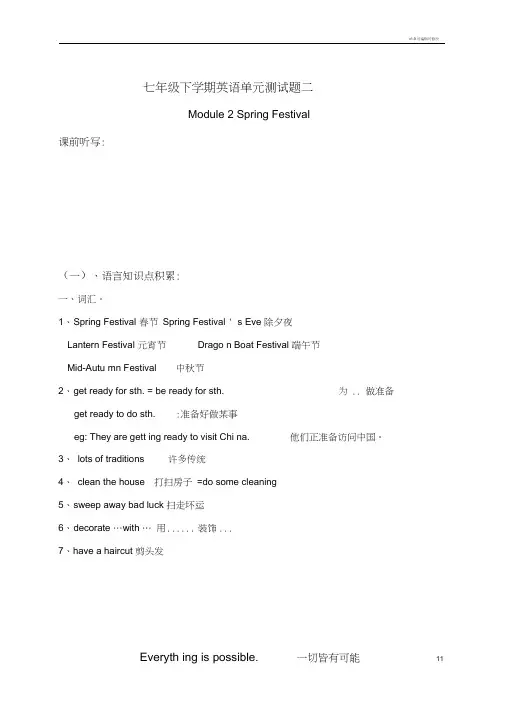
MODULE2 一、词汇 1、Spring Festival 春节 Spring Festival’s Eve除夕夜 Lantern Festival 元宵节 Dragon Boast Festival 端午节 Mid-Autumn Festival 中秋节 2、get ready for sth. = be ready for sth. get ready for doing sth.:为……做准备 get ready to do sth.:准备好做某事 eg: They are getting ready to visit China. 他们正准备访问中国。 3、lots of traditions 许多传统 4、clean the house 打扫房子 = do some cleaning 5、sweep away bad luck 扫走坏运 6、decorate …with … 用……装饰…… 7、have a haircut 剪头发 8、at midnight 在半夜 (at noon 在中午) at night in the evening 9、 put on:“穿上”强调动作(宾语是衣服鞋帽等) dress:“穿衣服 表示动作或状态(宾语是人) wear:“穿着,戴着”表示状态 (宾语是物) eg: (1)----Can you_______ your little brother? I am busy now. -----OK. I’ll do it right now. A. wear B. put on C. dress D. in (2)----Nancy, don’t always _______ that old jacket. It looks terrible. ----But I think it’s cool, Mum. A. wear B. dress C. put on D. take off 10. fireworks :“烟火”(要用复数) 11. bring sb. sth. =bring sth. to sb. 给某人带来…… bring:指从别处把某人/物“带来,拿来”eg: Please bring your textbook to school take :指从这里把某人/物“带走,拿走”eg: Take this empty box away. carry:指“搬运,携带”,不表示固定方向。eg: Let me carry this bag for you. 二、语法 现在进行时(二) 一般现在时和现在进行时的比较: 1) 一般现在时表示现在的状态。 He likes jiaozi. They have a lot of friends. 2) 一般现在时表示习惯性的或经常性的行为,现在进行时表示正在进行的行为。 He cleans his room every day. He is cleaning his room now.