2020学年山东八年级英语下册Unit3Couldyoupleasecleanyourroom第1课时SectionA1a_2d教学设计人教新目标版
- 格式:doc
- 大小:107.00 KB
- 文档页数:3
2020学年人教版英语精品资料
Unit 3 Could you please clean your room
第1课时 Section A 1a-2d
教学目标
一、知识与技能
1. 掌握重点词汇、短语和句型:Could you please…? Could I …?
2. 培养听力能力。
3. 能就家务活动提出委婉请求。
二、过程与方法
任务型教学法,同伴,小组互动,听、说、读、写相结合。
三、情感态度与价值观
熟悉家务,能体会到父母做家务的辛苦,树立帮父母做家务的意识。
教学重点
掌握重点词汇、短语和句型:Could you please…? Could I …?
教学难点
熟练掌握有关家务的词汇,短语和句型。
教法导航
讲练结合,听说结合,以学生为主。
学法导航
同伴、小组相结合,多听、多说。
教学准备
图片,多媒体。
教学过程
Step 1 Greetings
Greet the students as usual.
Step 2 Presentation
Ask the students:What do your mother and father usually do in your house? and
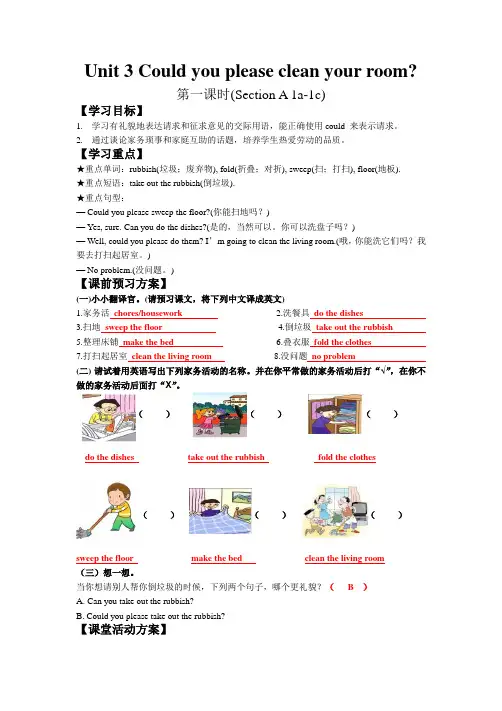
learn these phrases:do chores,sweep the floor,do the dishes,make the bed,take out the rubbish,fold the clothes,clean the living room.
Step 3 Memory game
Show students pictures quickly then cover them and ask students to say what
chores they saw.
Step 4 Practice
1a, Do you do these chores at home? Discuss them with your partner.
Step 5 Presentation and pairwork
T:Who does most of the chores at home? Your mother is tired after work every
day. On Sunday she wants you to help her. What does she say to you ? What do you
say ?
1. A:Could you please clean the living room?
B:Yes,sure./ All right/ OK./
2. A:Could you please sweep the floor? B:Sorry,I can’t. I have to do my homework.
Look at the picture below. Ask your partner to do the chores that you see.
Step 6 Listening
1b, Listen. Who will do these chores? Check (√) Peter’s mother or Peter.
Chores
Peter’s mother
Peter
do the dishes
sweep the floor
take out the rubbish
make the bed
fold the clothes
clean the living room
Step 7 Pair work
1c, Work in pairs and make conversations about the chores in 1a.
Step 8 Listening
2a, Peter asks his father if he can do four things. What does his father say?
Check (√) “yes” or “no”.
Peter wants
to… Peter’s father
says… His father’s reasons
go out for
dinner. yes no I have to do some work.
go to the
movies. yes no You have to clean your room
stay out late. yes no I need to eat breakfast.
get a ride. yes no You have a basketball game.
2b, Listen again. Why does Peter’s father say “no”? Draw lines to the reasons.
Step 9 Practice
2c, Make conversations using the information in 2a and 2b. first ask one or
two pairs to read the example dialogue and then get them to practice in pairs.
A:Could I use your computer?
B:Sorry. I’m going to work on it now.
A:Well,could I watch TV?
B:Yes,you can. But first you have to clean your room.
2d, Role-play the conversation
Step 10 Summary
1. New vocabulary: do the dishes, sweep the floor, take out the trash, make
the bed, fold the clothes, clean the room
2. ---Could you please…? ---Yes,please. / Sorry,I can’t.
---Could I …? ---Yes,you can. / Sorry….
Step 11 Homework
1. List all the main phrases of doing chores that you know. 2. Make a conversation between you and your mother,using the sentence pattern
“Could you please …?”
课堂作业
翻译短语和句子:
1.洗盘子 2. 把垃圾拿出去 3. 叠衣服 4. 扫地 5. 铺床 6. 打扫起居室 7. ---你能把垃圾拿出去吗?---当然。8. ---我能看电视吗?---是的,你能。
参考答案:1. do the dishes 2. take out the rubbish 3. fold your clothes 4.
sweep the floor 5.make your bed 6. clean the living room 7. ---Could you please
take out the rubbish? ---Yes,sure. 8. ---Could I watch TV? ---Yes,you can.
教学反思
在平时的教学中,我十分重视听说训练,尝试让学生在口语运用中学会表达他们的个人意见,抒发个人情感。因此,在第三单元中,功能话题是谈论家务事,这与学生的个人生活息息相关,只要引导得当,极易激发学生的兴趣,开展关于这一话题的讨论。