
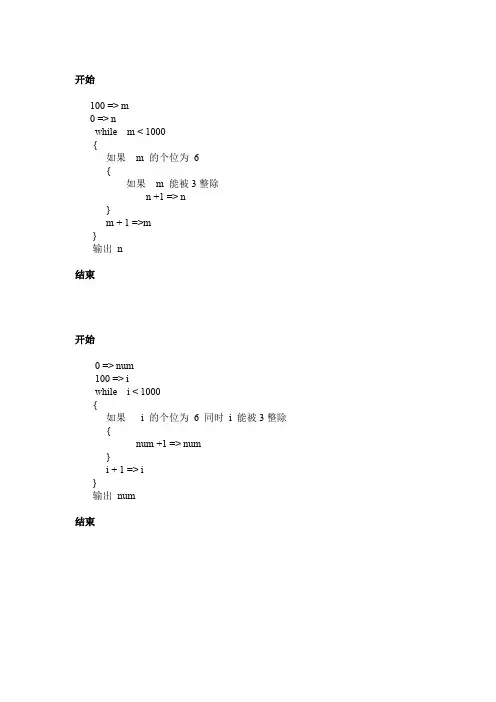
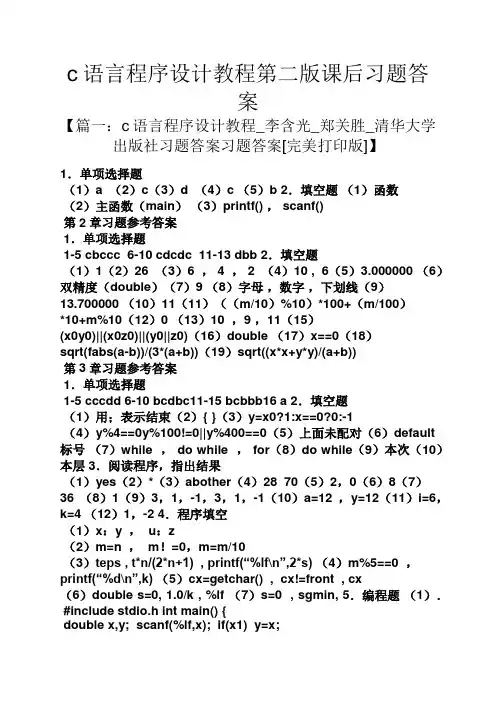
c语言程序设计基础之伪代码表示
- 格式:pdf
- 大小:45.10 KB
- 文档页数:1
![《C语言程序设计》课后习题答案解析[第四版]谭浩强](https://imgs-1438308264.cos.ap-hongkong.myqcloud.com/70a3dc2176c66137ee06197b.webp)
第1章程序设计和C语言11.1什么是计算机程序11.2什么是计算机语言11.3C语言的发展及其特点31.4最简单的C语言程序51.4.1最简单的C语言程序举例61.4.2C语言程序的结构101.5运行C程序的步骤与方法121.6程序设计的任务141-5 #include <stdio.h>int main ( ){ printf ("**************************\n\n"); printf(" Very Good!\n\n");printf ("**************************\n"); return 0;}1-6#include <stdio.h>int main(){int a,b,c,max;printf("please input a,b,c:\n");scanf("%d,%d,%d",&a,&b,&c);max=a;if (max<b)max=b;if (max<c)max=c;printf("The largest number is %d\n",max);return 0;}第2章算法——程序的灵魂162.1什么是算法162.2简单的算法举例172.3算法的特性212.4怎样表示一个算法222.4.1用自然语言表示算法222.4.2用流程图表示算法222.4.3三种基本结构和改进的流程图262.4.4用N S流程图表示算法282.4.5用伪代码表示算法312.4.6用计算机语言表示算法322.5结构化程序设计方法34习题36第章最简单的C程序设计——顺序程序设计37 3.1顺序程序设计举例373.2数据的表现形式及其运算393.2.1常量和变量393.2.2数据类型423.2.3整型数据443.2.4字符型数据473.2.5浮点型数据493.2.6怎样确定常量的类型513.2.7运算符和表达式523.3C语句573.3.1C语句的作用和分类573.3.2最基本的语句——赋值语句593.4数据的输入输出653.4.1输入输出举例653.4.2有关数据输入输出的概念673.4.3用printf函数输出数据683.4.4用scanf函数输入数据753.4.5字符数据的输入输出78习题823-1 #include <stdio.h>#include <math.h>int main(){float p,r,n;r=0.1;n=10;p=pow(1+r,n);printf("p=%f\n",p);return 0;}3-2-1#include <stdio.h>#include <math.h>int main(){float r5,r3,r2,r1,r0,p,p1,p2,p3,p4,p5;p=1000;r5=0.0585;r3=0.054;r2=0.0468;r1=0.0414;r0=0.0072;p1=p*((1+r5)*5); // 一次存5年期p2=p*(1+2*r2)*(1+3*r3); // 先存2年期,到期后将本息再存3年期p3=p*(1+3*r3)*(1+2*r2); // 先存3年期,到期后将本息再存2年期p4=p*pow(1+r1,5); // 存1年期,到期后将本息存再存1年期,连续存5次 p5=p*pow(1+r0/4,4*5); // 存活期存款。
c语言程序设计教程第二版课后习题答案【篇一:c语言程序设计教程_李含光_郑关胜_清华大学出版社习题答案习题答案[完美打印版]】1.单项选择题(1)a (2)c(3)d (4)c (5)b 2.填空题(1)函数(2)主函数(main)(3)printf() , scanf()第2章习题参考答案1.单项选择题1-5 cbccc 6-10 cdcdc 11-13 dbb 2.填空题(1)1(2)26 (3)6 , 4 , 2 (4)10 , 6(5)3.000000 (6)双精度(double)(7)9 (8)字母,数字,下划线(9)13.700000 (10)11(11)((m/10)%10)*100+(m/100)*10+m%10(12)0 (13)10 ,9 ,11(15)(x0y0)||(x0z0)||(y0||z0)(16)double (17)x==0(18)sqrt(fabs(a-b))/(3*(a+b))(19)sqrt((x*x+y*y)/(a+b))第3章习题参考答案1.单项选择题1-5 cccdd 6-10 bcdbc11-15 bcbbb16 a 2.填空题(1)用;表示结束(2){ }(3)y=x0?1:x==0?0:-1(4)y%4==0y%100!=0||y%400==0(5)上面未配对(6)default 标号(7)while , do while , for(8)do while(9)本次(10)本层 3.阅读程序,指出结果(1)yes(2)*(3)abother(4)28 70(5)2,0(6)8(7)36 (8)1(9)3,1,-1,3,1,-1(10)a=12 ,y=12(11)i=6,k=4 (12)1,-2 4.程序填空(1)x:y , u:z(2)m=n , m!=0,m=m/10(3)teps , t*n/(2*n+1) , printf(“%lf\n”,2*s) (4)m%5==0 ,printf(“%d\n”,k) (5)cx=getchar() , cx!=front , cx(6)double s=0, 1.0/k , %lf (7)s=0 , sgmin, 5.编程题(1). #include stdio.h int main() {double x,y; scanf(%lf,x); if(x1) y=x;else if(x=1.0x10) y=2*x-11; elsey=3*x-11;printf(%lf\n,y); return 0; } (2).#include stdio.h int main() {double x,y,z,min;scanf(%lf%lf%lf,x,y,z); if(xy) min=y; else min=x; if(minz)min=z;printf(min=%lf\n,min); return 0; } (3).#include stdio.h int main() {int y,m,d,flag,s=0,w,i;scanf(%d%d%d,y,m,d);flag=(y%4==0y%100!=0||y%400==0);w=((y-1)*365+(y-1)/4-(y-1)/100+(y-1)/400)%7;for(i=1;i=m;i++) {switch(i) {case 1:s=d;break; case 2:s=31+d;break; case 3:s=59+d;break; case 4:s=90+d;break; case 5:s=120+d;break; case6:s=151+d;break; case 7:s=181+d;break; case8:s=212+d;break; case 9:s=243+d;break; case10:s=273+d;break; case 11:s=304+d;break; case12:s=334+d;break;} }s=(w+s)%7; if(s==0)printf(星期日\n); elseprintf(星期%d\n,s); return 0; }(4).#include stdio.h int main() {float p,r;scanf(%f,p); if(p=10) r=p*0.1;else if(p10p=20) r=10*0.1+(p-10)*0.075; else if(p20p=40)r=10*0.1+10*0.075+(p-20)*0.05; else if(p40p=60)r=10*0.1+10*0.075+20*0.05+(p-40)*0.03;else if(p60p=100)r=10*0.1+10*0.075+20*0.05+20*0.03+(p-60)*0.015; else if(p100)r=10*0.1+10*0.075+20*0.05+20*0.03+40*0.015+(p-100)*0.01; printf(%f\n,r); return 0; } (5).#include stdio.h int main() {char c;while((c=getchar())!=\n) {if(c=ac=z) c=c-32; putchar(c);}return 0; } (6).#includestdio.h int main() {int m,k=2;printf(输入一个正整数:\n); scanf(%d,m); while(km) if(m%k==0) {printf(%4d,k); m=m/k; } else k++;printf(%4d\n,m); return 0; } (7).#includestdio.h int main() {int a,n,s=0,p=0,i;scanf(%d %d,n,a); for(i=1;i=n;i++) {p=p*10+a; s=s+p; }printf(%d\n,s); return 0; } (8).#includestdio.h int main(){int i,j,k;for(i=1;i=9;i++) for(j=0;j=9;j++) for(k=0;k=9;k++)printf(%5d,100*i+10*j+k); return 0; }(9).#includestdio.h #includemath.h int main() {float a=-10,b=10,x,f1,f2,f; f1=(((2*a-4)*a+3)*a)-6; f2=(((2*b-4)*b+3)*b)-6; do {x=(a+b)/2;f=(((2*x-4)*x+3)*x)-6; if(f*f10) { b=x; f2=f; } else { a=x;f1=f; }}while(fabs(f)=1e-6); printf(%6.2f\n,x); return 0; }(10).#includestdio.h#includemath.h int main() {int n=2;double eps,t,s=0,x;scanf(%lf %lf,x,eps); t=x; s=t;while(fabs(t)=eps) {t=-t*(2*n-3)*x*x/(2*n-2); s=s+t/(2*n); n++; }printf(%d,%lf\n,n,s); return 0; }(11).#includestdio.h int main() {unsigned long s,t=0,p=1; scanf(%u,s); while(s!=0) {if((s%10)%2!=0) {t=t+(s%10)*p; p=p*10; }s=s/10; }printf(%u\n,t); return 0; }第4章习题参考答案1.单项选择题1-5 dddbd 6-10 badcd 11-14 bdab 2.填空题(1)2(2)嵌套,递归(3)全局变量,局部变量,静态变量,动态变量(4)auto , static , register , extern (5)外部变量(6)编译,运行 3.阅读程序,指出结果(1)15(2)5(3)5,4,3 (4)i=5 i=2 i=2 i=4 i=2(5)求水仙花数(6)-5*5*5(7)30 (8)0 10 1 11 2 124.程序填空(1)float fun(float , float) , x+y,x-y, z+y,z-y (2)x , x*x+1 (3)s=0 , a=a+b 5.编程题(1).while(s!=0) #includestdio.h { unsigned int fun(unsigned int);p=p+s%10; int main() s=s/10; { } unsigned int s; return p; scanf(%u,s); } printf(%u\n,fun(s)); (2). return 0;#includestdio.h } #includestdlib.h unsigned int fun(unsignedint s) #includemath.h { void f1(float,float,float,float); unsigned int p=0; void f2(float,float,float,float);【篇二:《c语言程序设计》课后习题答案(第四版)谭浩强】t>1.1什么是计算机程序11.2什么是计算机语言11.3c语言的发展及其特点31.4最简单的c语言程序51.4.1最简单的c语言程序举例61.4.2c语言程序的结构101.5运行c程序的步骤与方法121.6程序设计的任务141-5 #include stdio.hint main ( ){ printf (**************************\n\n);printf( very good!\n\n);printf (**************************\n);return 0;}1-6#include stdio.hint main(){int a,b,c,max;printf(please input a,b,c:\n);scanf(%d,%d,%d,a,b,c);max=a;if (maxb)max=b;if (maxc)max=c;printf(the largest number is %d\n,max);return 0;}第2章算法——程序的灵魂162.1什么是算法162.2简单的算法举例172.3算法的特性212.4怎样表示一个算法222.4.1用自然语言表示算法222.4.2用流程图表示算法222.4.3三种基本结构和改进的流程图262.4.4用n?s流程图表示算法282.4.5用伪代码表示算法312.4.6用计算机语言表示算法322.5结构化程序设计方法34习题36第章最简单的c程序设计——顺序程序设计37 3.1顺序程序设计举例373.2数据的表现形式及其运算393.2.1常量和变量393.2.2数据类型423.2.3整型数据443.2.4字符型数据473.2.5浮点型数据493.2.6怎样确定常量的类型513.2.7运算符和表达式523.3c语句573.3.1c语句的作用和分类573.3.2最基本的语句——赋值语句593.4数据的输入输出653.4.1输入输出举例653.4.2有关数据输入输出的概念673.4.3用printf函数输出数据683.4.4用scanf函数输入数据753.4.5字符数据的输入输出78习题823-1 #include stdio.h#include math.hint main(){float p,r,n;r=0.1;n=10;p=pow(1+r,n);printf(p=%f\n,p);return 0;}3-2-1#include stdio.h#include math.hint main(){float r5,r3,r2,r1,r0,p,p1,p2,p3,p4,p5;p=1000;r5=0.0585;r3=0.054;r2=0.0468;r1=0.0414;r0=0.0072;p1=p*((1+r5)*5);// 一次存5年期p2=p*(1+2*r2)*(1+3*r3); // 先存2年期,到期后将本息再存3年期 p3=p*(1+3*r3)*(1+2*r2); // 先存3年期,到期后将本息再存2年期p4=p*pow(1+r1,5); // 存1年期,到期后将本息存再存1年期,连续存5次 p5=p*pow(1+r0/4,4*5); // 存活期存款。

