
English Romantic poetry
- 格式:ppt
- 大小:156.00 KB
- 文档页数:30
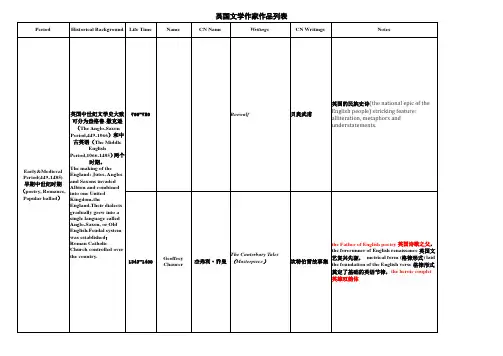
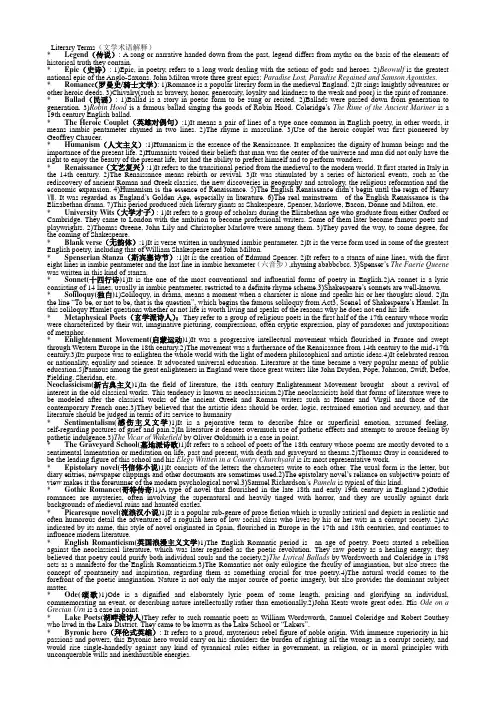
Literary Terms(文学术语解释)*Legend(传说): A song or narrative handed down from the past, legend differs from myths on the basis of the elements of historical truth they contain.*Epic(史诗): 1)Epic, in poetry, refers to a long work dealing with the actions of gods and heroes. 2)Beowulf is the greatest national epic of the Anglo-Saxons. John Milton wrote three great epics: Paradise Lost, Paradise Regained and Samson Agonistes.*Romance(罗曼史/骑士文学): 1)Romance is a popular literary form in the medieval England. 2)It sings knightly adventures or other heroic deeds. 3)Chivalry(such as bravery, honor, generosity, loyalty and kindness to the weak and poor) is the spirit of romance. *Ballad(民谣): 1)Ballad is a story in poetic form to be sung or recited. 2)Ballads were passed down from generation to generation. 3)Robin Hood is a famous ballad singing the goods of Robin Hood. Coleridge’s The Rime of the Ancient Mariner is a 19th century English ballad.*The Heroic Couplet(英雄对偶句):1)It means a pair of lines of a type once common in English poetry, in other words, it means iambic pentameter rhymed in two lines. 2)The rhyme is masculine. 3)Use of the heroic couplet was first pioneered by Geoffrey Chaucer.*Humanism(人文主义):1)Humanism is the essence of the Renaissance. It emphasizes the dignity of human beings and the importance of the present life. 2)Humanists voiced their beliefs that man was the center of the universe and man did not only have the right to enjoy the beauty of the present life, but had the ability to prefect himself and to perform wonders.*Renaissance(文艺复兴):1)It refers to the transitional period from the medieval to the modern world. It first started in Italy in the 14th century. 2)The Renaissance means rebirth or revival. 3)It was stimulated by a series of historical events, such as the rediscovery of ancient Roman and Greek classics, the new discoveries in geography and astrology, the religious reformation and the economic expansion. 4)Humanism is the essence of Renaissance. 5)The English Renaissance didn’t begin until the reign of Henry Ⅷ. It was reg arded as England’s Golden Age, especially in literature. 6)The real mainstream of the English Renaissance is the Elizabethan drama. 7)This period produced such literary giants as Shakespeare, Spenser, Marlowe, Bacon, Donne and Milton, etc.*University Wits(大学才子): 1)It refers to a group of scholars during the Elizabethan age who graduate from either Oxford or Cambridge. They came to London with the ambition to become professional writers. Some of them later become famous poets and playwrights. 2)Thomas Greene, John Lily and Christopher Marlowe were among them. 3)They paved the way, to some degree, for the coming of Shakespeare.*Blank verse(无韵体):1)It is verse written in unrhymed iambic pentameter. 2)It is the verse form used in some of the greatest English poetry, including that of William Shakespeare and John Milton.*Spenserian Stanza(斯宾塞诗节):1)It is the creation of Edmund Spenser. 2)It refers to a stanza of nine lines, with the first eight lines in iambic pentameter and the last line in iambic hexameter(六音步),r hyming ababbcbcc. 3)Spenser’s The Faerie Queene was written in this kind of stanza.*Sonnet(十四行诗)1)It is the one of the most conventional and influential forms of poetry in English.2)A sonnet is a lyric consisting of 14 lines, usually in iambic pentameter, restricted to a definite rhyme scheme.3)Shakespeare’s sonnets are well-known. *Soliloquy(独白)1)Soliloquy, in drama, means a moment when a character is alone and speaks his or her thoughts aloud. 2)In the line “To be, or not to be, that is the question”, which begins the famous soliloquy from Act3, Scene1 of Shakespeare’s Hamlet. In this soliloquy Hamlet questions whether or not life is worth living and speaks of the reasons why he does not end his life.*Metaphysical Poets(玄学派诗人):They refer to a group of religious poets in the first half of the 17th century whose works were characterized by their wit, imaginative picturing, compressions, often cryptic expression, play of paradoxes and juxtapositions of metaphor.*Enlightenment Movement(启蒙运动)1)It was a progressive intellectual movement which flourished in France and swept through Western Europe in the 18th century.2)The movement was a furtherance of the Renaissance from 14th century to the mid-17th century.3)Its purpose was to enlighten the whole world with the light of modern philosophical and artistic ideas.4)It celebrated reason or nationality, equality and science. It advocated universal education. Literature at the time became a very popular means of public education.5)Famous among the great enlighteners in England were those great writers like John Dryden, Pope, Johnson, Swift, Defoe, Fielding, Sheridan, etc.Neoclassicism(新古典主义)1)In the field of literature, the 18th century Enlightenment Movement brought about a revival of interest in the old classical works. This tendency is known as neoclassicism.2)The neoclassicists hold that forms of literature were to be modeled after the classical works of the ancient Greek and Roman writers such as Homer and Virgil and those of the contemporary French ones.3)They believed that the artistic ideas should be order, logic, restrained emotion and accuracy, and that literature should be judged in terms of its service to humanity*Sentimentalism(感伤主义文学)1)It is a pejorative term to describe false or superficial emotion, assumed feeling, self-regarding postures of grief and pain.2)In literature it denotes overmuch use of pathetic effects and attempts to arouse feeling by pathetic indulgence.3)The Vicar of Wakefield by Oliver Goldsmith is a case in point.*The Graveyard School(墓地派诗歌)1)It refers to a school of poets of the 18th century whose poems are mostly devoted to a sentimental lamentation or meditation on life, past and present, with death and graveyard as theams.2)Thomas Gray is considered to be the leading figure of this school and his Elegy Written in a Country Churchyard is its most representative work.*Epistolary novel(书信体小说)1)It consists of the letters the characters write to each other. The usual form is the letter, but diary entries, newspaper clippings and other documents are sometimes used.2)The epistolary novel’s reliance on subjective poi nts of view makes it the forerunner of the modern psychological novel.3)Samuel Richardson’s Pamela is typical of this kind.*Gothic Romance(哥特传奇)1)A type of novel that flourished in the late 18th and early 19th century in England.2)Gothic romances are mysteries, often involving the supernatural and heavily tinged with horror, and they are usually against dark backgrounds of medieval ruins and haunted castles.*Picaresque novel(流浪汉小说)1)It is a popular sub-genre of prose fiction which is usually satirical and depicts in realistic and often humorous detail the adventures of a roguish hero of low social class who lives by his or her wits in a corrupt society. 2)As indicated by its name, this style of novel originated in Spain, flourished in Europe in the 17th and 18th centuries, and continues to influence modern literature.*English Romanticism(英国浪漫主义文学)1)The English Romantic period is an age of poetry. Poets started a rebellion against the neoclassical literature, which was later regarded as the poetic revolution. They saw poetry as a healing energy; they believed that poetry could purify both individual souls and the society.2)The Lyrical Ballads by Wordsworth and Coleridge in 1798 acts as a manifesto for the English Romanticism.3)The Romantics not only eulogize the faculty of imagination, but also stress the concept of spontaneity and inspiration, regarding them as something crucial for true poetry.4)The natural world comes to the forefront of the poetic imagination. Nature is not only the major source of poetic imagery, but also provides the dominant subject matter.*Ode(颂歌)1)Ode is a dignified and elaborately lyric poem of some length, praising and glorifying an individual, commemorating an event, or describing nature intellectually rather than emotionally.2)John Keats wrote great odes. His Ode on a Grecian Urn is a case in point.*Lake Poets(湖畔派诗人)They refer to such romantic poets as William Wordsworth, Samuel Coleridge and Robert Southey who lived in the Lake District. They came to be known as the Lake School or “Lakers”.*Byronic hero(拜伦式英雄): It refers to a proud, mysterious rebel figure of noble origin. With immense superiority in his passions and powers, this Byronic hero would carry on his shoulders the burden of righting all the wrongs in a corrupt society, and would rise single-handedly against any kind of tyrannical rules either in government, in religion, or in moral principles withunconquerable wills and inexhaustible energies.Terza rima(三行体)1)It is an Italian verse that consists of a series of three-lines stanzas in which the middle line of each stanza rhymes with the first and third lines of the following stanza with the rhyming scheme ab a, bcb, cdc,ded, etc..2)Shelley’s “Ode to the West Wind” is a case in point*Critical Realism(批判现实主义)1)The Critical Realism of the 19th century flourished in the forties and in the beginning of fifties.2)The realists first and foremost set themselves the task of criticizing capitalist society from a democratic viewpoint and delineated the crying contradictions of bourgeois reality. But they did not find a way to eradicate social evils.3)Charls Dickens is the most important critical realist.*Psychological novel(心理小说)1)A vague term to describe that kind of fiction which is for the most part concerned with the spiritual, emotional and mental lives of the characters and with the analysis of characters rather than with the plot and the action.2)Thackeray’s charac terization of Rebecca Sharp is very much psychological.*Narration(叙述)1)Like description, narration is a part of conversation and writing. Narration is the major technique used in expository writing, such as autobiography.2)Successful narration must grow out of good observation, to-the-point selection and clear arrangement of details in logical sequence, which is usually chronological.3)Narration gives an exact picture of things as they occur.*Narrator(叙述者)1)It refers to one who narrates, or tells, a story.2)A story may be told by a first-person narrator, someone who is either a major or minor character in the story. Or a story may be told by a third-person narrator, someone who is not in the story at all.3)The word narrator can also refer to a character in a drama who guides the audience through the play, often commenting on the action and sometimes participating in it.*Plot(情节)1)Plot is the first and most obvious quality of a story. Plot is what happens in a story.2)It consists of the phrases of action in a story that are linked together by a chain of casual relationships.Point of view(叙述角度)1)The event of a story may be told as they appear to one or more participants or observers. In first-person narration the point of view is automatically that of the narrator.2)More variation is possible in third-person narration, where the author may choose to limit his or her report to what could have been observed or known by one of the characters at any given point in the action—or may choose to report the observations and thoughts of several characters. The author might choose to intrude his or her own point of view.*Naturalism(自然主义)1)A post Darwinian movement of the late 19th century that tried to apply the laws of scientific determinism to fiction. 2)The naturalist w ent beyond the realist’s insistence on the objective presentation of the details of everyday life to insist that the materials of literature should be arranged to reflect a deterministic universe in which a person is a biological creature controlled by environment and heredity.3)Major writers include Crane, Dreiser in America; Zola in France ; and Hardy and Gissing in England.*The Aesthetic Movement(唯美主义运动)1)It is a loosely defined movement in literature, fine art, the decorative arts and interior design in later nineteenth-century Britain. 2)It belongs to the anti-Victorian reaction and had post-Romantic roots, and as such anticipates modernism. It took place in the late Victorian Period from around 1868 to 1901, and is generally considered to have ended with the trial of Oscar Wilde (which occurred in 1895).3)The aesthetes believed that art did not have any didactic purpose; it need only be beautiful.Dramatic Monologue(戏剧独白)1)In literature, it refers to the occurrence of a single speaker saying something to a silent audience.2)Robert Browning is My Last Duchess is a typical example in which the duke, speaking to a non-responding audience, reveals not only the reasons for his disapproval of the behavior of his former duchess, but some tyrannical and merciless aspects of his own personality as well.。
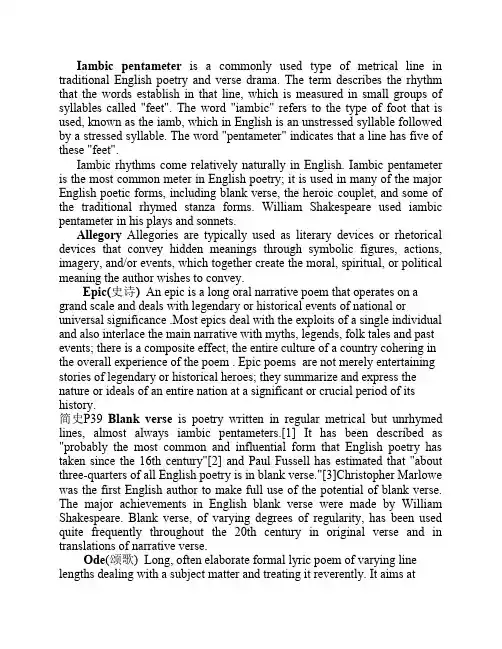
Iambic pentameter is a commonly used type of metrical line in traditional English poetry and verse drama. The term describes the rhythm that the words establish in that line, which is measured in small groups of syllables called "feet". The word "iambic" refers to the type of foot that is used, known as the iamb, which in English is an unstressed syllable followed by a stressed syllable. The word "pentameter" indicates that a line has five of these "feet".Iambic rhythms come relatively naturally in English. Iambic pentameter is the most common meter in English poetry; it is used in many of the major English poetic forms, including blank verse, the heroic couplet, and some of the traditional rhymed stanza forms. William Shakespeare used iambic pentameter in his plays and sonnets.Allegory Allegories are typically used as literary devices or rhetorical devices that convey hidden meanings through symbolic figures, actions, imagery, and/or events, which together create the moral, spiritual, or political meaning the author wishes to convey.Epic(史诗) An epic is a long oral narrative poem that operates on a grand scale and deals with legendary or historical events of national or universal significance .Most epics deal with the exploits of a single individual and also interlace the main narrative with myths, legends, folk tales and past events; there is a composite effect, the entire culture of a country cohering in the overall experience of the poem . Epic poems are not merely entertaining stories of legendary or historical heroes; they summarize and express the nature or ideals of an entire nation at a significant or crucial period of its history.简史P39Blank verse is poetry written in regular metrical but unrhymed lines, almost always iambic pentameters.[1] It has been described as "probably the most common and influential form that English poetry has taken since the 16th century"[2] and Paul Fussell has estimated that "about three-quarters of all English poetry is in blank verse."[3]Christopher Marlowe was the first English author to make full use of the potential of blank verse. The major achievements in English blank verse were made by William Shakespeare. Blank verse, of varying degrees of regularity, has been used quite frequently throughout the 20th century in original verse and in translations of narrative verse.Ode(颂歌) Long, often elaborate formal lyric poem of varying line lengths dealing with a subject matter and treating it reverently. It aims atglorifying an individual, commemorating an event, or describing nature intellectually rather than emotionally. Conventionally, many odes are written or dedicated to a specifie subject. For instance,Ode to the West Wind is about the winds that bring change of season in England. Ode to the Nightingale is about the nightingale that lures the poet temporarily away from his great misery. The earliest English odes include the Epithalamion and the Prothalamion,or marriage hymns by poet Edmund Spenser.Metaphysical poetry(玄学诗) a derogatory term invented by John Dryden(1631-1700 ) and later adopted by Samuel Johnson(1709-1784) describing a school of highly intellectual poetry marked by bold and ingenious conceits,incongruous imagery,complexity of thought,frequent use of paradox,and often by deliberate harshness or rigidity of expression.The main themes of metaphysical poets are love,death,and religion.According to them,all things in the universe, no matter how dissimilar they are to each other,are closely unified in God.The chief representative of this school was John Donne.Byronic belonging to or derived from Lord Byron(1788-1824)or his works. The Byronic hero is a character-type found in his celebrated narrative poem Childe Harold’s Pilgrimage(1812-18),his verse drama Manfred(1817),and other works:he is a boldly defiant but bitterly self –tormenting outcast,proudly contemptuous of social norms but suffering for some unnamed sin. Emily Bronte’s Heathcliff in Wuthering Heights(1847)is a later example.Heroic couplet a rhymed pair of iambic pentameter lines:Let Observation with extensive ViewSurvey Mankind, from China to Peru (Johnson)Named from its use by Dryden and others in the heroic drama of the late 17th century,the heroic couplet had been established much earlier by Chaucer as a major English verse-form for narrative and other kinds of non-dramatic portry: it dominated English poetry of the 18th century,notably in the couplets of Pope,before declining in importance in the early 19th century.Soliloquy a dramatic speech uttered by one character speaking aloud while alone on the stage (or while under the impression of being alone).The soliloquist thus reveals his or her inner thoughts and feelings to the audience,either in supposed self-communion or in a consciously direct address. Soliloquies often appear in plays from the age of Shakespeare, notably in his Hamlet and Macbeth. A poem supposedly uttered by a solitaryspeaker,like Robert Browning’s‘Soliloquy of the Spanish Cloister’(1842),may also be called a soliloquy. Soliloquy is a form of monologue,but a monologue is not a soliloquy if (as in the dramatic monologue) the speaker is not alone.简史P39 Sonnet a lyric poem comprising 14 rhyming lines of equal length:iambic pentameters in English,alexandrines inFrench,hendecasyllables in ltalian. The rhyme schemes of the sonnet follow two basic patterns.①The Italian sonnet②The English sonnetSpenserian stanza (宾塞诗体)an English poetic stanza of nine iambic lines, the first eight being pentameters while the ninth is a longer line known either as an iambic hexameter or as an alexandrine.The rhyme scheme is ababbcbcc. The stanza is named after Edmund Spenser,who invented it------probably on the basis of the ottava rima stanza-----for his long allegorical romance The Faerie Queene (1590-6). It was revived successfully by the younger English Romantic poets of the early 19th century: Byron used it for Childe Harold’s Pilgrimage(1812,1816), Keats for‘The Eve of St Agnes’(1820),and Shelley for The Revolt of Islam (1818)and Adonais (1821).Lake poets William Wordsworth, Samuel Taylor Coleridge, and Robert Southey became known as the Lake Poets, because they lived in the Lake District in the northwestern part of England. According to the critics, such as, Francis Jeffrey, Thomas De Quincey, the Lake Poets shared only friendship and brief periods of collaboration, not similar philosophies or poetic styles.Wordsworth used his imaginative powers to idealize nature, Coleridge explored the philosophical aspects of poetry,Southey's Romantic efforts centered on travel and adventure.Stream of Consciousness(意识流) Stream of Consciousness(意识流):Stream of consciousness, which presents the thoughts of a character in the random, seemingly unorganized fashion in which the thinking process occurs, has the following characteristics. First, it reveals the action or plot through the mental processes of the characters rather than through the commentary of an omniscient author. Second, character development is achieved through revelation of extremely personal and often typical thought processes rather than through the creation of typical characters in typical circumstances. Third, the action of the plot seldom corresponds to real, chronological time, but moves back and forth through present time to memories of past eventsand drams of the future. Fourth, it replaces narration, description, and commentary with dramatic interior monologue and free association.Critical Realism(批判现实主义) Critical realism is one of the literary genres that flourished mainly in the 19th century. It reveals the corrupting influence of the rule of cash upon human nature. Here lies the essentially democratic and humanistic character of critical realism. The English critical realists of the 19th century not only gave a satirical portrayal of the bourgeoisie and all the ruling classes, but also showed profound sympathy for the common people. In their best works, they used humor and satire to contrast the greed and hypocrisy of the upper classes with the honesty and good-heartedness of the obscure “simple people” of the lower classes. Humorous scenes set off the actions of the positive characters, and the humor is often tinged with a lyricism which serves to stress the fine qualities of such characters. At the same time,bitter satire and grotesque is used to expose the seamy side of the bourgeois society. The critical realists, however, did not find a way to eradicate the social evils they knew so well. They did not realize the necessity of changing the bourgeois society through conscious human effort. Their works do not point toward revolution but rather evolution or reformism. They often start with a powerful exposure of the ugliness of the bourgeois world in their works, but their novels usually have happy endings or an impotent compromise at the end. Here are the strength and weakness of critical realism.Classicism(古典主义): A movement or tendency in art, music, and literature to retain the characteristics found in work originating in classical Greece and Rome. It differs from Romanticism in that while Romanticism dwells on the emotional impact of a work, classicism concerns itself with form and discipline.Romanticism(浪漫主义) The term refers to the literary and artistic movements of the late 18th and early 19th century. Romanticism rejected the earlier philosophy of the Enlightenment, which stressed that logic and reason were the best response humans had in the face of cruelty, stupidity, superstition, and barbarism. Instead ,the Romantics asserted that reliance upon emotion and natural passions provided a valid and powerful means of knowing and a reliable guide to ethics and living.The Romantic movement typically asserts the unique nature of the individual, the privileged status of imagination and fancy, the value of spontaneity over “artifice” and “convention”, the human need for emotional outlets, the rejection of civilizedcorruption, and a desire to return to natural primitivism and escape the spiritual destruction of urban life Their writings are often set in rural, or Gothic settings and they show an obsessive concern with “innocent”characters----children, young lovers, and animals. The major Romantic poets included William Blake, William Wordsworth, John Keats , Percy Bysshe Shelley, and Lord Gordon Byron.Aestheticism( 美学主义) The basic theory of the Aesthetic movement----“art for art’s sake”----was set forth by a French poet, Theophile Gautier. The first Englishman who wrote about the theory of aestheticism was Walter Pater, the most important critical writer of the late 19th century. The chief representative of the movement in England was Oscar Wilde,with his Picture of Dorian Gray. Aestheticism places art above life, and holds that life should imitate art, not art imitate life. According to the aesthetes, all artistic creation is absolutely subjective as opposed to objective. Art should be free from any influence of egoism. Only when art is for art’s sake,can it be immortal They believed that art should be unconcerned with controversial issues, such as politics and morality, and that it should be restricted to contributing beauty in a highly polished style. This was one of the reactions against the materialism and commercialism of the Victorian industrial era, as well as a reaction against the Victorian convention of art for morality’s sake, or art for money’s sake.Neoclassicism The term mainly applies to the classical tendency which dominated the literature of the early period. It was, at least in part, the result of a reaction against the fires of passion which had blazed in the late Renaissance, especially in the metaphysical poetry. It found its artistic models in the classical literature of the ancient Greek and Roman writers like Homer, Virgil, Horace, Ovid, etc. and in the contemporary French writers such as Voltaire and Diderot. It put the stress on the classical artistic ideals of order, logic, proportion, restrained emotion, accuracy, good taste and decorum.Such elegant styles were found in almost all the writings of the period, especially in those of John Dryden, Alexander Pope,Jonathan Swift, Joseph Addison, Richard Steele, Henry Fielding, Samuel Johnson, Oliver Goldsmith, Edward Gibbon , the man who wrote the famous history The Decline and Fall of the Roman Empire(1776―1788) , and other neoclassicist writers. They were careful imitators. Their approach was thoroughly professional. Their works, mostly refined and perfect, are conscientiouscraftsmanship and often highly didactic. Neoclassical poetry , as represented by Dryden, Pope, and Johnson, reached its stylistic perfection during the period, although to the modem readers it seems to lack in imagination and energy. The neoclassical poetry is one of the most significant phenomena in the literature of the age, to which it has given its name.Naturalism(自然主义): it first appeared in France, there naturalists including Zola turned especially to “slum life”, in England flourished in the 2nd half of 19th century; naturalists argued that literature reflect life, be “true to life”, writer must reproduce in his writings life exactly as it is, (including all details without any selection), theory of “a slice of life”; However, a fallacy, for impossible to include all the details in real life; only give the appearance of life but not its essence. In England, two outstanding writers in the last decades: George Gissing, George Moore.Neo-Romanticism(新浪漫主义): it appeared at the end of 19th century and represented by Robert Louis Stevenson; it protests against the ugly social reality of their day but taking no positive steps about it,in a sense another form of escapism; dissatisfied with the contemporary reality, but at best a mild dissatisfaction; tried to find interest or enjoyment out from sheer imagination and fancy by creating exciting events and romantic characters that can hardly exist in reality,indulge in the description of exciting adventures in distant lands to deal with the heroic, to lay emphasis on the complexity and sensationalism of the material, Treasure Island, the representative in this school.Modernism(现代主义): Around the two world wars, many writers and artists began to suspect and be discontent with the capitalism. They tried to find new ways to express their understanding of the world. It was a movement of experiments in techniques in writing. It flourished in the 20s and 30s in English literature.They turned their interest to describing what was happening in the minds of their characters. Because of their emphasis on the psychological activities of the characters, their writings are also called psychological novels. The Representatives are W.B. Yeats and T.S. Eliot,D.H. Lawrence, E.M. Foster, James Joyce and Virginia Woolf.。

英国文学史习题_51. “If Winter comes, can Spring be far behind?” is an epigrammatic line by ______.A. John KeatsB. William WordsworthC. Percy Bysshe ShelleyD. William Blake2. I Wandered lonely as a Cloud is a ________.A. lyrical poemB. lyrical proseC. romance in proseD. sonnet3. At the turn of the 18th and 19th century, ______ appeared as a new literary trend in England.A. RenaissanceB. ReformationC. RomanticismD. Sentimentalism4. The Glorious Revolution in 1688 marked the beginning ofa (n)_________.A. absolute monarchy B, constitutional monarchyC. military dictatorshipD. democratic system5. The poetic view of _________ can be best understood from his remark about poetry, that is, “all good poetry is the spontaneous overflow of powerful feelings.”A. Samuel Taylor ColeridgeB. John KeatsC. William WordsworthD. Percy Bysshe Shelley6. In English poetry the ______ is regarded as the most common foot.A. iambB. anapestC. trocheeD. dactyl7. The Romantic Period in English literature began with the publication of _________.A. Songs of InnocenceB. Pride and PrejudiceC. Lyrical BalladsD. A Red, Red Rose8. It is generally regarded that Keat s’ most important and mature poems are in the form of _____.A. odeB. elegyC. epicD. sonnet9. We can perhaps describe the west wind in Shelley’s poem Ode to the West Wind with all the following terms EXCEPT _______.A. tamedB. swiftC. proudD. wild10. William Wordsworth asserts that poetry originates from _______.A. formB. reasonC. artistic devicesD. emotion11. The literary form which is fully-developed and the most flourishing during the Romantic Period is ________.A. proseB. dramaC. poetryD. Novel12. The author of Prometheus Unbound is _______.A. ByronB. ShelleyC. PopeD. Coleridge13. ______ is regarded as a “worshipper of nature”.A. John KeatsB. William BlakeC. William WordsworthD. Jane Austen14. Which of the following can NOT describe “Byronic hero”?A. proudB. mysteriousC. noble originD. progressive15. Who is the author of Childe Harold’s Pilgrimage?A. ByronB. BlakeC. KeatsD. Wordsworth16. Which of the following comments on the poem Ode to the West Wind is NOT true?A. The author of the poem is George Gordon Byron.B. The poem is written in the form of terza rima.C. The author gathers a wealth of symbolism in this poem.D. In the poem, the author expresses his eagerness to enjoy the boundless freedom from the reality.17. In his poem, Ode to the West Wind, Shelley intends to present his wind as a central _____ around which the poem weaves various cycles of death and rebirth. (北师大2004)A. conceptB. symbo lC. simileD. metonymy18. Of the following writers, which is NOT the representative of the Romantic Period?A. Samuel Taylor ColeridgeB. John KeatsC. William WordsworthD. John Bunyan19. William Wordsworth advocated all the following EXCEPT ________.A. the use of everyday language spoken by the common peopleB. the expression of the spontaneous overflow of powerful feelingsC. the use of humble and rustic life as subject matterD. the use of elegant wording and inflated figures of speech20. Of the following poets, which is NOT regarded as “Lake Poets”?A. Samuel Taylor ColeridgeB. Robert SoutheyC. William WordsworthD. William Blake21. Generally speaking, English Romanticism refers to the period of _______.A. 1798-1832B. 1660-1789C. 1836-1901D. 1789-183222. Romanticism does not emphasize _______.A. the special qualities of each individual’s mindB. the inner world of the human spiritC. individualityD. the features that men have in common23. Wordsworth thinks that ______ is the only subject of literary interest.A. the life of rising bourgeoisieB. aristocratic lifeC. the life of the royal familyD. common life24. For the Romanticists, _____ is not only the major source of poetic imagery, but also provides the dominant subject matter.A. loveB. manC. natureD. death25. ____ is the leading figure of the English Romantic poetry, the focal poetic voice of the period.A. William BlakeB. William WordsworthC. George Gordon ByronD. Percy Bysshe Shelley26. ______ is a poem based on a traditional Spanish legend ofa great lover and seducer of women.A. Prometheus UnboundB. The Revolt of IslamC. Don JuanD. Childe Harold’s Pilgrimage27. ______ is written in the terza rima form Shelley derived from his reading of Dante.A. Prometheus UnboundB. The Revolt of IslamC. Queen MabD. Ode to the WestWind28. The Romantic Movement expressed a more or less _____ attitude toward the existing social and political conditions.A. positiveB. negativeC. neutralD. indifferent29. William Wordsworth, _________ and______ have often been mentioned as the “Lake Poets”.A. Samuel Taylor Coleridge, George Gordon ByronB. John Keats, Robert SoutheyC. George Gordon Byron, Percy Bysshe ShelleyD. Samuel Taylor Coleridge, Robert Southey30. As a leading Romanticist, George Gordon Byron’s chief contribution is his creation of the “___ hero”, a proud, mysterious rebel figure, of noble origin.A. RomanticB. OrientedC. ByronicD. Tough。