
高一英语上unit7-cultural-relics课件(旧人教版)
- 格式:ppt
- 大小:1.79 MB
- 文档页数:11
Unit 7 Cultural relicsLISTENINGListen to the description of the three culture sites.Complete the map of each site based on what you hear on the tape.List the names and the importance of the sites,and what is being done to protect them.1 We are standing in front of the main building of this old palace.The palace is called the Winter Palace.On the left,there is a statue of a horse.On the right,there is a large stone elephant.The main building is in the centre.Why is the site so important?This site is important because it tells us about how people lived in the past.What steps have been taken to protect the site?Visitors are not allowed to go inside the house.Insead they can walk around the house,and look at the park behind it.There is also a small museum wherevisitors can look at the pictures of the inside of the house.2 We are standing in front of the Sunshine temple.This beautiful temple stands between a lake and the mountain.The temple is an important part of history.Many important things happened here.And many poems had been written about a temple. Water from the lake had distoried the temple.We are trying to save the temple by building a wall between the lake and the temple. We've also moved some of things in the temple to the new museumthat is being built between the mountain and the village.3 Mount Leshan is one of the most beautiful places in China.The mountain is an important part of Chinese history.People come here to look at the beautiful mountains and waterfalls.Over here between Redsun Mountain and the lake is the blue waterfall,one of the biggest in Leshan.Between the lake and village is the Moon Towerwhere people can go look at the moon and the stars at night.There are too many cars in Leshan and the air is becoming polluted.We're trying to limited the number of cars on the mountain and try to use more buses. READINGA CITY OF HEROESWhere there is a river,there is a city.Perhaps this is not always true,but it is true that many of the world's greatest citieshave been built on the banks of a river.The Neva River flows through the centre of St Peterburg in Russia.Three hundred years ago,the Russian Czar Peter the Great came here and built a new capitalSt Petersburg Peter the Great,like his country,was strong and proud.Many great palaces were built during his lifetime.The palaces were large and beautiful,and they often looked like something out of a fairy tale.St Petersburg has also been the centre of many important events in history.In 1941,the Germans tried to destroy the city.It was under attack for 900 days,but the people of the city never gave in.The Germans burned many of the palaces as they left.St Petersburg was almost in ruins:fires burned everywhere.Buildings were destroyed,and paintings and statues lay in pieces on the ground.Restoring the city and its cultural relics seemed impossible,but the people of this great city would not give up,"We will not let our history and culture be destroyed,and we will do everything we can to save our city!"When the Nazis had gone,the people of St Petersburg began rebuilding the city.Pieces of the palaces that had been hidden before the Nazis camecould now be used to rebuild the city and its culture.It was not easy.Painters and workers had to be very careful when they were trying to bring the city back to life. It was difficult to save the palaces and buildingswithout destroying their old beauty.With the help of old paintings and photographs,the people of St Petersburg were able to bring back the beauty of their cultureand history.Now,after years of hard work,parts of statues have been put back together and missing pieces have been replaced. Old paintings,including a portrait of Peter the Greatwhich was found in the snow outside St Petersburg,have been carefully recreated,and the old palaces have been made as wonderful as in the past.today Peter the Great on his bronze horsecan once again look out over the city he built.Like their hero Peter,the people of St Peterburg have shown that dreams can come true.Strong,proud and unitedthe people of St Petersburg are the modern heroes of Russia.INTEGRATING SKILLSReading and writingDear Editor,I live in Paris,France.In my country there is a famous site,called the Chauvet Caves.I am very worried about itbecause some of the cave paintings have been destroyed by air pollution.No,the pollution does not come from cars or factories, but from human beings.Thouands of tourists visit the caves every year.And we should build a website where people can look at the pictures and paintingsYours sincerely,SophieWords and expressions UNIT 7culturalrelicpyramidEgyptStonehengestatuecapsulerepresentincludeNevaSt PetersburgCzarfairy talegive inruinin ruinsburn(burnt;burned,)restoreNazirebuild bring...back to life beauty photograph portrait recreatebronzeuniteartistperiodvasepull downstone Catherine damageset upwebsiteancientprojectbrickdynastyofficialChauvetcavethe Chauvet Cavespollutioncarbondioxidecarbon dioxidsincerelyadj.文化的n.遗物;遗迹;纪念物n.(古代埃及的)金字塔;锥体n.埃及n.史前巨石柱(英国)n.雕像n.太空舱;胶囊vt.代表;表现vt.包括;包含n.涅瓦河(俄罗斯西北部河流) 圣彼得堡(俄罗斯城市)n.(俄国)沙皇n.神话;童话;谎言让步;投降n.废墟;遗迹;毁灭;崩溃成为废墟遭到严重破坏焚烧;烧焦;点(灯)vt.修复;重建n.纳粹党人重建;复原;改造使苏醒;使生动;使活泼n.美;美景;美好的东西n.照片n.肖像;人像vt.再创造;重新创造n.青铜vi.联合;团结n.艺术家n.一段时间;时期n.花瓶;瓶拆毁;推毁;推翻n.石;石头;宝石凯瑟琳(女子名)vt.& n.损害;伤害设立;创立n.站点;网址adj.古代的;古老的n.计划;方案;工程n.砖;砖形物n.朝代;王朝n.官员;公务员adj.官方的;正式的;公务的肖维n.洞穴;窑洞肖维岩洞(法国)n.污染;玷污n.碳元素n.二氧化物二氧化碳adv.真诚地。

The third PeriodTeaching Aims:1. Learn some word formation.2. Learn the grammar item—the Present Perfect Passive Voice.Teaching Important Points:1. The use and form of the Present Perfect Passive Voice.2. Make sure the Ss know how to change the verbal phrases from the Active Voice into the Passive Voice.Teaching Difficult Points:How to use the Present Perfect Passive Voice correctly.Teaching Methods:1. Discussion method to make the Ss master some common word formation.2. Explanation and inductive methods to enable the Ss to master the grammar item better.3. Pair work or group work to make every student work in class.Teaching Aids:1. the blackboard2. a projector and some slidesTeaching Procedures:Greet the whole class as usual.T: First, I’ll check your homework.Retell the text we learned in the last period, using your own words. Now, I’ll give you two minutes to prepare for ter, I’ll ask some students to retell it.T: (Two minutes later.)Are you ready?Ss: Yes.T: OK. Who’d like to have a try? Wang Xin, please.S1:…T: Very good. Thank you for your performance.T: Now, please look at the blackboard. See how the following is formed.(Teacher writes the word “rebuild” on the Bb) who knows?S2: I know. The word “rebuild” is formed by adding a prefix before “build”.T: Do you know the meaning of “re-”?S3:Yes.It means “again”.“Rebuild” means “build again.”Its Chinese meaning is “重建”.T: OK. Very good. Now, open your books and find similar words in the reading passage. I’ll give you three minutes to do the exercise. Do it by yourselves. After that, I’ll check your answers with the whole class. OK?Ss: OK.T: Now, you can begin.T: (After three minutes) Have you finished?Ss: Yes.T: Well. Li Lin, say your answers, please.S4: I find two similar words. They are “replace” and “recreate”.T: Good. Anything else?S5: I think the word “restore” is the same as “rebuild”.T: Very good. Sit down, please. There are three words in the reading passage, whose forms are the same as the word on the blackboard. They are…(Teacher writes them down on the blackboard.)Do you know their Chinese meanings?S6:Yes.They mean “把……放回(原处),取代”“重新创造”“使恢复”.T: Well done. Can you give us some similar examples according to what you’ve learned?S7:Yes.For example: rewrite, retell, reunite.T: Good. Besides the prefix “re-”,we also lea rnt some other prefixes, like “in-”“im-”“dis-”“un-”.Who’s able to think of some examples?S8: Let me try. For example: in-, inexpensive, invisible; im-, impossible, impolite; dis-, discover, disappear; un-,unfair, unhappy.(Teacher writes them down on the Bb.)T: Very good. Now, turn to Page 46.Let’s look at Part 2.Fill in the blanks with the correct forms of the words or phrases in the box. I’ll give you five minutes to do it. When you finish, you may check your answers with your partner. At last, I’ll c heck your answers with the whole class. Are you clear about that?Ss: Yes.T: OK. Begin, please.(Teacher goes among the Ss and answer the questions raised by the students.) T: (Five minutes later.)Are you ready?Ss: Yes.T: Well, I’ll ask some students to say their answers. One student, one sentence. Besides, you need to put the sentences into Chinese.Suggested answers:1. in ruins圆明园曾是园中之园,由来自全国各地的最好的艺术家花了150年的时间所建。

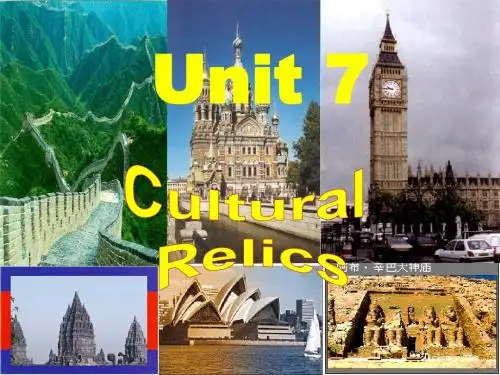
Unit 7 Cultural relicsⅠ.Brief Statements Based on the UnitCultural relics is the main topic of this unit. It contains introducing cultural relics, restoring and rebuilding, as well as protecting them. At the beginning of the unit, there famous cultural Relics are shown in the pictures. The students are asked to use the kind of language needed to talk about them and name the similar ones. Listening asks the students to fill up the pictures, using what we’ve heard. Thus their listening ability can be improved. Speaking is a good exercise. When it is finished, the students’imagination and creativity can be fully improved. Pre-reading, Reading and Post-reading show us a great city-St. Petersburg. The whole text uses the construction of St Petersburg as an example of how cultural relics and sites can be restored or rebuilt, suggesting that they are important part of the city’s and people’s culture. Language study gets the students to learn word formation and grammatical items. Then Integrating skills shows the students a letter of protecting cultural relics and then asks the students to write two letters. In this way, their writing skill will be improved. The students can not only improve their ability tolisten, speak, read and write, but also learn plenty of useful words and expressions. At the same time, they will learn much about cultural relics.Ⅱ. Teaching Aims and DemandsCategory Contents based on the new course standardTopics 1. Talk about cultural relics2. Talk about ways to protect cultural relics3. Giving advice and make suggestionsFunctions Giving advice& Make suggestions: What shall we…? Maybe we could…Shall we…? I’d like to…Can’t we…? What/How about…? Should we…? Why don’t you…? Let’s… Why not…?Words and Expressions cultural pyramid represent include ruin burn restore rebuild beauty photograph portrait recreate unite artist period vase stone damage ancient project brick official cave pollution carbon breath limit sincerelygive in in ruins bring…bank to life pull down set upGrammar The Passive Voice (1)1. The Present Perfect Passive Voice is used to describe something the has been affected or dealt with.e.g. Now, after years of hard word, parts of statues have been put back together and missing pieces have been replaced. Old paintings, …have been carefully recreated, and the old palaces have been made as wonderful as in the past.2. The Present Perfect Passive Voice is used to describe somebody who has accept ed on action or has been dealt with passively. e.g. The sick woman has been sent to hospital , and now you can’t visit her, Jeck has been told about it, so you needn’t call him up.Ⅲ. Teaching Time: Four periodsⅣ.Background Information1. PyramidPyramid is any one of the very large square-based stone monuments, which were constructed by the ancient Egyptians as royal burial places, especially during the Old Kingdom (2614~2818 B.C.), and by the Aztecs and Mayas as centres of ritual worship. The huge pyramid of Khufu at Giza was one of the Seven Wonders of the World.The kings of ancient Egypt planned strong tombs to keep their bodies safe after death and to hold their treasures. Over these tombs huge stone pyramids were built. There are over 80 pyramids in Egypt, but the Great Pyramid is the largest of all.The Great Pyramid was built nearly five thousand years ago for a king called Khufu. It is located on the west bank of the Nile River, not far from Cairo. In fact, all the pyramids along the Nile are on its west bank.The ancient Egyptians compared the rising of the sun to the beginning of life and the setting of the sun to the end of life. This is why their dead were buried on the west bank of the Nile.It is very hard to realize just how big the Great Pyramidis. It has over 2 300 000 blocks of solid stone. These huge stone blocks weigh an much as a small car. Some even weigh fifteen tons. Without machinery, the ancient Egyptians cut and moved and lifted each of these stones. Many of the blocks come from the east bank of the Nile, and they were taken across the river in boats at flood time. It took more than 100 000 slaves twenty years to build the Great Pyramid.The Great Pyramid is over 450 feet high today, and it was once higher. Its base covered thirteen acres. Each of the sides of the pyramid is 755 feet long, or about as long as two city blocks. It takes about twenty minutes to walk all the way around the pyramid.Every king wanted his tomb to be the best. But Khufu outdid them all. The surface of his pyramid used to shine with smooth white limestone, and its top come to a sharp point. Inside, the body was preserved to last forever, and many treasures were buried with him.Now after many centuries, the shining surface is worn away, and men have taken some of the huge stone locks to build other things. Thieves have stolen the treasures, and they have stolen the body of Khufu himself, No doubt this is a matter of regret, but the same thing has happened to manyother ancient tombs.Although the limestone surface is gone, the huge stones are exposed and you can climb then, like steps, to the top. When you have reached the top, you can see for miles about you. You can see the smaller pyramids and the Sphinx, the great stone statue of the lion with a human head. To the west you can see the Libran Desert, and to the east you can see the green Nile valley and the modern city of Cairo.2. What Is the Riddle of Sphinx?斯芬克斯之谜The ancient people of Egypt, Greece, and the Near East all had legends about imaginary creatures with human heads and animal-like bodies. These people built statues of these creatures, called sphinxes to guard their temples and tombs.The sphinx in Greek mythology had the head of a woman and the body of a lion. She is said to have lived on a high rock outside the ancient city of Thebes and stopped all travelers passing by to ask them this riddle:What goes on four feet in the morning, on two feet at noon, and on three feet in the evening? Anyone who couldn’t solve the riddle was eaten by the sphinx. Fox many years, thousands of travelers were said to have suffered this fate. Finallya young man named Oedipus put an end to the sphinx’s evil doings by giving the correct answer. This so enraged the sphinx that she jumped from the mountainside to her death.Now, what do you think is Oedipus’answer to the riddle?The First PeriodTeaching Aims:1. Talk about some cultural relics to make the Ss aware of the importance of protecting cultural relics and protect them.2. Train the Ss’ listening ability.3. Train the Ss’ speaking ability.Teaching Important Points:1. Talk about ways to protect cultural relics.2. How to improve the Ss’ listening ability.3. How to give advice and make suggestions.Teaching Difficult Point:Improve the Ss’ listening ability by listeni ng to some materials.Teaching Methods:1. Talking method to enable the Ss to express themselves freely.2. Listening method to improve the Ss’ listeningability.Teaching Aids:1. a tape recorder2. a projector and some slidesTeaching Procedures:Step Ⅰ.Greetings and Warming upT: Yesterday I asked you to search as much information as possible about cultural relics in the world through the Internet, Now I’ll ask some of you to report the findings.S1:…T: You have done a really great job in searching through the Internet. I also get some information about the cultural relics in the world. Here, I want to show them to you in the form of pictures. (Teacher uses the multimedia to show some pictures and stops at the three pictures)T: Are you familiar with the pictures? Can you tell me anything about them?S2: The first picture is the pyramids in Egypt. And it is one of the Seven Wonders in the World.S3: The second picture is the Great Wall of China. On it there are many tourists and watch towers.T: Have you ever been to the Great Wall?S3: Yes. It is very beautiful. It attracts many tourists from different countries. There is a famous saying about the Great Wall in our country. It is “A man who doesn’t go to the Great Wall is not a true man”.S4: I think the third picture is the mysterious stone circles at Stonehenge.T: Wonderful! Which one would you like to see most? Why?S5: I’d like to see Stonehenge in Britain. Because I don’t know much about it. I think it is very beautiful and full of mystery.S6: …Step Ⅱ.SpeakingT: Yes. Everyone give me his reason about seeing one of the sites, and do most of you think that they are all important to the world? (Yes.) And since they are so important and they are now being destroyed, what is being doing done to protect them? Let’s turn to Page 43 and listen to the description of the three cultural sites.(Before students listen to it, teacher gives students two minutes to go through the requirements.)T: OK. Let’s listen to the tape. I’ll play it three times. The first time I play it, you should listen attentively.You need to complete the map of each site according to what you’ve heard on the tape. The second time I play it, you need to fill in the form. The third time, you need to check your answers. At last, I’ll ask some students to say their answers. If necessary, I’ll play it once again.(Teacher plays the tape for the Ss to finish the tasks. At last, checks the answers with the whole class.) Suggested answers:Step Ⅲ SpeakingT: We’ve found out importance of the three world’sfamous cultural relics. Now we’ll turn our attention to our won culture. You’re asked to design a culture capsule, and this capsule is a large box. It will be sent into space so that anyone who finds it will understand who we are. You can select five things that represent Chinese culture but you can’t put any living things in the capsule. Work in pairs or groups and write down your information and reasons on a piece of paper. Before you do it, you can look at the following expressions on the screen. You’ll find them useful.(Teacher shows the following on the screen)(Give the Ss a few minutes to go through the useful expressions.)T: (After a while) Have you finished?Ss: Yes.T: OK. You can begin. If you have any questions during the discussion, you can ask me. Are you clear about that?Ss: Yes.(Teacher goes among the Ss and takes part in their activities. Meanwhile, answer the question raised by the Ss.)T: (A few minutes later.) Are you ready?Ss: Yes.T: OK. I’ll ask some students to report their answers. One student, one thing. Wang Ting, please.S8: I think we should put the model of the Great Wall in the box.T: Why?S8: Because the Great Wall is one of the seven wonders in the world. It represents the great Chinese people and has a long history.T: Do you agree with him?Ss: Yes.T: OK. Let’s go on.S9: I’d like to choose two photos of the clay figu res of warriors and horses to put in the box.T: Why?S9: Because the clay figures of warriors and horses represent the culture of the Qin Dynasty. It is in a good state of preservation. We can see the Qin Dynasty was a powerful dynasty at that time.T: Very good. Let’s go on.S10: Maybe we can put in one or two cloisonnes. Becausecloisonnes represent Chinese china art. They are unique in workmanship.T: Well done. What else shall we put in?S11: Why not put a small statue of Buddha in?T: Give your reason.S11: Because it represents Buddhism culture of China.T: Good. Li Lin, give your suggestion, please.S12: In my opinion, the Imperial Palace is a miniature of feudalism culture and architectural art, so I put the model of it in.T: Very good. After class, fill in the form using short sentences. Do you understand?Ss: Yes.Step Ⅳ.Summary and HomeworkT: In this class, we’ve done some listening practice about some cultural sites. By listening to it, we’ve realized some cultural sites are being destroyed, so we must take action to protect them. We’ve also done some speaking practice and learnt some useful expressions about giving advice and making suggestions. They are…(Write the useful expressions on the Bb.)After class, you can use the expressions to make a dialogue to use them freely. And youneed do the exercises in Listening and Talking in your workbook on Page 121. OK. Class is over. See you tomorrow.Ss: See you tomorrow!Suggested answers to exercises for Listening:Ex.1. The words mentioned on the tape are: objects, buried, tombs, brick (bricks), wooden, Egyptians, make-up Ex.2.1. Because cultural relics can help us understand how people lived in the past; protecting our cultural relics is a way to help protecting our history; cultural relics can help us understand who we are and where we come from.2. Because most of the things we use in everyday life do not survive or last. Things make of cloth, paper. Wood etc, will not be around after a thousand years.3. We know that the ancient Egyptians lived in houses made of bricks, that ancient Egyptian women wore make-up, and that most people slept slept on wooden beds.4. Because they put everyday objects in the tombs of important people. The tombs were locked and hidden and the things inside were well kept over thousands of years.Sample dialogue:H: Is everybody ready? Then we can begin. Good afternoon, ladies and gentlemen. Thank you for being here today. As youknow, we must try to decide what we’re going to do about the plan to build new houses where the old temple is. I’d like to hear from each of you what you think about the plan. Would you like to start by telling us who you are and what you think we should do?A: Thank you. Yes. I am an expert on cultural relics. My name is Bob White. I want to protect the temple. I believe that it’s a bad idea to build the new houses where the temple is. If we destroy the temple, we’re destroying our history. If we move the temple, we may history. If we move the temple, we may destroy the temple and we won’t be able to look for things on the site.H: What kind of things do you mean?A: There may be clothes or tools of other objects buried around the temple These things can tell us about how people live in the past. We must protect the temple, because it is an important part of our history, because it can teach us about the past, and because it is wrong for us to destroy what our people built in the past.B: I’m…, a businessman. I agree with Mr. White when he says that the temple is important and that we should protect our cultural relics. But we must also think about today andthe future. The people in our village need houses to live in and they need jobs, …C: I’m a villager and I agree with Mr. Jones, Our village needs jobs and houses. …Step Ⅴ.The Design of the Writing on the BlackboardUnit 7 Cultural relicsThe First PeriodAsking for suggestions:What shall we put in?Can’t we put in…?Should we put in…?Making suggestions:Let’s put in…What/How about…?Maybe we could put in…Why not…?I’d like to choose…Why don’t you…?Step Ⅵ.Record after Teaching____________________________________________________________________________________________________________________________。
