
学术英语(管理) Unit 3
- 格式:ppt
- 大小:434.00 KB
- 文档页数:10
(完整word版)学术综合英语英语填空题翻译Unit3
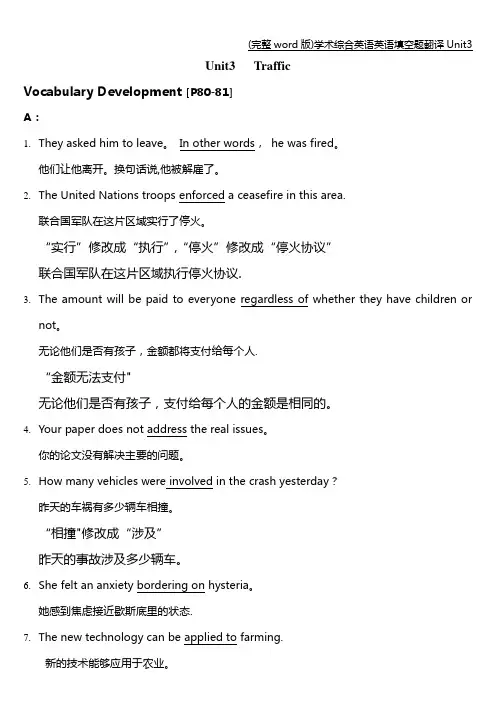
Unit3 Traffic
Vocabulary Development [P80-81]
A:
1. They asked him to leave。 In other words, he was fired。
他们让他离开。换句话说,他被解雇了。
2. The United Nations troops enforced a ceasefire in this area.
联合国军队在这片区域实行了停火。
“实行”修改成“执行”,“停火”修改成“停火协议”
联合国军队在这片区域执行停火协议.
3. The amount will be paid to everyone regardless of
whether they have children or
not。
无论他们是否有孩子,金额都将支付给每个人.
“金额无法支付"
无论他们是否有孩子,支付给每个人的金额是相同的。
4. Your paper does not address the real issues。
你的论文没有解决主要的问题。
5. How many vehicles were involved in the crash yesterday?
昨天的车祸有多少辆车相撞。
“相撞"修改成“涉及”
昨天的事故涉及多少辆车。
6. She felt an anxiety bordering on hysteria。
她感到焦虑接近歇斯底里的状态.
7. The new technology can be applied to farming.
新的技术能够应用于农业。 (完整word版)学术综合英语英语填空题翻译Unit3
8. What do these results suggest to you?
你对这些结果有什么意见?
“意见”修改成“建议”
这些结果对你有怎样的建议?

Unit 3: Writing a Research Paper
In this unit, we will focus on the essential skills and techniques
required for writing a research paper in academic English.
Writing a research paper is a crucial aspect of graduate study, as
it demonstrates the ability to conduct independent research,
analyze data, and effectivelymunicate ideas in written form. This
unit will cover the following topics:
1. Understanding the Structure of a Research Paper
2. Developing a Research Question
3. Conducting Literature Review
4. Organizing Your Thoughts and Ideas
5. Writing a Strong Introduction
6. Presenting Your Methodology
7. Reporting Your Findings
8. Constructing a Compelling Conclusion
9. Referencing and Citations
10. Editing and Proofreading
1. Understanding the Structure of a Research Paper
A research paper typically follows a specific structure, including

精品文档
精品文档 Unit 3 Reviewing Literature
Objectives:
- Learn how to formulate a research problem
- learn how to cite other people’s previous work
- Try to be critical and related in your reviewing
- Avoid plagiarism
Contents
- Reading and discussion: sample introduction and elements in literature review.
- Language focus: tense in citation and citing verbs
- Writing practice: information prominent citation, author prominent citation, and
weak author prominent citation
- Literature reviews related to your research
- No plagiarism
- Classroom extension: literature review of the social effects of tourism on developing
countries
1. Reading Activity
1.1 Pre-reading Task
A literature review is not just a summary of what you have read. It focuses on a
specific topic of interest to you and includes a critical analysis of relationship among
精品文档
精品文档 Unit 3 Reviewing Literature
Objectives:
- Learn how to formulate a research problem
- learn how to cite other people’s previous work
- Try to be critical and related in your reviewing
- Avoid plagiarism
Contents
- Reading and discussion: sample introduction and elements in literature review.
- Language focus: tense in citation and citing verbs
- Writing practice: information prominent citation, author prominent citation, and
weak author prominent citation
- Literature reviews related to your research
- No plagiarism
- Classroom extension: literature review of the social effects of tourism on developing
countries
1. Reading Activity
1.1 Pre-reading Task
A literature review is not just a summary of what you have read. It focuses on a
specific topic of interest to you and includes a critical analysis of relationship among