
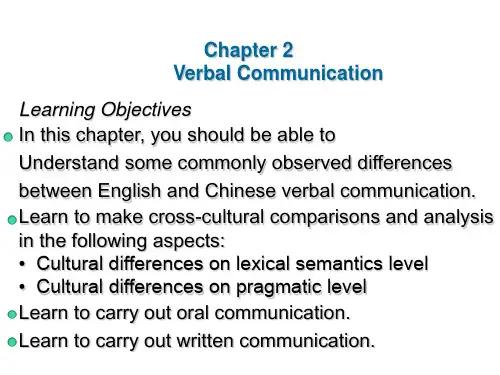
Verbal Communication
- 格式:ppt
- 大小:327.00 KB
- 文档页数:35

(完整word版)《跨文化交际英语实用教程》名词解释
《跨文化交际英语实用教程》名词解释
Define the following terms:
1. Culture: it refers to a learned set of shared interpretations about beliefs, values,
norms and social practices, which affect the behaviors of a relatively large group
of
people. 文化:它是指一组学习者对信仰、价值观、规范和社会实践的共同理解,从而影响了一个相对大的群体的行为。
2. Intercultural communication:
It is communication between people from different
cultural backgrounds, or it refers to communication between people whose
cultural
perceptions and symbol systems are distinct enough to alter the communication event.
跨文化交际:它是来自不同文化背景的人们之间的交流,也就是说,人们的文化观念和符号系统之间的沟通是不同的,足以改变交际活动。
3. Denotative meaning tends to be described as the definitional, literal,
obvious or
commonsense meaning of a word. 外延意义往往被描述为定义,文字,一个词明显或常识性的意义。
4. Connotative meaning is used to refer to the socio—cultural associations of the word.
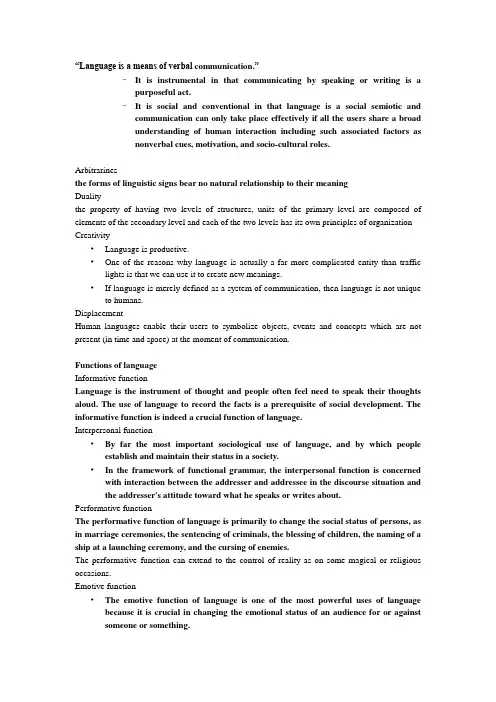
“Language is a means of verbal communication.”
– It is instrumental in that communicating by speaking or writing is a
purposeful act.
– It is social and conventional in that language is a social semiotic and
communication can only take place effectively if all the users share a broad
understanding of human interaction including such associated factors as
nonverbal cues, motivation, and socio-cultural roles.
Arbitrarines
the forms of linguistic signs bear no natural relationship to their meaning
Duality
the property of having two levels of structures, units of the primary level are composed of
elements of the secondary level and each of the two levels has its own principles of organization
Creativity
• Language is productive.
• One of the reasons why language is actually a far more complicated entity than traffic

人类沟通的方式英语作文
English:
Human communication is a complex process that involves the
exchange of information, ideas, thoughts, and feelings through
verbal, non-verbal, and written channels. Verbal communication,
which includes spoken and written language, is perhaps the most
common form of human interaction. Through words, people convey
their thoughts, share information, and express emotions. Non-verbal
communication, on the other hand, includes gestures, body
language, facial expressions, and tone of voice. These non-verbal
cues often convey more meaning than words alone and can greatly
influence the way a message is perceived. Written communication,
encompassing letters, emails, texts, and social media posts, allows
people to communicate over distances and across time, enabling the
sharing of ideas and information on a global scale. Additionally,

八年级上册第二单元英语笔记
In the second unit of the eighth-grade English textbook, students delve into the world
of communication and the various forms it takes. This unit explores the nuances of verbal
and non-verbal communication, emphasizing the importance of effective communication
skills in everyday life. From understanding body language to mastering public speaking,
students are equipped with valuable tools to navigate social interactions and express
themselves confidently.
The unit commences by introducing the fundamental aspects of communication. It
elucidates the difference between verbal and non-verbal communication, elucidating how
both play crucial roles in conveying messages. Verbal communication encompasses
spoken words, while non-verbal communication involves gestures, facial expressions,
and body language. Through interactive activities and examples, students grasp the