六年级(上册)英语重点单词、重点句子总复习试题
- 格式:doc
- 大小:28.23 KB
- 文档页数:8
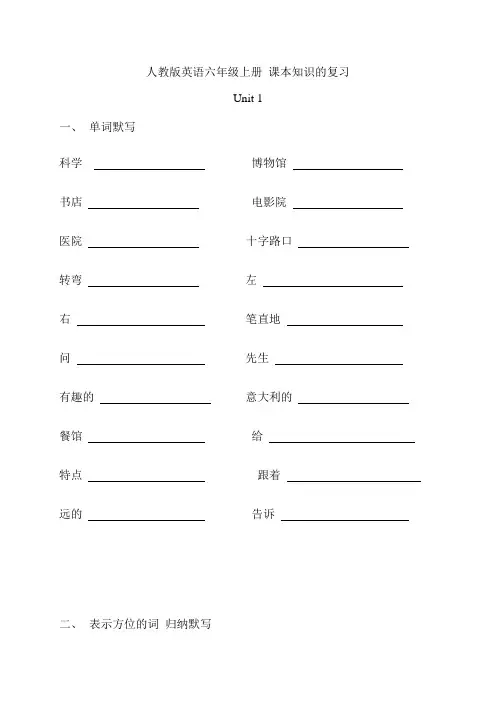
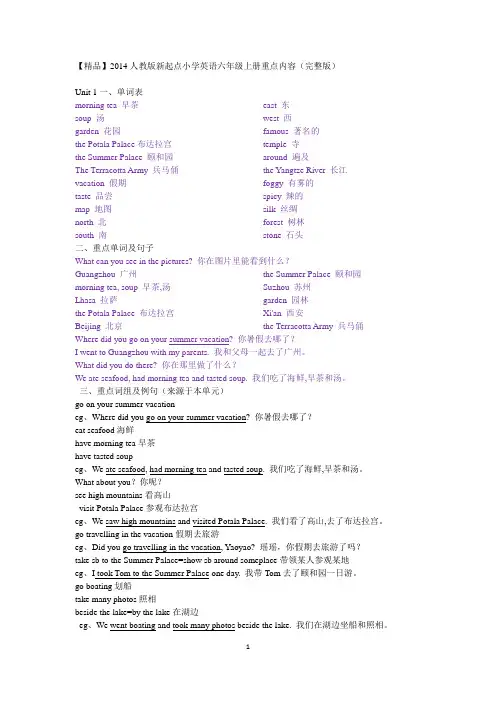
PEP六年级上册四会单词及句子复习Unit1 第一单元四会单词:Science museum科学博物馆 post office邮局 bookstore书店cinema电影院 hospital医院 crossing十字路口 turn left向左转 go straight直走 turn right向右转四会句子:1-- Where is the museum shop?博物馆的商店在哪儿?--It`s near the door在大门附近2 --How can we get there?我们怎么到那儿?--Turn left at the bookstore到书店左转Unit2 第二单元四会单词:on foot走路 by bus乘公共汽车 by taxi乘出租车 by plane乘飞机 by subway乘地铁 by ship乘船 by train乘火车 slow down减速 stop停下 wait等 go走四会句子:1-- How do you come to school? 你怎么来学校的?--Usually, I come on foot通常我走路来2 In the USA people on bikes must wear one.在美国骑自行车的人必须戴头盔。
3 Don’t go at the red light! 别闯红灯。
4 I must pay attention to the traffic lights我必须注意交通信号灯Unit3第三单元四会单词:visit my grandparents拜访我的外祖父母 see a film看电影take a trip远行 go to the supermarket去超市 dictionary词典 comic book连环画书 word book单词书 postcard明信片四会句子:1 --What are you going to do tomorrow? 你明天打算做什么?--I’m going to have an art lesson.我要上美术课2 We’re going to draw some pictures in Renmin Park.我要到人民公园去画画3 --Where are you going? 你们打算去哪儿?--We`re going to the cinema我们打算去电影院4 When are you going? 你们什么时候去?Unit4 第四单元四会单词:dancing跳舞 singing唱歌 reading stories看故事书 playing football 踢足球doing kung fu打功夫 cooks Chinese food做中国菜 studies Chinese 学习汉语 does word puzzles猜字谜 goes hiking远足四会句子:1 --What are Peter `s hobbies? 彼得有什么爱好? --He likes reading stories他喜欢读故事2 --Does he live in Sydney? 他住在悉尼吗? --No, he doesn`t不,他没有3 --Does he like doing word puzzles and going hiking? 他喜欢猜字谜和远足吗?--Yes, he does是的,他喜欢Unit5第五单元四会单词:factory worker工厂工人 postman邮递员 businessman生意人police officer警察 fisherman渔民 scientist科学家 pilot飞行员coach教练四会句子:1 --What does he do? 他是做什么的?--He is a businessman.他是商人2--Where does he work? 他在哪儿工作?-- He works at sea. 他在海上工作。
3 --How does he go to work? 他怎么上班?--He goes to work by bike.他骑自行车上班。
Unit6第六单元四会单词:angry生气的 afraid害怕的 sad悲伤地 worried担心的happy开心的 see a doctor看医生 do more exercise做更多的锻炼take a deep breath深深吸一口气 wear warm clothes穿暖和的衣服 count to ten数到十四会句子:1 They’re afraid of him.它们害怕它2The cat is angry with them. 这只猫生它们的气。
3 What`s wrong?怎么了?Your father is ill.你爸爸生病了。
4 He should see a doctor his morning.他今天早上应该去看病。
5 Don`t be sad.别伤心!PEP六年级上册常用句型问路和指路-Where is+地点名词?……在哪儿? -It’s+介词短语. 在……。
-How can we/I get(to)...?我们/我怎么到……呢?-Turn left/right./Go straight./You can go by+交通工具. 左/右转。
直走。
/你可以乘坐……去那儿。
询问并回答对方来或去某地的交通方式:How do you come/go(to)+地点?你/你们怎么来/去……I/We come/go(to)+地点+by bike/on foot….我/我们骑自行车/步行……来/去……询问对方某个时间打算做某事的句型及答语:-What are you going to do +表示将来的时间?你……打算去做什么?-I’m going to +动词原形+将来的时间. 我打算……去做……询问对方打算去哪儿的句型及答语:Where are you going (+表示将来的时间)? 你(……)打算去哪儿?I’m going to +表示地点的名词.我打算……去….询问对方打算什么时候去做某事的句型及答语:When are you going(+动词原形)?你打算什么时候去(……)?I am going to +动词原形+将来时间.我打算……去……。
注:be going to +动词原形=will+ 动词原形询问别人的爱好并作出回答:What is/are 某人的 hobby/hobbies? ……有什么爱好?=(What do/does 某人 like?)主语+like/likes +动词-ing+其他. ……喜欢做……=某人的hobby is/are….某人的爱好是...。
助动词does引导的一般疑问句及答语:Does+第三人称单数主语+动词原形+其他?……做……吗? -Yes,he/she/it does. No,he/she/it doesn’t.是的,他/她/它是。
不,他/她/它不是。
询问他人的职业并作出回答:What do /does +主语+do?......是做什么的?=What be +某人?主语+be动词+a/an +职业名词. ……是……询问他人的工作地点并作出回答:Where do/does +主语+ work? ……在哪儿工作?主语+work/works+表示地点的副词或介词短语。
……在……工作。
询问他人怎么去上班:How do/does +主语+ go to work?主语+go to work+by bike/on foot….询问他人正在做什么及描述正在做某事:What+be+某人+doing?主语+be动词+动词-ing+其他….正在…Don’t祈使句:Don’t+动词原形+其他. 不要……Don’t+b e+形容词+其他. 不要……表达对某人或某事的关心:What’wrong (with +某人)?描述及提问某人的感受的句型:How+do/does 某人+feel? 主语+feel/feels+(表示感受的)形容词+其他.=主语+be动词+(表示感受的)形容词+其他. ……是……用should来给对方提建议及征求意见的句型:What should 某人+do? 某人should+动词原形.你应该…..语法复习一、现在进行时态(3种变化规律)1. 直接加ing:do—doing draw—drawing cook—cooking answer—answering r ead—reading listen—listening fly—flying sing—singing play—pl aying2. 去掉末尾的e加ing:write—writing dance—dancing take—taking have—having make —making ride—riding dive—diving3. 双写末尾字母加ing:get—getting run—running swim—swimming sit—sitting put—p utting你正在干什么?What are you doing? I’m answering the phone. 他/她/它正在干什么?What is he/she/it doing? He’s/She’s/It’s…他(她、它)们正在干什么?What are they doing? They are …看到like或likes后面的动词要加上ing二、一般将来时态 (be going to/will + 动词原形)表示一般将来时的时间状语有:this morning, this afternoon, this evening, tomorrow, tonight, this we ekend, on the weekend, next week, next month, next year, next week end.例:(今晚)你将要做什么?What are you going to do (this evening)?—I’m going to the cinema. I’m going to visit my grandparents.你将什么时候去? When are you going? —I’m going at 7:10. 你将怎样去呢? How are you going? —I’m going by bus.今天下午你将要去哪里?Where are you going this afternoon? —I’m going to the bookstore.你将要买什么呢?What are you going to buy?I’m going to buy a comic book.你将和谁一起去? Who are you going with?I’m going with my parents.三、第三人称单数后面的动词要加s或es1. 一般情况加s,如:read—reads;live—lives;play—plays;sing—sings2. 动词末尾以s,x,ch,sh或部分以o结尾的加es(记住课本中出现的这几个:watches, teaches, goes, does, washes, passes)3. 辅音字母+y结尾的把y变i再加es,如:fly—flies;study—studies4. 特殊情况:have--has5. 第三人称单数包括:he; she; it; my father/friend; Amy/Hangzhou 等一个人名或地名。