
英语专业四级便条写作范文
- 格式:pdf
- 大小:431.73 KB
- 文档页数:15

英语四级真题应用文范文 篇1
The population on earth is increasing rapidly, and with the developmcnr of modern industry,
more and more people are flowing into cities. So, the housing problem in big cities is
becoming more and more serious.
There have been many suggested solutions to this problem. And I\'m in favour of the idea of
building satellite cities in suburbs. The fresh air and beautiful scenery will attract people to
leave the overcrowdedcity. With many people leaving the city, more space will be available
for those remaining. We can find a lot of successful examples in other coun tries which solve
the housing problem by building satellite cities.
Meantime, I don\'t think developing to the underground will help solve the problem. I can
hardly imagine that people will like to live under the ground, withoul the sky and the sun. It
-一,祝贺类
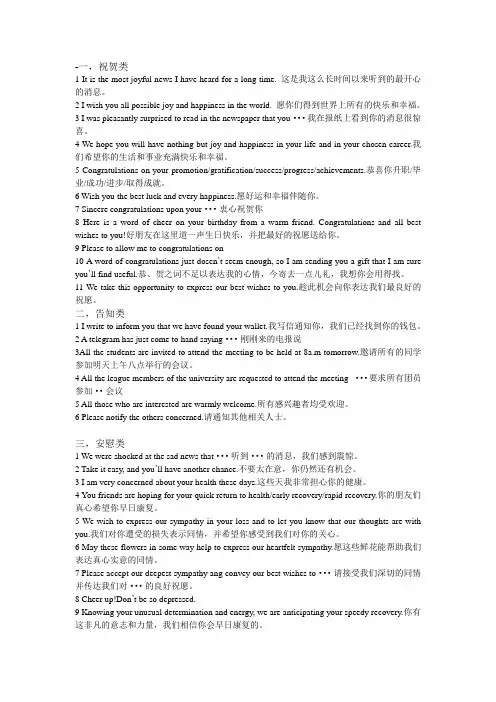
1 It is the most joyful news I have heard for a long time. 这是我这么长时间以来听到的最开心的消息。
2 I wish you all possible joy and happiness in the world. 愿你们得到世界上所有的快乐和幸福。
3 I was pleasantly surprised to read in the newspaper that you···我在报纸上看到你的消息很惊喜。
4 We hope you will have nothing but joy and happiness in your life and in your chosen career.我们希望你的生活和事业充满快乐和幸福。
5 Congratulations on your promotion/gratification/success/progress/achievements.恭喜你升职/毕业/成功/进步/取得成就。
6 Wish you the best luck and every happiness.愿好运和幸福伴随你。
7 Sincere congratulations upon your···衷心祝贺你
8 Here is a word of cheer on your birthday from a warm friend. Congratulations and all best
wishes to you!好朋友在这里道一声生日快乐,并把最好的祝愿送给你。
9 Please to allow me to congratulations on
10 A word of congratulations just dosen’t seem enough, so I am sending you a gift that I am sure

1 英语便条的格式及范文
(共2篇)
以下是网友分享的关于英语便条的格式及范文的资料2篇,希望对您有所帮助,就爱阅读感谢您的支持。 第一篇 英语便条写作的格式句型以及范文 Dieins: Yu hve ike he Russin Ninl Blle Tupe, hih is visiing nd yu n give i yu fiend Alie Wie ne he nd sy: 1) he ie f he sh, ) he ple hee yu ill i f he Yu shuld ie bu 6 ds n 诚挚邀请对方参加某活动 n 介绍活动的内容、时间、地点,相关内容
2 n 再次发出邀请或者期待对方回复 开头用语 ① Will yu d us he fv f jining u py? ② My I ke his ppuniy invie yu u univesiy give leue? ③ If yu hve n he plns f Mndy, My 15h, ill yu e u py y he? ④ I hpe yu ill give e he plesue f yu pny n he sin f dinne ih fe fiends nex Sudy, he 16h his nh, 6 ’lk ⑤ I exending yu u fl inviin ⑥ I is ih he gees plesue h I ie dilly invie yu end he eeing ⑦ I gives e he gees plesue invie yu visi his exhibiin ⑧ Will yu give he plesue f dining ih us he Beijing Hel n Sundy, Obe he enh, eigh ’lk p? 结束用语 ① We uld be vey plesed if yu uld hn us ih yu pny Aniiping yu eply ② I hpe yu n’ deline y inviin ③ We hpe yu n e nd lk fd seeing yu le ④ We e niiping yu eply ⑤ Aiing n ely epne f u dil inviin nd ih kind egds Sundy De Alie, Hee is piee f gd nes f yu The Russin Ninl Blle Tupe ill give

Notewriting(便条写作)
1.便条的特点及要求
便条是完成介绍、预约、道歉、请求、致谢、投诉等功能的简短的书信形式。
(1)特点
A.构件简单(simple)
书信由7个部分组成:
发信人信息(包括地址、邮编、写信时间)
收信人信息(如果彼此熟悉,此部分可省去不写)
对收信人的称呼(后边的标点符号一般用逗号)
正文
结尾客套语(之后一定有逗号)
签名(之后一定不能有标点符号)
职务名称(若写信人不是以集体名义写的,此部分不写)
而便条相对简短,仅仅由时间、对方称呼、正文、结尾客套语和签名组成。如便条
是以集体名义写的,则要添加职务名称。
(2)文体适中(casual)
与书信相比,便条文体的通俗,倾向于非正式化、始终口语化的语言。
书信中,除了和亲近的、熟悉的人交流,一般不用缩略形式,如I'm,we’re,it’s,
couldn’t等。
一般要用较为正式的、略显复杂的语言结构,即句子完整、复杂而且比较长的
句子;而便条不拘泥于此。
书信中,除了和亲近的、熟悉的人交流,一般用词较正式,如“Wearegreatly
honoredtowritetoyou”;“witnessed”等;而便条中可以用比较随意的“I’msorry;
manythanks”等等。
但是,以上区别并非绝对,如在双方地位悬殊或非常陌生的情况下,便条用正式的
文体也是合理的。
(3)内容凝练(preciseandtothepoint)
(4)规矩细腻
日期写法:“月日(基数词),年”法,如Sep.23,2011;或“日(序数词)月
年”法,如“23rdSep.2011”。为避免失误,建议一般用第一种,注意“日”
与“年”之间要用逗号。月份的写法除五月(May)外,其余均可用简写形式:
Jan.,Feb.,Mar.,Apr.,Aug.Sep.,Oct.,Nov.和Dec.等,但考试时写全称保险。
称呼的写法
1)对有一定社会距离、不熟悉的人:DearMadam,DearSir,DearPresident,