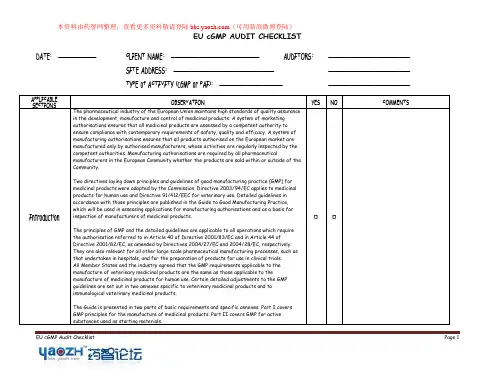
EU cGMP Audit Checklist Page 1EU cGMP AUDIT CHECKLISTDATE: ____________ CLIENT NAME: ____________________________ AUDITORS: __________________________ SITE ADDRESS: __________________________________________________________TYPE of ACTIVITY (cGMP or PAI): ______________________________________________APPLICABLE SECTIONSOBSERVATIONYESNOCOMMENTSIntroductionThe pharmaceutical industry of the European Union maintains high standards of quality assurance in the development, manufacture and control of medicinal products. A system of marketing authorisations ensures that all medicinal products are assessed by a competent authority to ensure compliance with contemporary requirements of safety, quality and efficacy. A system of manufacturing authorisations ensures that all products authorised on the European market are manufactured only by authorised manufacturers, whose activities are regularly inspected by the competent authorities. Manufacturing authorisations are required by all pharmaceuticalmanufacturers in the European Community whether the products are sold within or outside of the Community.Two directives laying down principles and guidelines of good manufacturing practice (GMP) for medicinal products were adopted by the Commission. Directive 2003/94/EC applies to medicinal products for human use and Directive 91/412/EEC for veterinary use. Detailed guidelines in accordance with those principles are published in the Guide to Good Manufacturing Practice, which will be used in assessing applications for manufacturing authorisations and as a basis for inspection of manufacturers of medicinal products.The principles of GMP and the detailed guidelines are applicable to all operations which require the authorisation referred to in Article 40 of Directive 2001/83/EC and in Article 44 ofDirective 2001/82/EC, as amended by Directives 2004/27/EC and 2004/28/EC, respectively. They are also relevant for all other large scale pharmaceutical manufacturing processes, such as that undertaken in hospitals, and for the preparation of products for use in clinical trials. All Member States and the industry agreed that the GMP requirements applicable to the manufacture of veterinary medicinal products are the same as those applicable to themanufacture of medicinal products for human use. Certain detailed adjustments to the GMP guidelines are set out in two annexes specific to veterinary medicinal products and to immunological veterinary medicinal products.The Guide is presented in two parts of basic requirements and specific annexes. Part I covers GMP principles for the manufacture of medicinal products. Part II covers GMP for active substances used as starting materials.EU cGMP Audit ChecklistPage 2Chapters of Part I on “basic requirements” are headed by principles as defined in Directives2003/94/EC and 91/412/EEC. Chapter 1 on Quality Management outlines the fundamental concept of quality assurance as applied to the manufacture of medicinal products. Thereafter, eachchapter has a principle outlining the quality assurance objectives of that chapter and a text which provides sufficient detail for manufacturers to be made aware of the essential matters to be considered when implementing the principle.Part II was newly established on the basis of a guideline developed on the level of ICH and publishe d as ICH Q7a on “active pharmaceutical ingredients”, which was implemented as GMP Annex 18 for voluntary application in 2001. According to the revised Article 47 and Article 51, respectively, of the Directive 2001/83/EC and Directive 2001/82/EC, as amended, detailed guidelines on the principles of GMP for active substances used as starting materials shall be adopted and published by the Commission. The former Annex 18 has been replaced by the new Part II of the GMP Guide, which has an extended application both for the human and the veterinary sector.In addition to the general matters of Good Manufacturing Practice outlined in Parts I and II, a series of annexes providing detail about specific areas of activity is included. For some manufacturing processes, different annexes will apply simultaneously (e.g. annex on sterile preparations and on radiopharmaceuticals and/or on biological medicinal products).A glossary of some terms used in the Guide has been incorporated after the annexes.The Guide is not intended to cover security aspects for the personnel engaged in manufacture. This may be particularly important in the manufacture of certain medicinal products such ashighly active, biological and radioactive medicinal products. However, those aspects are governed by other provisions of Community or national law.Throughout the Guide it is assumed that the requirements of the Marketing Authorisationrelating to the safety, quality and efficacy of the products are systematically incorporated into all the manufacturing, control and release for sale arrangements of the holder of the Manufacturing Authorisation.The manufacture of medicinal products has for many years taken place in accordance with guidelines for Good Manufacturing Practice and the manufacture of medicinal products is not governed by CEN/ISO standards. Harmonised standards as adopted by the European standardisation organisations CEN/ISO may be used at industry’s discretion as a tool forimplementing a quality system in the pharmaceutical sector. The CEN/ISO standards have been considered but the terminology of these standards has not been implemented in this third edition of the Guide.EU cGMP Audit Checklist Page 3It is recognised that there are acceptable methods, other than those described in the Guide, which are capable of achieving the principles of Quality Assurance. The Guide is not intended to place any restraint upon the development of any new concepts or new technologies which have been validated and which provide a level of Quality Assurance at least equivalent to those set out in this Guide. It will be regularly revised.EU cGMP Audit ChecklistPage 4APPLICABLESECTIONSOBSERVATION YES NO COMMENTS 1.0 QualityManagementPrinciples ∙Does the sponsor’s quality management appear to satisfy the criteria outlined in the principlesas detailed in the following statement?The holder of a Manufacturing Authorisation must manufacture medicinal products so as to ensure that theyare fit for their intended use, comply with the requirements of the Marketing Authorisation and do not placepatients at risk due to inadequate safety, quality or efficacy. The attainment of this quality objective is theresponsibility of senior management and requires the participation and commitment by staff in many differentdepartments and at all levels within th e company, by the company’s suppliers and by the distributors. To achievethe quality objective in a reliable manner there must be a comprehensively designed and correctly implementedsystem of Quality Assurance incorporating Good Manufacturing Practice and thus Quality Control. It should befully documented and its effectiveness monitored. All parts of the Quality Assurance system should beadequately resourced with competent personnel, and suitable and sufficient premises, equipment and facilities.There are additional legal responsibilities for the holder of the Manufacturing Authorisation and for theQualified Person(s).Quality Assurance ∙Is the QA group of the firm adhering to the major milestones outlined below?Quality Assurance is a wide ranging concept which covers all matters which individually or collectively influencethe quality of a product. It is the total sum of the organised arrangements made with the object of ensuringthat medicinal products are of the quality required for their intended use. Quality Assurance thereforeincorporates Good Manufacturing Practice plus other factors outside the scope of this Guide. The system ofQuality Assurance appropriate for the manufacture of medicinal products should ensure that:i.medicinal products are designed and developed in a way that takes account of the requirements of GoodManufacturing Practice and Good Laboratory Practice;ii.production and control operations are clearly specified and Good Manufacturing Practice adopted;iii.managerial responsibilities are clearly specified;iv.arrangements are made for the manufacture, supply and use of the correct starting and packaging materials;v.all necessary controls on intermediate products, and any other in-process controls and validations are carried out;vi.the finished product is correctly processed and checked, according to the defined procedures;vii.medicinal products are not sold or supplied before a Qualified Person has certified that each production batch has been produced and controlled in accordance with the requirements of the Marketing Authorisation and any otherregulations relevant to the production, control and release of medicinal products;viii.satisfactory arrangements exist to ensure, as far as possible, that the medicinal products are stored, distributed and subsequently handled so that quality is maintained throughout their shelf life;ix.there is a procedure for Self-Inspection and/or quality audit which regularly appraises the effectiveness andapplicability of the Quality Assurance system.cGMP ∙Does the QA group adhere to cGMP concepts as outlined below?Good Manufacturing Practice is that part of Quality Assurance which ensures that products are consistentlyproduced and controlled to the quality standards appropriate to their intended use and as required by theMarketing Authorisation or product specification. Good Manufacturing Practice is concerned with bothproduction and quality control. The basic requirements of GMP are that:EU cGMP Audit Checklist Page 51.0 Quality Managementi.all manufacturing processes are clearly defined, systematically reviewed in the light of experience and shown to be capable of consistently manufacturing medicinal products of the required quality and complying with their specifications;ii. critical steps of manufacturing processes and significant changes to the process are validated; iii. all necessary facilities for GMP are provided including: iv. appropriately qualified and trained personnel; v. adequate premises and space; vi. suitable equipment and services;vii. correct materials, containers and labels; viii. approved procedures and instructions; ix. suitable storage and transport;x. instructions and procedures are written in an instructional form in clear and unambiguous language, specifically applicable to the facilities provided;xi. operators are trained to carry out procedures correctly;xii.records are made, manually and/or by recording instruments, during manufacture which demonstrate that all thesteps required by the defined procedures and instructions were in fact taken and that the quantity and quality of the product was as expected. Any significant deviations are fully recorded and investigated;xiii. records of manufacture including distribution which enable the complete history of a batch to be traced, are retained in a comprehensible and accessible form;xiv. the distribution (wholesaling) of the products minimises any risk to their quality; xv. a system is available to recall any batch of product, from sale or supply;xvi.complaints about marketed products are examined, the causes of quality defects investigated and appropriate measures taken in respect of the defective products and to prevent reoccurrence.Quality Control∙ Does the QA group adhere to the QC principles outlined below?Quality Control is that part of Good Manufacturing Practice which is concerned with sampling, specifications and testing, and with the organisation, documentation and release procedures which ensure that the necessary and relevant tests are actually carried out and that materials are not released for use, nor products released for sale or supply, until their quality has been judged to be satisfactory. The basic requirements of Quality Control are that:i.adequate facilities, trained personnel and approved procedures are available for sampling, inspecting and testing starting materials, packaging materials, intermediate, bulk, and finished products, and where appropriate for monitoring environmental conditions for GMP purposes;ii. samples of starting materials, packaging materials, intermediate products, bulk products and finished products are taken by personnel and by methods approved by Quality Control; iii. test methods are validated;iv. records are made, manually and/or by recording instruments, which demonstrate that all the required sampling, inspecting and testing procedures were actually carried out. Any deviations are fully recorded and investigated; v.the finished products contain active ingredients complying with the qualitative and quantitative composition of the Marketing Authorisation, are of the purity required, and are enclosed within their proper containers and correctly labelled;vi.records are made of the results of inspection and that testing of materials, intermediate, bulk, and finished products is formally assessed against specification. Product assessment includes a review and evaluation of relevant production documentation and an assessment of deviations from specified procedures;vii. no batch of product is released for sale or supply prior to certification by a Qualified Person that it is in accordance with the requirements of the Marketing Authorisation;viii.sufficient reference samples of starting materials and products are retained to permit future examination of theEU cGMP Audit Checklist Page 61.0 Quality Managementproduct if necessary and that the product is retained in its final pack unless exceptionally large packs are produced.Product QualityReviewDoes the QA group adhere to the following principles regarding product quality review?Regular periodic or rolling quality reviews of all licensed medicinal products, including export only products, should be conducted with the objective of verifying the consistency of the existing process, theappropriateness of current specifications for both starting materials and finished product to highlight any trends and to identify product and process improvements. Such reviews should normally be conducted and documented annually, taking into account previous reviews, and should include at least:i. A review of starting materials and packaging materials used for the product, especially those from new sources; ii. A review of critical in-process controls and finished product results;iii. A review of all batches that failed to meet established specification(s) and their investigation;iv. A review of all significant deviations or non-conformances, their related investigations, and the effectiveness of resultant corrective and preventative actions taken;v. A review of all changes carried out to the processes or analytical methods;vi. A review of Marketing Authorisation variations submitted/granted/refused, including those for third country (export only) dossiers;vii. A review of the results of the stability monitoring programme and any adverse trends;viii. A review of all quality-related returns, complaints and recalls and the investigations performed at the time; ix. A review of adequacy of any other previous product process or equipment corrective actions;x. For new marketing authorisations and variations to marketing authorisations, a review of post-marketing commitments;xi. The qualification status of relevant equipment and utilities, e.g. HVAC, water, compressed gases, etc; xii.A review of Technical Agreements to ensure that they are up to date.The manufacturer and marketing authorisation holder, where different, should evaluate the results of thisreview and an assessment should be made whether corrective and preventative action or any revalidation should be undertaken. Reasons for such corrective actions should be documented. Agreed corrective and preventative actions should be completed in a timely and effective manner. There should be management procedures for the ongoing management and review of these actions and the effectiveness of these procedures verified during self inspection. Quality reviews may be grouped by product type, e.g. solid dosage forms, liquid dosage forms, sterile products, etc. where scientifically justified.Where the marketing authorisation holder is not the manufacturer, there should be a technical agreement in place between the various parties that defines their respective responsibilities in producing the quality review. The Qualified Person responsible for final batch certification together with the marketing authorisation holder should ensure that the quality review is performed in a timely manner and is accurate.EU cGMP Audit Checklist Page 7APPLICABLE SECTIONS OBSERVATIONYESNOCOMMENTS2.0 PersonnelPrinciple∙ Does the sponsor have adequate personnel systems in place to meet the criteria outlined in the following statement?The establishment and maintenance of a satisfactory system of quality assurance and the correct manufacture of medicinal products relies upon people. For this reason there must be sufficient qualified personnel to carry out all the tasks which are the responsibility of the manufacturer. Individual responsibilities should be clearly understood by the individuals and recorded. All personnel should be aware of the principles of Good Manufacturing Practice that affect them and receive initial and continuing training, including hygiene instructions, relevant to their needs.General∙ Is the sponsor in compliance with the following statements?2.1 The manufacturer should have an adequate number of personnel with the necessary qualifications and practical experience. The responsibilities placed on any one individual should not be so extensive as to present any risk to quality.2.2 The manufacturer must have an organisation chart. People in responsible positions should have specific duties recorded in written job descriptions and adequate authority to carry out their responsibilities. Their duties may be delegated to designated deputies of a satisfactory qualification level. There should be no gaps or unexplained overlaps in the responsibilities of those personnel concerned with the application of Good Manufacturing Practice.Key Personnel∙ Is the sponsor in compliance with the following areas?2.3 Key Personnel include the head of Production, the head of Quality Control, and if at least one of these persons is not responsible for the duties described in Article 51 of Directive 2001/83/EC,1 the QualifiedPerson(s) designated for the purpose. Normally key posts should be occupied by full-time personnel. The heads of Production and Quality Control must be independent from each other. In large organisations, it may be necessary to delegate some of the functions listed in 2.5, 2.6 and 2.7.2.4 The duties of the Qualified Person(s) are fully described in Article 51 of Directive 2001/83/EC, and can be summarised as follows:a. for medicinal products manufactured within the European Community, a Qualified Person must ensurethat each batch has been produced and tested/checked in accordance with the directives and the marketing authorisation;2 b. for medicinal products manufactured outside the European Community, a Qualified Person mustensure that each imported batch has undergone, in the importing country, the testing specified in paragraph 1 (b) of Article 51; c. a Qualified Person must certify in a register or equivalent document, as operations are carried outand before any release, that each production batch satisfies the provisions of Article 51.The persons responsible for these duties must meet the qualification requirements laid down in Article 493 of2.0 Personnelthe same Directive, they shall be permanently and continuously at the disposal of the holder of theManufacturing Authorisation to carry out their responsibilities. Their responsibilities may be delegated, butonly to other Qualified Person(s).2.5 The head of the Production Department generally has the following responsibilities:i.to ensure that products are produced and stored according to the appropriate documentation inorder to obtain the required quality;ii.to approve the instructions relating to production operations and to ensure their strictimplementation;iii.to ensure that the production records are evaluated and signed by an authorised person before theyare sent to the Quality Control Department;iv.to check the maintenance of his department, premises and equipment;v.to ensure that the appropriate validations are done;vi.to ensure that the required initial and continuing training of his department personnel is carried outand adapted according to need.2.6 The head of the Quality Control Department generally has the following responsibilities:i.to approve or reject, as he sees fit, starting materials, packaging materials, and intermediate, bulkand finished products;ii.to evaluate batch records;iii.to ensure that all necessary testing is carried out;iv.to approve specifications, sampling instructions, test methods and other Quality Control procedures;v.to approve and monitor any contract analysts;vi.to check the maintenance of his department, premises and equipment;vii.to ensure that the appropriate validations are done;viii.to ensure that the required initial and continuing training of his department personnel is carried outand adapted according to need.Other duties of the Quality Control Department are summarised in Chapter 6.2.7 The heads of Production and Quality Control generally have some shared, or jointly exercised,responsibilities relating to quality. These may include, subject to any national regulations:∙the authorisation of written procedures and other documents, including amendments;∙the monitoring and control of the manufacturing environment;∙plant hygiene;∙process validation;∙training;∙the approval and monitoring of suppliers of materials;∙the approval and monitoring of contract manufacturers;∙the designation and monitoring of storage conditions for materials and products;EU cGMP Audit Checklist Page 8EU cGMP Audit Checklist Page 92.0 Personnel∙ the retention of records;∙ the monitoring of compliance with the requirements of Good Manufacturing Practice;∙the inspection, investigation, and taking of samples, in order to monitor factors which may affect product quality.Training∙ Is the sponsor in compliance with the following areas?2.8 The manufacturer should provide training for all the personnel whose duties take them into production areas or into control laboratories (including the technical, maintenance and cleaning personnel), and for other personnel whose activities could affect the quality of the product.2.9 Besides the basic training on the theory and practice of Good Manufacturing Practice, newly recruited personnel should receive training appropriate to the duties assigned to them. Continuing training should also be given, and its practical effectiveness should be periodically assessed. Training programmes should be available, approved by either the head of Production or the head of Quality Control, as appropriate. Training records should be kept.2.10 Personnel working in areas where contamination is a hazard, e.g. clean areas or areas where highly active, toxic, infectious or sensitising materials are handled, should be given specific training.2.11 Visitors or untrained personnel should, preferably, not be taken into the Production and Quality Control areas. If this is unavoidable, they should be given information in advance, particularly about personal hygiene and the prescribed protective clothing. They should be closely supervised.2.12 The concept of Quality Assurance and all the measures capable of improving its understanding and implementation should be fully discussed during the training sessions.Personnel Hygiene∙ Is the sponsor in compliance with the following areas?2.13 Detailed hygiene programmes should be established and adapted to the different needs within the factory. They should include procedures relating to the health, hygiene practices and clothing of personnel.These procedures should be understood and followed in a very strict way by every person whose duties take him into the production and control areas. Hygiene programmes should be promoted by management and widely discussed during training sessions.2.14 All personnel should receive medical examination upon recruitment. It must be the manufacturer’sresponsibility that there are instructions ensuring that health conditions that can be of relevance to the quality of products c ome to the manufacturer’s knowledge. After the first medical examination, examinations should be carried out when necessary for the work and personal health.2.15 Steps should be taken to ensure as far as is practicable that no person affected by an infectious disease or having open lesions on the exposed surface of the body is engaged in the manufacture of medicinal products.2.16 Every person entering the manufacturing areas should wear protective garments appropriate to the operations to be carried out.2.0 Personnel2.17 Eating, drinking, chewing or smoking, or the storage of food, drink, smoking materials or personalmedication in the production and storage areas should be prohibited. In general, any unhygienic practice withinthe manufacturing areas or in any other area where the product might be adversely affected, should beforbidden.2.18 Direct contact should be avoided between the operator’s hands and the exposed product as well as withany part of the equipment that comes into contact with the products.2.19 Personnel should be instructed to use the hand-washing facilities.2.20 Any specific requirements for the manufacture of special groups of products, for example sterilepreparations, are covered in the annexes.EU cGMP Audit Checklist Page 10EU cGMP Audit Checklist Page 11APPLICABLE SECTIONS OBSERVATIONYESNOCOMMENTS3.0 Premises & EquipmentPrinciple∙ Is the sponsor in compliance with the following areas?Premises and equipment must be located, designed, constructed, adapted and maintained to suit the operations to be carried out. Their layout and design must aim to minimise the risk of errors and permit effective cleaning and maintenance in order to avoid cross-contamination, build up of dust or dirt and, in general, any adverse effect on the quality of products.Premises∙ Is the sponsor in compliance with the following areas?General3.1 Premises should be situated in an environment which, when considered together with measures to protect the manufacture, presents minimal risk of causing contamination of materials or products.3.2 Premises should be carefully maintained, ensuring that repair and maintenance operations do not present any hazard to the quality of products. They should be cleaned and, where applicable, disinfected according to detailed written procedures.3.3 Lighting, temperature, humidity and ventilation should be appropriate and such that they do not adversely affect, directly or indirectly, either the medicinal products during their manufacture and storage, or the accurate functioning of equipment.3.4 Premises should be designed and equipped so as to afford maximum protection against the entry of insects or other animals.3.5 Steps should be taken in order to prevent the entry of unauthorised people. Production, storage and quality control areas should not be used as a right of way by personnel who do not work in them.Production Area3.6 In order to minimise the risk of a serious medical hazard due to cross-contamination, dedicated and self contained facilities must be available for the production of particular medicinal products, such as highlysensitising materials (e.g. penicillins) or biological preparations (e.g. from live micro-organisms). The production of certain additional products, such as certain antibiotics, certain hormones, certain cytotoxics, certain highly active drugs and non-medicinal products should not be conducted in the same facilities. For those products, in exceptional cases, the principle of campaign working in the same facilities can be accepted provided thatspecific precautions are taken and the necessary validations are made. The manufacture of technical poisons, such as pesticides and herbicides, should not be allowed in premises used for the manufacture of medicinal products.3.7 Premises should preferably be laid out in such a way as to allow the production to take place in areas connected in a logical order corresponding to the sequence of the operations and to the requisite cleanliness levels.。