
语言学教程5.1
- 格式:ppt
- 大小:655.50 KB
- 文档页数:7


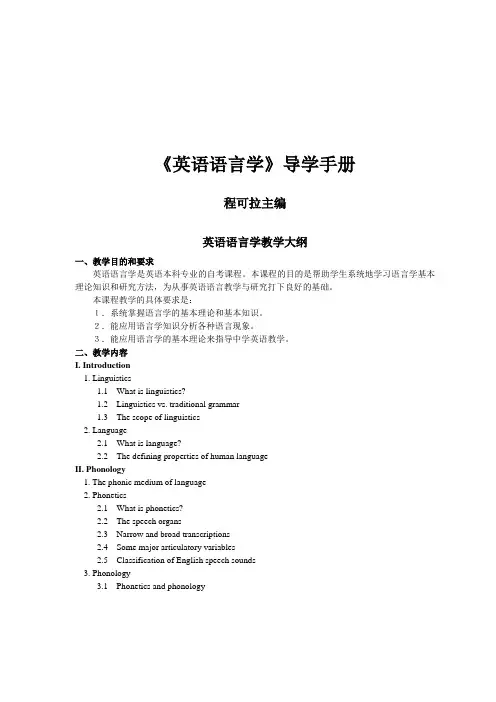
《英语语言学》导学手册程可拉主编英语语言学教学大纲一、教学目的和要求英语语言学是英语本科专业的自考课程。
本课程的目的是帮助学生系统地学习语言学基本理论知识和研究方法,为从事英语语言教学与研究打下良好的基础。
本课程教学的具体要求是:1.系统掌握语言学的基本理论和基本知识。
2.能应用语言学知识分析各种语言现象。
3.能应用语言学的基本理论来指导中学英语教学。
二、教学内容I. Introduction1. Linguistics1.1 What is linguistics?1.2 Linguistics vs. traditional grammar1.3 The scope of linguistics2. Language2.1 What is language?2.2 The defining properties of human languageII. Phonology1. The phonic medium of language2. Phonetics2.1 What is phonetics?2.2 The speech organs2.3 Narrow and broad transcriptions2.4 Some major articulatory variables2.5 Classification of English speech sounds3. Phonology3.1 Phonetics and phonology3.2 Phone, phoneme and allophone3.3 Phonemic contrast, complementary distribution, and minimal pair3.4 Some rules of phonology3.5 Suprasegmental features---Stress, tone, intonationIII. Morphology1. Morphology1.1 Open classes and closed classes1.2 Internal structure of words and rules for word formation2. Morphemes---the minimal units of meaning3. Derivational and inflectional morphemes4. Morphological rules of word formation5. CompoundsIV. Syntax1. Syntax1.1 What is syntax?1.2 Sentence2. Structuralist approach2.1 Form classes2.2 Constituent structure2.3 Immediate constituent analysis2.4 Endocentric and exocentric constructions2.5 Advantage of IC analysis2.6 Labelled tree diagram2.7 Discontinuous constituents3. Transformational-generative grammar3.1 Competence and performance3.2 Criteria for judging grammars3.3 Generative aspect3.4 Transformational aspect3.5 Deep and surface structures4. The Standard Theory4.1 Components of a TG4.2 The base4.3 Transformations4.4 The form of T-rules4.5 The phonological component4.6 The semantic componentV. Semantics1. Semantics1.1 What is semantics?2. Some views on semantics2.1 Naming things2.2 Concepts2.3 Context and behaviourism2.4 Mentalism3. Lexical meaning3.1 Sense and reference3.2 Synonymy3.3 Polysemy and homonymy3.4 Hyponymy3.5 Antonymy3.6 Relational opposites4. Componential analysis4.1 Componets of meaning4.2 Meaning relations in terms of componential analysis5. Sentence meaning5.1 How to define the meaning of a sentence?5.2 Selectional restrictions5.3 Basic statements about meaning6. The semantic structure of sentences6.1 Extended use of componential analysis6.2 Prediction analysis6.3 Subordinate and downgraded predictions6.4 Advantages of predication analysisVI. Pragmatics1. What does pragmatics study?2. Speech act theory3. Principles of conversation3.1 The co-operative principle3.2 The politeness principleVII. Language change1. Introduction2. Sound change3. Morphological and syntactic change3.1 Change in “agreement” rule3.2 Change in negation rule3.3 Process of simplification3.4 Loss of inflections4. V ocabulary change4.1 Addition of new words4.2 Loss of words4.3 Changes in the meaning of words5. Some recent trends5.1 Moving towards greater informality5.2 The influence of American English5.3 The influence of science and technology6. Causes of language changeVIII. Language and society1. The scope of sociolinguistics1.1 Indications of relatedness between language and society1.2 Sociolinguistics vs. traditional linguistic study1.3 Two approaches in sociolinguistics2. Varieties of language2.1 Varieties of language related to the user2.2 Standard dialect2.3 Varieties of language related to the use3. Communicative competence4. Pidgin and creole5. Bilingualism and diglossiaIX. Language and culture1. Introduction2. What is culture?3. Language and meaning4. Interdependence of language and culture5. The significance of cultural teaching and learning6. Linguistics evidence of cultural differences6.1 Greetings6.2 Thanks and compliments6.3 Terms of address6.4 Colour words6.5 Privacy and taboos6.6 Rounding off numbers7. Cultural overlap and diffusion8. ConclusionX. Language acquisition1. Introduction1.1 Language acquisition1.2 The beginning of language1.3 Stages in first language acquisition1.4 Age and native language acquisition1.5 Common order in the development of language1.6 Different rate of language development2. Phonological development2.1 Regular sound development2.2 Mother and father words2.3 Grammatical development2.4 Vocabulary development2.5 Sociolinguistic development3. Theories of child language acquisition3.1 A behaviorist view of language acquisition3.2 A nativist view of language acquisitionXI. Errors analysis and second language acquisition1. Differences and similarities between first and second language acquisition2. The inadequacy of imitation theory3. Interference3.1 Phonological evidence3.2 Lexical evidence3.3 Grammatical evidence4. Cross-association5. Overgeneralization6. Strategies of communication7. Performance errors三、教学原则和方法1.启发式教学原则:教师积极引导学生理解分析问题,发挥学生的主观能动性,培养他们综合分析问题解决问题的能力。