
英语中考试卷评析共24页文档
- 格式:ppt
- 大小:1.60 MB
- 文档页数:24


初三英语中考试卷分析及复习策略初中阶段的最后一个学期, 也是初三英语教学进入总复习阶段的关键时期。
如何通过较短时间的复习,做到事半功倍,是摆在我们全体初三学生和英语教师面前紧张而艰巨的任务,也是值得我们研究和讨论的问题。
在这里我谈谈自己在去年的初三英语复习中的一些做法以及经验与感悟,与各位同行共享,相互学习和借鉴。
以求在今年的中考中能给大家提供帮助。
在每一轮的复习过后都有一个相同的感受就是每一轮复习都比较仓促,我把中考试题分了三部分,听力作文45分;综合能力65分,阅读40分。
保基础,抓中档,争高分,是对全体学生的要求。
无论是第一轮的课本复习,还是第二轮的阶段复习,教学的着眼点都要新,要着眼于培养和提高学生的能力,必须摸清学生的知识缺陷,有的放矢,从而提高课堂学习效率。
首先,从宏观上要制定一个合理的复习计划初中英语三年共五本书,语言知识复杂,内容繁多,我们应该遵循《课程标准》,以标为本的原则,着重把握中考要求及考试范围,对《英语中考说明》要反复研究、推敲。
删除繁,偏,怪,难题。
我不会做的题决不要求学生做。
整个复习大致分为三个阶段。
第一阶段:细过课本。
4月至5月让学生快速浏览初中五册的课本,主要利用早自习复习,朗读,熟记单词及重要的短语、词组,并将它们融入到具体句型及课文中一起记忆,对那些平时易疏漏的单词要重点记忆,夯实基础。
同时老师有必要辅以听写作为检测学生是否掌握单词的手段。
另外也可通过词汇互译的方法辅之以笔头练习,进行语言知识的归纳和运用,加强学生对词汇的记忆。
每次遇到好文章时我就请几位同学朗读并回答一到两个问题,为听力测试做了有利的铺垫。
同时每册书摘选5个作文题作为作业,并在课堂上演讲。
学生在不知不觉中熟知了作文素材。
通过这一阶段的复习,给学生的听力测试和词汇掌握打下了坚实的基础。
第二阶段:分类复习(即专项复习)。
5月底6月初。
这一阶段应充分发挥学生的主观能动性,以教师总结为辅,学生复习为主。

---Title: Analysis of the English Examination Paper---Introduction:The English examination paper serves as a comprehensive assessment tool to evaluate the students' understanding and proficiency in the English language. This analysis aims to dissect the various components of the paper, including the structure, content, and level of difficulty, to provide insights into the strengths and weaknesses of the students, as well as to suggest areas for improvement in both teaching and learning.---1. Paper Structure:The examination paper is typically divided into several sections, each designed to test different aspects of the English language. Thefollowing is a breakdown of the common sections:- Reading Comprehension: This section assesses the student's ability to read, understand, and interpret written text. It includes multiple-choice questions, true/false statements, and short answer questions.- Vocabulary and Grammar: This section tests the student's knowledge of vocabulary and grammatical structures. It may include fill-in-the-blanks, sentence completion, and error identification tasks.- Writing: This section evaluates the student's ability to express ideas coherently and effectively in writing. It often requires the student to write an essay or complete a passage.- Listening Comprehension: This section tests the student's ability to understand spoken English. It may include tasks such as listening to a passage and answering questions, or listening to a conversation and identifying the main idea.- Speaking: This section assesses the student's fluency andpronunciation in spoken English. It may involve role-playing, group discussions, or individual presentations.---2. Content Analysis:The content of the examination paper should be aligned with the curriculum objectives and reflect the students' learning experiences. The following aspects should be considered:- Relevance: The topics and themes covered in the paper should be relevant to the students' age, interests, and educational level.- Diversity: The paper should include a variety of topics to cater to different interests and to assess the students' knowledge across various domains.- Level of Difficulty: The questions should be appropriately challenging, with a mix of easy, medium, and difficult questions to assess the students' overall performance.---3. Level of Difficulty:The level of difficulty in the examination paper should be carefully considered to ensure that it accurately reflects the students' abilities:- Diagnostic: The paper should be able to diagnose the strengths and weaknesses of the students in different areas of English language learning.- Standardized: The difficulty level should be consistent with the standards set by the educational authorities to ensure fair comparisons among students.- Adaptive: If the examination system allows, the difficulty level ofthe questions could be adaptive based on the students' responses, providing a more personalized assessment.---4. Strengths and Weaknesses:An analysis of the students' performance should highlight their strengths and weaknesses:- Strengths: Identify areas where the students have excelled, such as strong vocabulary knowledge or effective writing skills.- Weaknesses: Identify areas where the students need improvement, such as difficulty with certain grammatical structures or weak listening skills.---5. Recommendations for Improvement:Based on the analysis, the following recommendations can be made:- Teaching Strategies: Suggest teaching methods that can help students improve in their weak areas, such as incorporating more speaking and listening activities.- Resource Allocation: Advise on the allocation of resources to support areas where students are struggling.- Curriculum Review: Suggest reviewing the curriculum to ensure it is meeting the students' needs and aligning with the examination content.---Conclusion:The analysis of the English examination paper is a critical step in understanding the students' performance and in refining the teaching and learning process. By carefully examining the structure, content, and difficulty level of the paper, as well as the students' strengths and weaknesses, educators can make informed decisions to enhance the quality of English language education.。

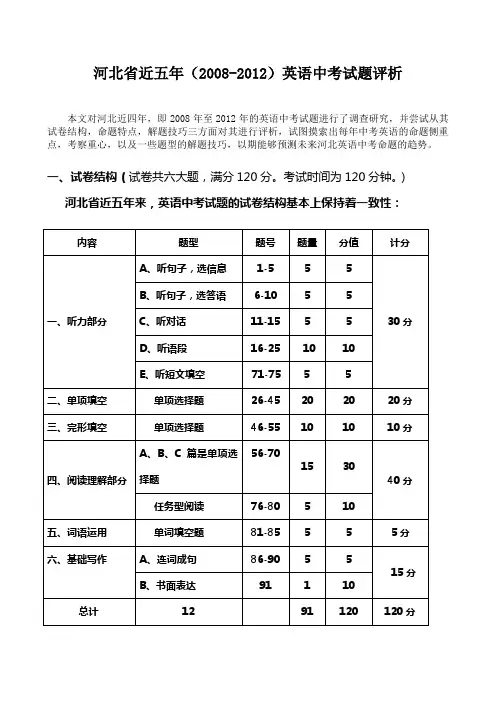
河北省近五年(2008-2012)英语中考试题评析本文对河北近四年,即2008年至2012年的英语中考试题进行了调查研究,并尝试从其试卷结构,命题特点,解题技巧三方面对其进行评析,试图摸索出每年中考英语的命题侧重点,考察重心,以及一些题型的解题技巧,以期能够预测未来河北英语中考命题的趋势。
一、试卷结构(试卷共六大题,满分120分。
考试时间为120分钟。
)河北省近五年来,英语中考试题的试卷结构基本上保持着一致性:二、试题剖析:1、基础知识部分近五年河北中考英语试题中的基础知识部分只包含了两个题型,从未发生改变:单项选择和完形填空。
的掌握情况,以及能够在一定的语境中运用语法,词汇及语用等知识的能力。
从对语法知识考查的内容上来看,其覆盖面广,且包含了尽量全面的知识点。
但从近五年英语中考试题中的单项选择一题中考查的知识项目总结来看,的确有些考查重点方面的转变。
如下表所示:从上表中可以看到,从2008年到2012,英语中考试题中的单项选择一直考查的语法项有冠词,代词,介词,形容词,动词时态,情态动词,动词不定式,被动语态,动词/动词短语,宾语从句。
而从2009到2010间,一直没有出现There be句型语法项的考点,而在2011就开始出现了。
除此之外,感叹句的考查处于变动中,疑似以隔年规律出现。
而对于数词,反意疑问句几乎不做考查。
(2)完形填空(共10分)这一题型,旨在考查考生运用所学语言知识的能力,在对篇章整体理解的基础上,考查考生根据上下文的意思和逻辑联系进行推理、判断的能力。
本题型重点涉及到词汇搭配、习惯用法以及基础语法等知识的运用。
从完形填空文章的类型选取上来看,完形填空选择的文本篇幅逐年加长,字数增加,完整性较强,且属于叙事性的文章。
而且,由近五年英语中考中完形填空的文本选择总结来看,从今年开始说明文题材开始转向记叙文,相信未来英语中考试题中此类题型中文章的选择也必然是和中学生的学习,生活,思想变化,心理状态息息相关的,而且一般都具有一定的人生启示和教育意义。