
9分达人听力 Test 2 原文(1)
- 格式:docx
- 大小:2.71 MB
- 文档页数:11

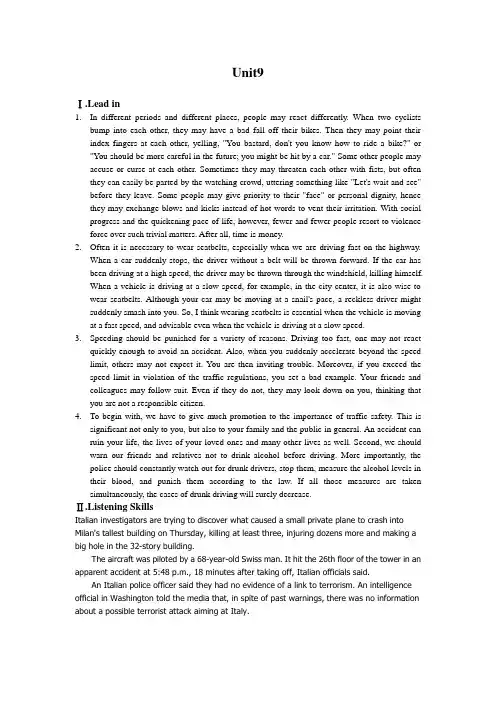
Unit9Ⅰ.Lead in1.In different periods and different places, people may react differently. When two cyclistsbump into each other, they may have a bad fall off their bikes. Then they may point their index fingers at each other, yelling, "You bastard, don't you know how to ride a bike?" or "You should be more careful in the future; you might be hit by a car." Some other people may accuse or curse at each other. Sometimes they may threaten each other with fists, but often they can easily be parted by the watching crowd, uttering something like "Let's wait and see"before they leave. Some people may give priority to their "face" or personal dignity, hence they may exchange blows and kicks instead of hot words to vent their irritation. With social progress and the quickening pace of life, however, fewer and fewer people resort to violence force over such trivial matters. After all, time is money.2.Often it is necessary to wear seatbelts, especially when we are driving fast on the highway.When a car suddenly stops, the driver without a belt will be thrown forward. If the car has been driving at a high speed, the driver may be thrown through the windshield, killing himself.When a vehicle is driving at a slow speed, for example, in the city center, it is also wise to wear seatbelts. Although your car may be moving at a snail's pace, a reckless driver might suddenly smash into you. So, I think wearing seatbelts is essential when the vehicle is moving at a fast speed, and advisable even when the vehicle is driving at a slow speed.3.Speeding should be punished for a variety of reasons. Driving too fast, one may not reactquickly enough to avoid an accident. Also, when you suddenly accelerate beyond the speed limit, others may not expect it. You are then inviting trouble. Moreover, if you exceed the speed limit in violation of the traffic regulations, you set a bad example. Your friends and colleagues may follow suit. Even if they do not, they may look down on you, thinking that you are not a responsible citizen.4.To begin with, we have to give much promotion to the importance of traffic safety. This issignificant not only to you, but also to your family and the public in general. An accident can ruin your life, the lives of your loved ones and many other lives as well. Second, we should warn our friends and relatives not to drink alcohol before driving. More importantly, the police should constantly watch out for drunk drivers, stop them, measure the alcohol levels in their blood, and punish them according to the law. If all those measures are taken simultaneously, the cases of drunk driving will surely decrease.Ⅱ.Listening SkillsItalian investigators are trying to discover what caused a small private plane to crash into Milan's tallest building on Thursday, killing at least three, injuring dozens more and making a big hole in the 32-story building.The aircraft was piloted by a 68-year-old Swiss man. It hit the 26th floor of the tower in an apparent accident at 5:48 p.m., 18 minutes after taking off, Italian officials said.An Italian police officer said they had no evidence of a link to terrorism. An intelligence official in Washington told the media that, in spite of past warnings, there was no information about a possible terrorist attack aiming at Italy.Milan fire brigade officials said the aircraft had only the pilot and no passengers, according to the flight plan. It was on fire as it flew into the tower. There was an explosion in the building when the four-seat plane hit, but there was no danger that the building would collapse, the police said.Ⅲ.Listening InTask1.The SeatbeltLisa: Do you wear the seatbelt every time you drive or ride in a car?Mike: No, seatbelts are for chickens. Besides, I'm a great driver.Lisa: The chances of being injured in a car accident this year are 1 in 75. I think that's worth thinking about seriously.Mike: Have you ever been involved in an automobile accident?Lisa: Only once. My car slid on a rainy night and went off the road. Fortunately I was wearing my seatbelt.Mike: I've never had a serious accident.Lisa: My brother was more unlucky than I was. Last December he was almost killed in an accident. He was in the back seat of his friend's car when it rolled. He wasn't wearing a seatbelt.Mike: Wow, that's terrible.Lisa: Fastening your seatbelt should be an automatic thing as soon as you get into your car. But too many people still refuse to wear seatbelts.Mike: It's just hard for me to get in the habit of wearing one.Lisa: All it takes is one close-call and you'll wear your seatbelt.Mike: O.K., I've got the message. From now on I'll hook up my seatbelt.Task2.How many parachutes are left?There were three passengers in a plane that had a sudden engine trouble. One was the smartest man in the world, another was a lawyer, and the other was a little girl. The pilot told them they must jump out to lighten the weight on board; otherwise, the plane would crash. However, there were only two parachutes. The smartest man in the world jumped to his feet and shouted, "The people who would benefit the world the most should get the parachutes. I'm the smartest man, so I'm one of those." With that, he seized a parachute and threw himself out of the plane.\r\nThe lawyer looked at the little girl and said, "I've led a good long life, and you're just starting yours. You take the other parachute."With tears in her eyes, the little girl said, "That smart man was very unreasonable. Just now he grabbed my school bag and jumped out. Mom will scold me for losing the bag. But at least I have a parachute."Task3.Why did you stop at a green light?One day, two friends were driving downtown when they came to an intersection with a traffic light. The light was red but the driver sped right through the red light. The passenger looked in terror at the driver and shouted, "What the hell are you doing? You're going to get us killed!!" The driver replied, "Don't worry, my mom always drives like this, and she is all right." Later, they came to another traffic light, and that too was red. Again the driver shot right through the light. Again the passenger looked at the driver and shouted, "I thought I have told you, you would get us killed! Would you please stop this nonsense!?"The driver looked at the passenger and answered, "All right! I get it, but I told you my mom drove like this all the time! And she's quite OK."They came to another traffic light. It was green. The driver slammed on the brakes, suddenly stopping the car. The passenger was thrown forward. "What on earth are you doing?" he screamed. "This is the third time you almost got us killed. Why did you stop at a green light?" "Well," said the driver, "my mom might be coming the other way."Ⅳ.let’s talkSpeeding TicketA policeman stops a driver and says to the driver, "Sir, you were speeding. Can I see your license, please?"The driver replies, "I don't have one.""You don't have one?"The driver answers, "I lost it for drunk driving."The policeman is surprised. "I see. Will you show me your vehicle registration papers, please?" "I'm sorry, I can't do that."The policeman asks, "Why not?""I stole this car."The officer says, "Stole it?"The driver answers, "Yes, and I killed the owner."The officer is shocked. "You did what?""She's in the trunk if you want to see."The officer is horrified and calls for backup. Within minutes, five police cars show up, surrounding the car. A police chief cautiously approaches the car, asking, "Sir, could you open the trunk of your car, please?"The driver opens the trunk, revealing nothing but an empty trunk.The chief says, "Is this your car, sir?"The driver says "Yes," and hands over the registration papers.The officer is quite surprised. "One of my officers says you don't have a driving license."The driver quickly produces his license. The chief examines it and finds nothing wrong. He looks puzzled. "Thank you, sir. One of my officers told me you didn't have a license, stole this car, and murdered the owner."The man replies, "I bet the lying bastard told you I was speeding, too!"Ⅵ.further listening and speakingEmergency CallOperator: Hello. This is the emergency 911 operator.Taxi Driver: Help! Help! Please help me!Operator: Yes sir. Please calm down and explain exactly what is happening.Taxi Driver: Calm down! My car has broken down on the highway; I have a lady passenger, and she's going into labor.Operator: Now relax, sir. Explain exactly where you are.Taxi Driver: I'm..I'm in the southbound lane of No. 15 Expressway, about 15 miles from the tunnel, and this lady isn't going to wait.Operator: Okay. What's your name, sir, and your passenger's?Taxi Driver: It's.. It's Mike, and I have no idea about the woman. She's in no condition to tell me. How soon can someone get here?Operator: I've just sent an ambulance to your location. They should be there any second. Taxi Driver: Hey, is there anything I can do while we wait for the ambulance?Operator: Yes, uh, keep her calm and warm.Have a drink!Taxi Driver: Okay. Please hurry.. Oh, they're too late. It's a boy!In the middle of the night, in the middle of nowhere, a woman and a man are involved in a car accident. Both of their cars are damaged, but surprisingly neither of them is hurt.After they climb out of their cars, the woman says, "So you're a man. That's interesting. I'm a woman. Wow, just look at our cars! There's nothing left. But fortunately we're not injured. This must be a sign from God that we should meet and be friends and live together in peace for the rest of our days."The man replies, " I agree with you completely. This must be a sign from God!"The woman continues, "And look at this, here's another miracle. My car is completely destroyed, but this bottle of wine didn't break. Surely God wants us to drink this wine and celebrate our good luck."Then she hands the bottle to the man. The man nods his head in agreement, opens it, takes a few large drinks, and then hands it back to the woman. The woman takes the bottle, immediately puts the cork back in the bottle, and puts it away. The man asks, "Aren't you having any?" The woman replies, "Yes, but not until the police get here."Max, a farm boy, accidentally overturned his wagon loaded with corn. The farmer who lived nearby heard the noise.Pa Won't Like It"Hey, Max!" the farmer shouted. "Forget your troubles. Come in with us, then I'll help you get the wagon up.""That's mighty nice of you," Max answered, "but I don't think pa would like me to.""Come on," the farmer insisted."Well, okay," the boy finally agreed, and added, "but pa won't like it."After a hearty dinner, Max thanked his host. "I feel a lot better now, but I know pa is going to be really upset.""Don't be silly!" the neighbor said with a smile. "By the way, where is your pa?""Under the wagon."。

Unit 9Task 1【答案】1) the campus hero; the women’s track coach2) the class started before I got here3) will develop4) cloudy; the glass is a little dirty5) a symbol of happiness; wear black【原文】1) Man: I had the girls running in circles when I was in college.Woman: I never knew you were the campus hero.Man: I wasn't. I was the women's track coach.2) Instructor: Mr. Jenkins, why are you late?Student: I guess because the class started before I got here.3) Woman: Doctor, you have to come immediately--my baby swallowed some camera film!Doctor: Just calm yourself, nothing will develop.4) Customer: Waiter, this water is cloudy.Waiter: The water's okay, madam. It's just that the glass is a little dirty.5) Woman: The bride wears white on her wedding day as a symbol of happiness, for this is themost joyous day in her entire life.Man: Why does the groom wear black?Task 2【答案】【原文】Catherine: I think firstly I find the French language, very melodic to listen to. It's very easy on the ear, and it almost sounds poetic. No matter what kind of mood the individual is in,who's talking, or what they're talking about, there seems to be a rhythm to the language.And it's rounded; there are no sharp, jagged edges to the language, so it's very pleasingto the ear.Chris: I think the accent I really like is the Dane speaking English. They sound awful when they speak Danish, but when they speak English there's a beautiful, low, sensitive, verysoft quality about it.Donald: I like the way they bring their French pronunciation into English. They can't pronounce "h"s and they can't pronounce "th" properly. And I think that actually sounds very nice.Also I like the rhythm: they bring French rhythms into English--nice, steady rhythmsand I like that too. It's just it, it... whenever I hear a French person speaking English itsounds more gentle and more lyrical.Lesley: I think the most attractive foreign accents for me are Mediterranean accents because they, if you like, import their own culture into the English accent and give it a lot of life that sometimes, that kind of--the gestures and everything that the English people don't have, so you get a beautiful mixture of the serious Northern European and the Southern European together.Susan: I like the Swedish accent because it, it makes me smile and the way it's spoken is so sing-songy that you can't help but smile when other people actually speak it. And it always makes you want to try and put the accent on yourself.Task 3【答案】spelling; meaning; history; a slab of ham; a lump of bread; hunk of something to eat; a strong man;a book of maps; the top bone of the neck; Olympians; holding the sky on his head and hands; Sixteenth; on the cover of a book of maps; blessing; I hope you will have a good night; day’s eye; it has a little golden eye, like a tiny sun; the English daisy closes at night; the English loved their daisies.【原文】The spelling and meaning of words are very interesting. But what's more interesting is the history of a word, or where it came from. Let's examine some of the words and see how they got into our language.LUNCH Lunch perhaps comes from an old Spanish word lonje, a slab of ham. We may also get our word from a form of lump, maybe a lump of bread, but whether lunch comes from ham or bread, it meant a hunk of something to eat.ATLAS An atlas is a strong man, and also a book of maps. The story of this word begins a long time ago in Greece. The ancient Greeks believed that their gods had once been a race of giants called Titans. The Titans fought with another group of gods called Olympians, and the Olympians won. Atlas was a Titan. He was punished for fighting by having to stand at the western edge of the world, holding the sky on his head and hands, so that it would not fall on the world and smash anything.After the ancient Greek religion died out, the idea of Atlas changed. From holding up the sky with his head and hands, he came to be thought of as holding the world on his shoulders. Mercator, a mapmaker of the sixteenth century, used a picture of Atlas on the cover of a book of maps, so a book of maps came to be called an atlas.The word has still another meaning. The top bone of the neck is called atlas because it supports the head.GOOD-BYE Good-bye is a blessing; originally it was God be with ye, and in the course of time it became one word. Many of our greetings are good wishes, but we say them with so little thought that we forget this. When we say good morning, good evening, good night, and so on, what we are really saying is, "I hope you will have a good morning (or evening, or night)."DAISY The daisy has a little golden eye, like a tiny sun. Perhaps this is the reason the English people named it day's eye, or perhaps they chose the name because the English daisy closes at night. The English loved their daisies, which were pink and red, as well as white. Six hundred years or so ago, the English poet Chaucer said:The daisy, or else the eye of the day,The queen, and prettiest flower of all.Task 4【答案】A.1) T2) T3) F4) T5) FB.1) b2) c3) a4) c5) c6) b【原文】MATTHEW: Chris, why is it that there are so many different languages , and that in Europe certainly if you travel more than a hundred miles , you're likely to find peoplespeaking a completely different language to your own?CHRIS: Well, it's true to say that there are er ... hundreds and hundreds of different languages.It's perhaps um . . . however , more interesting and more informative to say that thereare several different groups of languages er . .. Most European languages,with theexception of I think Finnish and er .. . Basque and . . . Hungarian I believe,belong tothe Indo-European group of languages, I'm not very sure myself of the . . . the actualdetails of the history of these languages, but you can be very sure that er ... most ofthese languages , say Latin and Greek nd our own language a and er . . . German ander ... French and ... all the others, are connected. The reason why you can travel fromone Willage to another in Switzerland and er . . . from one area to another in Englandand find different dialects, if not different languages spoken, is that um ... severalhundred years ago communication was by word of mouth. Word of mouth meant thatpeople had to move ; if people were to move they needed roads and there were noroads.MATTHEW: Do you see any chance for a universal language like Esperanto?CHRIS: Not for an artificial er ... language, no ... I suppose the Roman Catholic Church usedLatin. but Latin had a ... a particular religious basis and this is probably why it wastherefore chosen. I don't see very much chance for Esperanto; I think it's an awfullygood idea but I don't believe that language works like that.I think people willprobably er .. . work towards the most convenient language to use.They will not setout to learn a new language. It seems to me that er ... either English,. Russian orChinese, perhaps Japanese, will be the language of the future er . . . My bet's onEnglish.MATTHEW: Maggie, why do you think it is that so few English people speak a second language? MAGGIE: I think when you learn a language at school ...it tends to be rather a dead occupation, and it's very difficult to stimulate any interest among school children. But when youactually go to the country and spend say a month in . . . in an exchange visit whenyou're a schoolgirl, or a schoolboy um ... then you suddenly become more interestedbecause you ... you want to communicate with poeple when you're actually abroad,and it's not safe to rely on the fact that most people speak English when um . . . inforeign countries. Mm . . . I think English people traditionally thought that . . . thatforeigners always spoke English, and a lot of foreigners do, but there are people thatyou meet in the street or you want to take a bus somewhere, then you find that youneed to speak the language and'it's very unnerving to be in a situation where you can'tcommunicate with people when you do want to travel around.MATTHEW: Have you ever been abroad and learnt er ... a language in the country? MAGGIE: Yes , well when I was a secretary I er... went and lived in Geneva for two years, andI learnt French at school but I . . . I really didn't speak it at all. I knew it theoreticallybut I wasn't able to communicate with people. But I was in a situation where if I didn'tspeak French , then I would not have been able to do my shopping and buyfood ,and so I picked the language up and I made friends with French people ... SwissFrench people, and I found that if I wanted to communicate with all . . . all the peoplethat I met , then I had to learn French, and I think it's the best method of learningbecause you're in the situation. It's very hard at times —you can sit through dinnerparties and not understand what ... what's going on and you think everybody thinksyou're stupid because you can't communicate with them, but it's ... it's the hard waybut I think it's the best way to learn.MATTHEW: Elfriede, you come from Austria and yet you've been living in England now for the last three years. Has having to learn and speak another language created greatproblems?ELFRIEDE: Um ... At the beginning, yes, it was rather difficult for me to get the right job . . .um. after you've lived here for one or two years you get to know the system and thenthat's quite good. You know how to use libraries and oh .. . you get to know where toum... call in emergencies; um ... you get to know ... er ...trying to get a radio andunderstand the radio and all the . . . programmes they have . . . um and when they'reon and the little stories.MATTHEW: What about English humour on the radio?ELFRIEDE: Um . . . I think that takes a very very long time to understand and I'm sorry to say that I haven't managed yet to understand it completely, but er... I find it veryinteresting to speak other languages um ... because English people have differenter ...have a different mentality, and have a very different character and a differenttemperament and it is fascinating for me to talk to them um... and also for myself tobe able to express myself in a different language and to communicate with them.Task 5【答案】1) A mother is leaving instructions with her babysitter before going out.2) Wake up; give her the dummy; give her a cuddle; sing to her; read her a story; go back to sleep.3) Two friends are taking about their holiday together.4) It reminds.., of... holiday; city; wine; good food; tower; view; walking along the river; paintings;I love...; I like...; I remember...5) Two women are meeting at a doctor’s waiting room.6) It's diagnosed; have another look; do something about...; go away; give.., for...; it's your turn. 【原文】Number 1Fiona: Okay, Deek, I'm off now. [Okay.] Everything's okay, is it?Deek: Yes, I think so. The only thing is... is she likely to wake up?Fiona: No, I don't think so. She doesn't usually, but...Deek: What if she does?Fiona: Well, yes. Don't. worry about it. Her dummy's by the bed, so if you just pick her up, give her the dummy, give her a little bit of a cuddle; [Yes.] sing to her if you like.Deek: Shall I read her a story or something?Fiona: Yes, anything like that. [Yes.] Then she should just go back to sleep again quite happily. Deek: Okay.Fiona: Oh! And I've left stuff for you in the fridge. There's some salad and cold chicken and some beer as well. Okay then?Deek: Right then. Bye.Fiona: Bye-bye.Number 2Lesley: Ah ... it's such a lovely day. It reminds me of last week, doesn't it you?Fiona: Oh don't! I mean that was just so fantastic, that holiday!Lesley: I love that city, you know.Fiona: I do too. Really, it's got something about it, a certain sort of charm ...Lesley: Mm, and all that wine and good food ...Fiona: And so cheap. Right, I mean, compared to here ...Lesley: Yes, although the shops are expensive.Fiona: Mm, yes.Lesley: I mean, really I bought nothing at all. I just ate and ate and drank and drank.Fiona: I know. Wasn't that lovely?Lesley: Yes, and I, I go there. I like listening to the people talking, sitting outside drinking wine. Fiona: Yes. Could you understand what they were saying? When they were speaking quickly, I mean.Lesley: Well, it is difficult, of course. And then I liked that tower, too.Fiona: You liked that tower? I'm not sure about it, really. (No) It's very unusual, right in the centre of the city.Lesley: True, but there's a lovely view from the top.Fiona: Oh, you went right up, didn't you? (Mm, yes) Oh no, I didn't.Lesley: Of course you didn't.Fiona: I remember that day. We weren't together.Lesley: No, that's right. (Mm) You went down by the river, didn't you?Fiona: That's it. Oh, walking along the river and all the couples (Yes) and it's so romantic ... (Is it true) and the paintings too ...Lesley: They do have artists down by the river, do they? (Yes) Oh, how lovely!Fiona: Oh, it really is super.Lesley: Yes. Oh, I think we ought to go back there again next year, don't you?Fiona: I do, yes. (Mm) If only just to sample some more of the wine.Lesley: It'd be lovely, wouldn't it?Fiona: Yes.Number 3Mary: I'm so pleased. What about you then?Jane: Well, he said he wanted to have another look at it.Mary: Yes. What are they doing about it?Jane: Well, I don't think they're going to do anything really. It just sometimes goes away [Well, can't...] something like that.Mary: Well, can't they give you anything for it?Jane: Well, no, they didn't say the9 could. [Really?] No, just got to be patient and wait for it to go away.Mary: Well, that seems a bit stupid, doesn't it?Jane: Yes, it does.Mary: You'd have thought.., you'd have thought they'd have thought of something.Jane: Yes. Ooh it's your mm.Mary: Yes. Certainly.Jane: Good luck!Mary: Thank you!Task 6【答案】A.1) c2) a3) b4) cB.1) T2) F3) F4) T5) F6) T【原文】Learning to SpeakIt is, everyone agrees, a huge task that the child performs when he learns to speak, and the fact that he does so in so short a period of time challenges explanation.Language learning begins with listening. Individual children vary greatly in the amount of listening they do before they start speaking, and late starters are often long listeners. Most children will “obey” spoken instructions some time before they can speak, though they word obey is hardly accurate as a description of the eager and delighted cooperation usually shown by the child. Before they can speak, many children will ask questions by gesture and by making questioning noises.Any attempt to trace the development from the noises babies make to their first spoken words leads to considerable difficulties. It is agreed that they enjoy making noises, and that during the first few months one or two noises sort themselves out as particularly indicative of delight, distress, sociability, and so on. But since these cannot be said to show the baby’s intention to communicate, they can hardly be regarded as early forms of language. It is agreed, too, that from about three months they play with sounds for enjoyment, and that by six months they are able to add new sounds to their voices. This self imitation leads on to deliberate imitation of sounds made or words spoken to them by other people. The problem then arises as to the point at which one can say that these imitations can be considered as speech.It is a problem we need not get our teeth into. The meaning of a word depends on what a particular person means by it in a particular situation; and it is clear that what a child means by a word will change as he gains more experience of the world. Thus the use, at say seven months, of "mama" as a greeting for his mother cannot be dismissed as a meaningless sound simply Because he also uses it at other times for his father, his dog, or anything else he likes.Playful and apparently meaningless imitation of what other people say continues after the child has begun to speak for himself. I doubt, however, whether anything is gained when parents cash in on this ability in an attempt to teach new sounds.Task 7【答案】Topic: Body language1. Brief introduction"statements"; non-verbal communication; small facial expressions, hand gestures and body movements that we make to express our feelings2.Detailed introductionour facial expressions and gestures are automatic and unconscious most of the time; we paid conscious attention to the hidden messages in body language; facial; body2.1 facial expressionsEyes, eyebrows, lips and facial muscles: capable of “saying” things.2.2 Hand and body gesturesHand or sign language: highly developed, especially by the deaf.bring our finger to our lips; scratch or rub our heads; slap our heads; take our head in both hands to sort of clear our minds3. ConclusionA sampling of; we pull an ear; we cross our legs; who don't communicate with body language; writers; frowns, scratches his chin, slaps his head, purses his lips, stares at the ceiling and throws up his arms.【原文】Let's talk about body language. You already "speak" it and "read" it. Body language is all of the small facial expressions, hand gestures and body movements that we make. We may not realize it,but each movement and expression says something about our feelings.In fact, we might say that body language is the clearest and most common way Of communicating our feelings directly to others. We all know the most obvious body "statements": We wave our hands in greeting, we shake hands, pat each other on the back, we hug friends and kiss loved ones. We smile, we laugh, we wink and we frown, and sometimes we cry. All of these gestures are called non-verbal communication (non-verbal means we do not use words to "say" what we feel.)Normally, we don't think very much about our body language. Our facial expressions and gestures are automatic and unconscious most of the time. But researchers tell us we might learn to under-stand each other a little better if we paid conscious attention to the hidden messages in body language. Let's consider a few of the more obvious facial, hand and body gestures.The human face is wonderfully rich in its ability to express feelings. The eyes, the eyebrows, the lips and the facial muscles are all capable of "saying" things.For example, we speak of "wide-eyed wonder". If the eyes open wide, that may mean surprise, wonder, excitement or sometimes fear. And that is an important thing to remember about body language--one element alone does not tell us everything. We have to see gestures in Combination. So wide eyes alone would not tell us whether the person was surprised, pleased or scared, but when we see wide eyes, a little smile and a slight tilt of the head, we understand that the person is "wonderfully pleased"."Squinty" eyes, tight lips, and the head pushed forward probably suggest anger or hostility.Half-closed eyes may suggest fatigue, boredom or indifference. But add a lowered tilt of the head, a fluttering of the eyelids and a slight smile, and we get a coy and flirtatious message.Strangely enough, one of the eye features over which we have very little control--the size of our pupils--says something about our interest in a subject. If we like something, our pupils get larger. Studies show that most men think a woman with large pupils is more "attractive" than the same woman with small pupils. But the men aren't really conscious of the pupils. They just know they like the "looks" better in the samples with large pupils. No wonder eye make-up is so popular.Eyebrows are almost like signal flags: one brow up, one down suggests doubt, disbelief or uncertainty. Both up means surprise or mistrust. Squeeze them together and we get a frown or scowl.The lips shape non-verbal as well as verbal messages. The smile is the most obvious, but try baring the teeth just on one side or pull the lips tightly across the teeth and the smile becomes a snarl and a threat. In this, and in many of our other body gestures, we are close to the animals.The lower lip by itself can say little things. The "pout" is a fat lower lip pushed way out. It means "I'm not happy because I'm not getting what I want." But if we tuck the lower lip into our mouth and bite it, we are conveying anxiety and fear. Licking the lips is a "dry mouth" gesture which usually means stress or anxiety.There are whole books written on hand gestures, and, in fact, hand or sign language has often been highly developed, especially as an aid to the deaf. But the routine hand language, such as pointing with the index finger to accuse someone, or the clenched fist beating in the air to threaten someone, is familiar to us all. But a clenched fist held close to the body usually means tension or anxiety while the open hands, palms up may mean "I'm innocent" or "give me" or "forgive me".Both hands raised up and facing the audience means "I give up" or "I surrender". But tilt thehands and palm down and extend the arm and it means "I bless" or "I give". The "pat on the head" is a kind of blessing or gesture of love and giving. We clap hands to indicate approval or in some cases to call someone or get attention.When the hands get very busy we say that someone "talks with his hands" and among certain individuals and cultures it is almost impossible to talk without a wild display of hand motions.If we are slightly puzzled by something, we may bring our finger to our lips. If it's a real puzzler, we scratch or rub our heads. If we do something wrong, we slap our heads. To start allover something, we often begin by taking our head in both hands to sort of clear our minds and "set our head on straight".These are only a sampling of the many types of body language. There are books which discuss everything from the way we pull an ear to the way we cross our legs. From the looks of things, the only people who don't communicate with body language are the writers. Readers never get to see how often the writer frowns, scratches his chin, slaps his head, purses his lips, stares at the ceiling and throws up his arms.Task 8In contemporary English, there are many reported differences in the talk of males and females . In same gender pairs having conversations, women generally discuss their personal feelings more than men . Men appear to prefer non-personal topics such as sport and news . Men tend to respond to mention personal experiences that match or connect with the other woman’s . There is a pattern documented in the American English social context of women cooperating and seeking connection via language, whereas men are more competitive and concerned with power via language . In mixed-gender pairs having conversations, the rate of men interrupting women is substantially greater than he reverse. Women are reported to use more expressions associated with tentativeness , such as “hedges”(sort of , kind of ) and “tags”(isn’t it ? , don’t you ?) , when expressing an opinion : Well ,erm , I think that golf is kind of boring , don’t you ?。

Bernice 雅思阅读8月机经总结及解析8月2日考试分析:8月的第一场考试似乎并不怎么友善,三篇文章都是新题,题材方面涉及文史,自然和社会科学,不了解相关背景的同学可能会感觉相当吃力。
在题型方面,段落信息配对依然不出意料地出现在了试卷上,也再一次提醒大家在课堂上说过的“三座大山”需要重点练习。
本次考试判断和选择成了题型中的主力,尤其是选择,两篇文章都出现了选择题,而且还有文章主旨单选题来凑热闹。
要想拿下雅思阅读并取得好成绩,搞定选择题成了现在的趋势,希望烤鸭们平时多多练习。
文章分析:8月9日本次雅思阅读考试再现3新格局,三篇文章均为新题,文章题材涉及文史,社会科学,难度较大。
在题型方面,主旨配对和人名理论配对依旧是重点也是难点。
相比而言,本次考试判断和填空成了题型中的主力,尤其是填空,三篇文章都出现了填空题,而且第三篇文章还出现了有词库的摘要填空。
希望烤鸭们平时一定要多多练习高频题型,熟练把握并且控制做题节奏。
在话题方面,2014年以来,人文话题较往年居多,本年已考过绘画与个性的关系,博物馆,音乐,海岸雕塑和艺术的定义等,本次考试又考到了艺术话题。
建议烤鸭们平时增加对此类话题的文章的补充阅读;另外本年不止一定考到了新西兰的相关内容,本年已考过了除澳大利亚的古生物灭绝,更有新西兰的纺织业,木材产业,全球变暖,本次考试又涉及到了新西兰的路。
建议烤鸭们多关注新西兰以及澳洲的一些科普内容。
8月16日本场雅思阅读考试难度不大。
1.从话题来看,本场考试的话题有,动物和全球化,心理,都为旧话题,可以参考剑桥真题的相关文章。
2.从考试题型来看,涉及到摘要填空,是非无判断,段落细节信息匹配,单选和流程图填空。
其中判断题和摘要填空所占比重较大。
建议烤鸭们在备考时一定要注意对高频题型的熟练度,速度的把控和正确率的提升,流程图填空是雅思阅读的送分题,提醒考生合理分配时间,先易后难,抓住基本分数。
8月21日考试分析: 本次考试难度不大。

九分达人听力第18套原文及翻译
摘要:
1.文章简介
2.听力原文
3.听力翻译
4.总结
正文:
【文章简介】
本文为一篇关于九分达人听力第18 套题目的原文及翻译的文章,旨在帮助英语学习者提高听力水平。
通过原文和翻译的对比,学习者可以更好地理解听力材料,从而提高自己的英语听力能力。
【听力原文】
请参考以下九分达人听力第18 套的原文:
【听力翻译】
请参考以下九分达人听力第18 套的翻译:
【总结】
通过本文的对比,学习者可以更好地理解九分达人听力第18 套题目的含义。
在日常学习中,多加练习听力题目,可以提高学习者的英语听力水平。
同时,对于难以理解的题目,可以通过参考翻译,加深对原文的理解。