大学英语四级信息匹配题型解题技巧
- 格式:ppt
- 大小:275.00 KB
- 文档页数:10
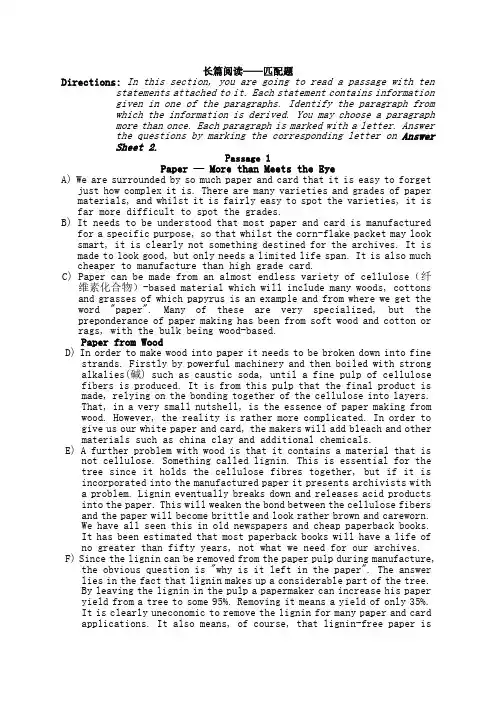
长篇阅读——匹配题Directions: In this section, you are going to read a passage with ten statements attached to it. Each statement contains informationgiven in one of the paragraphs. Identify the paragraph fromwhich the information is derived. You may choose a paragraphmore than once. Each paragraph is marked with a letter. Answerthe questions by marking the corresponding letter on AnswerSheet 2.Passage 1Paper — More than Meets the EyeA) We are surrounded by so much paper and card that it is easy to forgetjust how complex it is. There are many varieties and grades of paper materials, and whilst it is fairly easy to spot the varieties, it is far more difficult to spot the grades.B) It needs to be understood that most paper and card is manufacturedfor a specific purpose, so that whilst the corn-flake packet may look smart, it is clearly not something destined for the archives. It is made to look good, but only needs a limited life span. It is also much cheaper to manufacture than high grade card.C) Paper can be made from an almost endless variety of cellulose(纤维素化合物)-based material which will include many woods, cottons and grasses of which papyrus is an example and from where we get the word "paper". Many of these are very specialized, but the preponderance of paper making has been from soft wood and cotton or rags, with the bulk being wood-based.Paper from WoodD) In order to make wood into paper it needs to be broken down into finestrands. Firstly by powerful machinery and then boiled with strong alkalies(碱) such as caustic soda, until a fine pulp of cellulose fibers is produced. It is from this pulp that the final product is made, relying on the bonding together of the cellulose into layers.That, in a very small nutshell, is the essence of paper making from wood. However, the reality is rather more complicated. In order to give us our white paper and card, the makers will add bleach and other materials such as china clay and additional chemicals.E) A further problem with wood is that it contains a material that isnot cellulose. Something called lignin. This is essential for the tree since it holds the cellulose fibres together, but if it is incorporated into the manufactured paper it presents archivists witha problem. Lignin eventually breaks down and releases acid productsinto the paper. This will weaken the bond between the cellulose fibers and the paper will become brittle and look rather brown and careworn.We have all seen this in old newspapers and cheap paperback books.It has been estimated that most paperback books will have a life of no greater than fifty years, not what we need for our archives. F) Since the lignin can be removed from the paper pulp during manufacture,the obvious question is "why is it left in the paper". The answer lies in the fact that lignin makes up a considerable part of the tree.By leaving the lignin in the pulp a papermaker can increase his paper yield from a tree to some 95%. Removing it means a yield of only 35%.It is clearly uneconomic to remove the lignin for many paper and card applications. It also means, of course, that lignin-free paper isgoing to be more expensive.G) However, it is nevertheless what the archivist must look for in hissupplies. There is no point whatsoever in carefully placing our valuable artifacts in paper or card that is going to hasten their demise. Acid is particularly harmful to photographic materials, causing them to fade and in some cases simply vanish!H) So, how do we tell a piece of suitable paper or card from one thatis unsuitable? You cannot do it by simply looking, and rather disappointingly, you cannot always rely on the label. "Acid-free"might be true inasmuch as a test on the paper may indicate that it is a neutral material at this time. But lignin can take years before it starts the inevitable process of breaking down, and in the right conditions it will speed up enormously.I) Added to this, as I have indicated earlier, paper may also containother materials added during manufacture such as bleach, china clay, chemical whiteners and size. This looks like a bleak picture, and it would be but for the fact that there are suppliers who will guarantee the material that they sell. If you want to be absolutely sure that you are storing in, or printing on, the correct material then this is probably the only way.J) Incidentally, acids can migrate from material to material. Lining old shoe boxes with good quality acid-free paper will do little to guard the contents. The acid will get there in the end.Paper from RagK) Paper is also commonly made from cotton and rag waste. This has the advantage of being lignin-free, but because there is much less cotton and rag than trees, it also tends to be much more expensive than wood pulp paper. You will still need to purchase from a reliable source though, since even rag paper and card can contain undesirable additives.L) A reliable source for quality rag papers is a recognized art stockiest. Many water color artists insist on using only fine quality rag paper and board.M) The main lesson to learn from this information is that you cannot rely on purchasing archival materials from the high street. The only safe solution is to purchase from specialist suppliers. It may cost rather more, but in the end you will know that your important and valuable data and images have the best home possible.1. The corn-flake packet is cheaper than high grade card.2. There are a lot of materials which can be used for making paper, butthe superior ones are soft wood, cotton and rags.3. During the whole manufacturing process, the final product is madefrom a pulp of cellulose fibres.4. In order to make white paper and card, the makers will add bleach.5. Lignin is essential for the tree but it will make paper easy to break.6. Many paper producers will preserve lignin during manufacture, becauseleaving the lignin will make more paper from a tree.7. Acid is particularly harmful to photographic materials.8. If the lignin is removed from the paper, the paper will be more expensive.9. Although free of lignin, paper made from cotton and rag waste canalso cost more money than wood pulp paper because there is much lesscotton and rag than trees.10. What we can learn from “Paper from Rag” is that you had betterbuy archival materials from specialist suppliers.文章精要:本文主要介绍了我们平常所见所用的纸的复杂性,通过介绍用木头和破布料造纸的过程,使我们对纸的类别、属性有了更深入的了解。

四级长篇阅读匹配题做题技巧
四级长篇阅读匹配题是四级考试中的重要题型,也是考生普遍认为比较难的题型之一。
这种题型要求考生在阅读完一篇较长的文章后,根据文章内容和所给选项,将选项与文章中的相应段落匹配起来。
对于许多考生来说,这种题型比较考验阅读理解的能力和语言表达的能力。
以下是一些四级长篇阅读匹配题做题技巧,供考生参考。
1. 通读全文,了解文章大意
在做题之前,先通读全文,了解文章的主题和大意,这有助于考生更好地理解文章的细节和各段落的主旨。
2. 抓住关键词
在阅读文章的过程中,要注意抓住关键词,这有助于考生更好地理解文章的内涵和细节。
3. 不要被选项的形式所迷惑
在做题的时候,不要被选项的形式所迷惑,而是要看清选项所表达的意思,然后再回到文章中去找到相应的段落。
4. 注意选项的排列顺序
有时候,选项不是按照文章的顺序排列的,这就需要考生在做题的时候注意选项的排列顺序,以免将其匹配到错误的段落。
5. 排除干扰项
在做题的时候,有时候会出现一些干扰项,这些选项与文章内容相关度较低,不应该被选作答案。
考生要学会排除这些干扰项,准确地找到与文章内容相关的答案。
6. 注意时间分配
在考试的时候,要注意时间的分配,不要花太多时间在一道题上,以免影响后面的答题。
总之,在做四级长篇阅读匹配题的时候,考生应该认真阅读文章,抓住关键词,注意选项的排列顺序和干扰项的排除,合理分配时间,这样才能更好地完成这种题型。
在备考的时候,要多做一些练习题,提高自己的阅读理解和语言表达能力,为考试打下坚实的基础。

备考英语四级的经验技巧归纳备考英语四级的经验技巧【阅读】四级阅读排除法一:排除与原文相关句态度相反的选项即态度相反原则,选项所述主题与原文正好相反或态度不一致,可立即排除。
四级阅读排除法二:排除与原文相关句主题不一致的选项即主题一致性,是排除法的第一要义。
很多题目,仅仅通过主题不一致原则就可以排除得出正确答案。
句子主题,通常体现在名词或动词上。
因此审题和排除选项时,首先要关注句子中的核心名词和动词,找寻题目与选项的一致性。
四级阅读排除法三:排除用语过于极端或负面的选项,四级阅读文章来源多为学术性的报纸期刊,其语言的一大特征是客观性和严谨性,因此鲜少出现极端或过于负面信息的表达。
如果题目选项中出现明显的极端选项,可以直接排除。
四级阅读排除法四:注意结合文章主旨和主题做排除,在解答个别较困难的题目时,除了应用以上排除原则外,还可以结合全文主旨和主题来排除选项作答,有时可大大简化做题的难度。
【选词填空】一通读后,我们了解了这篇文章的主要内容。
二词性,把选项A到O所有的词的词性都标出来了。
那么如何判断所缺单词的词性呢?最关键的一点就是看空的前后词。
例:题的空前面是一个冠词a,空后是of,毫无疑问中间缺少名词。
三词形,既然要填名词,填单数还是复数?前面有a,毫无疑问是单数,所以要注意名词单复数。
四语法,我们把这几个词依次带入题中,看是否符合语法。
五词义,把词分别带入。
例:应该是a × ofstudies(一次研究的…)呢?带入flow(流量),mood(情绪)或者performance(表现),根本讲不通嘛!注意:平时大家遇到特别难判断的题时可以按照这五步来做,但是如果遇到一眼通过句意就能选择出来的就别这么浪费时间了。
英语四级成功备考20个经验技巧1、要养成随身携带英语书的习惯!我在窗边、厨房、客厅,甚至厕所都放了英语书,快速看上一两分钟就足够了!什么都怕天天做,什么都怕坚持!2、把难单词、难句子制作成海报,贴在家里最显眼的地方,不知不觉就掌握了!3、不读英语就难受!不读英语就“寝食难安”!让读英语变成“最大的爱好”!4、睁开眼睛的第一件事就是“大声喊英语”!喊出一天的活力和辉煌!喊出一天的充实和成功!5、入睡前一定要大喊英语十分钟!让英语进入潜意识,做梦也在学英语。