英语标点的正确使用
- 格式:pdf
- 大小:91.51 KB
- 文档页数:4
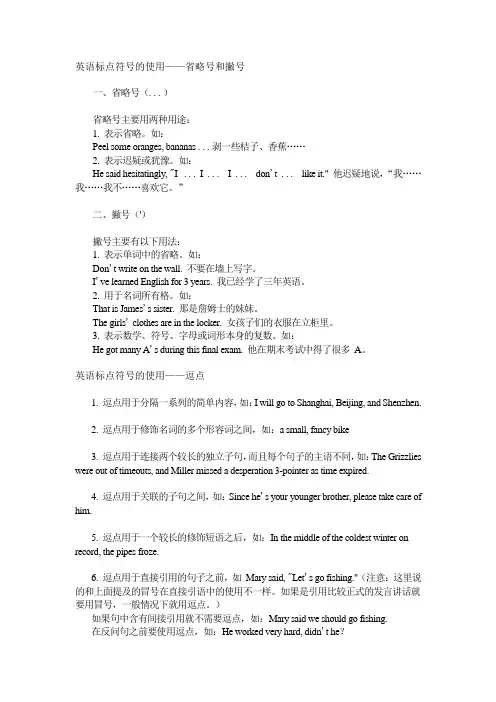
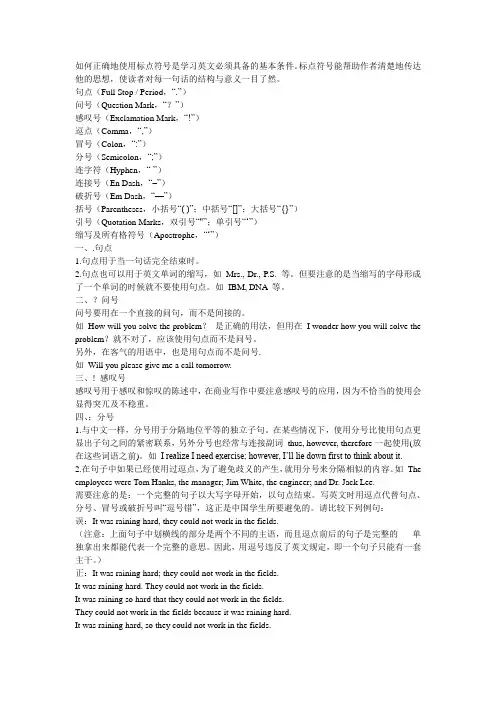
Usage Correct punctuation is essential for clear and effective writing. The following list contains some of the most critical punctuation rules.
Commas are used to separate parts of a sentence. They tell readers to pause between words or groups of words, and they help clarify the meanings of sentences.
_ Commas are used to separate three or more words, phrases, or clauses in a series. EXAMPLE: Practice will be held before school, in the afternoon, and at night. _ Commas are used after an introductory dependent clause (a group of words before the subject of a sentence that do not form a complete sentence). EXAMPLE: If your friends enjoy Chinese food, they will love this restaurant. _ Commas are used to set off introductory words, introductory adverbial, participial, or infinitive phrases, and longer introductory prepositional phrases. EXAMPLE: Incidentally, I was not late this morning. (word) Hoping for a bigger fish, Rob spent three more hours fishing. (phrase)
_ Commas are used between independent clauses joined by a coordinating conjunction (for, and, nor, but, or, yet, so). EXAMPLE: My dog had fleas, so we gave him a bath. _ Commas set off nonessential phrases or clauses. EXAMPLE: The man, I think, had a funny laugh. _ Commas set off an appositive (a word or phrase that renames a noun). EXAMPLE: Tanya, Debbie's sister, gave a brilliant speech last night.
End of sentence punctuation is used to let the reader know when a thought is finished. _ A statement (or declarative sentence) is followed by a period. EXAMPLE: Orem is the home of Utah Valley State College. _ A direct question (or interrogative sentence) is followed by a question mark. EXAMPLE: When did Joe buy a red shirt? _ Do not use a question mark after a declarative sentence that contains an indirect question. EXAMPLE: Marie wants to know when Joe bought a red shirt. _ An exclamatory sentence is followed by an exclamation point. EXAMPLE: What a good movie! _ Use exclamation marks sparingly because they can unnecessarily exaggerate sentences. EXAMPLE: Monet was the most influential painter of his time! (Most emphasizes influential painter; therefore, an exclamation point is not needed.) Usage Semicolons are used to separate clauses or phrases that are related and that receive equal emphasis. _ Semicolons join independent clauses in a compound sentence if no coordinating conjunction is used. EXAMPLE: Michael seemed preoccupied; he answered our questions abruptly. _ Semicolons are used before a conjunctive adverb (transition word) that joins the clauses of a compound sentence. EXAMPLE: The emergency room was crowded; however, Warren was helped immediately.
_ Semicolons help avoid confusion in lists where there are already commas. EXAMPLE: We traveled to London, England; Paris, France; Berlin, Germany; and Sofia, Bulgaria.
Colons follow independent clauses and are used to call attention to the information that comes after. _ Colons come after the independent clause and before the word, phrase, sentence, quotation, or list it is introducing. EXAMPLE: Joe has only one thing on his mind: girls. (word) Joe has only one thing on his mind: the girl next door. (phrase) Joe has only one thing on his mind: he wants to go out with Linda. (clause) Joe has several things on his mind: his finals, his job, and Linda. (list)
_ Never use a colon after a verb that directly introduces a list. INCORRECT: The things on Joe’s mind are: finals, work, and Linda. CORRECT: The things on Joe’s mind are finals, work, and Linda.
Hyphens are used to form compound words or join word units. They are used to join prefixes, suffixes, and letters to words.
_ Use hyphens with compound numbers from twenty-one to ninety-nine and with fractions used as modifiers. EXAMPLE: forty-two applicants two-thirds majority (two-thirds is an adjective modifying majority) three-fourths empty (three-fourths is an adverb modifying empty) two thirds of the voters (two thirds is not being used as an adjective here because thirds is a noun being modified by two)
_ Use hyphens in a compound adjective only when it comes before the word it modifies. However, some compound adjectives are always hyphenated, such as well-balanced. Look up compound adjectives in the dictionary if you are unsure whether or not to hyphenate them. EXAMPLE: a well-liked author an author who is well liked a world-renowned composer a composer who is world renowned