
小学六年级英语小升初 总复习 课件
- 格式:ppt
- 大小:1.89 MB
- 文档页数:33

人教PEP版英语六年级下册《小升初语法总复习 1》课件
练习 三、一般疑问句 (1)肯定陈述句中本来是没有助动词的,要加上去,位置在主语(某人或某物)后,动词前。 (2)确定助动词用do、does,根据句中动词,动词是原形的助动词就用do,动词是第三人称单数的助动词就用does, (3)在助动词后加not。 (4)原句中动词假如发生变化就要恢复成原形。 强调一点,有some的要考虑是否要用any。
练习 二、 句型转换
练习 * * 人教Pep)六年级英语下册课件 一、词类: 这里强调一点:不可数名词都默认为单数,所以总是用 is 1)名词复数如何加后缀(各种不同情况变化) A.一般情况直接加-s book-books bag-bags cat-cats
bed-beds B.以s. x. sh. ch结尾加-es :bus-buses box-boxes
brush-brushes watch-watches peach―peaches glass―glasses C.以“辅音字母+y”结尾变y为i, 再加-es family-families study―studies
D.以“f或fe”结尾变f或fe为v,再加-es knife-knives E.不规则名词复数man-men woman-women policeman-policemen
policewoman-policewomen mouse-mice foot-feet child-children
fish-fish Chinese-Chinese 一、词类: 练习 写出下列各词的复数
I _________him _________this ___________her ______

XS湘少版小学六年级英语 下册 期末考试 小升初毕业 小考(总复习专题训练)
小学英语语法及习题
一、名词复数规则
1.一般情况下,直接加-s,如:book-books, bag-bags, cat-cats, 2.以s. x. sh. ch结尾,加-es,如:bus-buses, box-boxes, brush-brushes, watch-watches
3.以“辅音字母+y”结尾,变y为i, 再加-es,如:family-families,
strawberry-strawberries
4.以“f或fe”结尾,变f或fe为v, 再加-es,如:knife-knives
5.不规则名词复数:
man-men, woman-women, policeman-policemen, policewoman-policewomen,
mouse-mice child-children ,foot-feet,.tooth-teeth,fish-fish, people-people,
Chinese-Chinese, Japanese-Japanese
写出下列各词的复数
this _______watch _______child _______photo ________ day________
foot________ book_______ dress ________tooth_______ sheep ______box_______
strawberry _____
thief _______yo-yo ______ peach______ sandwich ______man______
woman_______ paper_______ water________
二、一般现在时
一般现在时基本用法介绍
【No. 1】一般现在时的功能
1.表示事物或人物的特征、状态。如:The sky is blue.天空是蓝色的。
intanxianshubuxuexiao-gavin997108236@
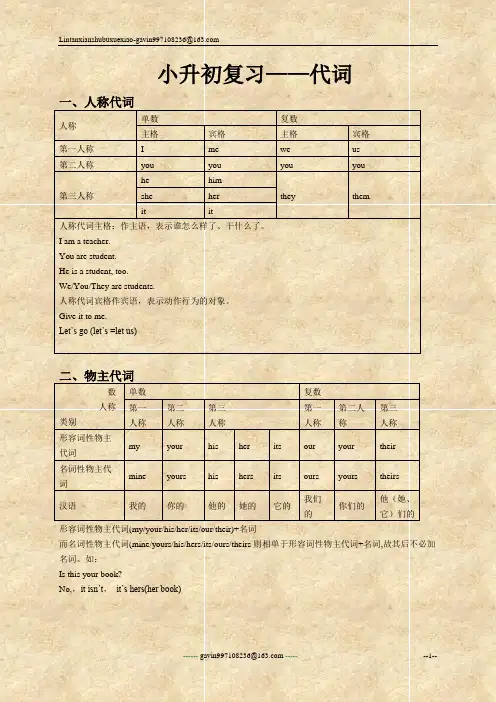
------ gavin997108236@ ----- --1-- 小升初复习——代词
一、人称代词
人称 单数 复数
主格 宾格 主格 宾格
第一人称 I me we us
第二人称 you you you you
第三人称 he him
they them she her
it it
人称代词主格:作主语,表示谁怎么样了、干什么了。
I am a teacher.
You are student.
He is a student, too.
We/You/They are students.
人称代词宾格作宾语,表示动作行为的对象。
Give it to me.
Let’s go (let’s =let us)
二、物主代词
数
人称
类别 单数 复数
第一
人称 第二
人称 第三
人称 第一
人称 第二人称 第三
人称
形容词性物主代词 my your his her its our your their
名词性物主代词 mine yours his hers its ours yours theirs
汉语 我的 你的 他的 她的 它的 我们的 你们的 他(她、它)们的
形容词性物主代词(my/your/his/her/its/our/their)+名词
而名词性物主代词(mine/yours/his/hers/its/ours/theirs则相单于形容词性物主代词+名词,故其后不必加名词。如:
Is this your book?
No,,it isn’t, it’s hers(her book)
intanxianshubuxuexiao-gavin997108236@
------ gavin997108236@ ----- --2-- 代词练习
一、选出括号中正确的词,在正确的词上打勾。

2023年小升初语法总复习(四)
一般将来时
一、一般将来时的定义:表示将要发生的动作或存在的状态及打算、计划或准备做事情。句中一般含有以下时间状语:tomorrow, next day(week, month, year...), soon, the day after
tomorrow等。
二、一般将来时的句型结构:
1.肯定句:
(1)will+do,如:We will go shopping tomorrow.我们明天将去购物。
(1)be going to+do,如:I am going to shop tomorrow.我明天将去购物。
2.否定句:在be动词(am, is, are)后加not或情态动词will后加not,也可所写成won’t。
如:I am going to shop tomorrow.-I am not going to shop tomorrow.
I will go shopping tomorrow.-I will not go shopping tomorrow.
3.一般疑问句:be动词或will提到句首,some改成any,and改为or,第一、二人称互换。如:I am going to shop tomorrow.-Are you going to shop tomorrow?
I will go shopping tomorrow.-Will you go shopping tomorrow?
4.特殊疑问句:特殊疑问词+一般疑问句?
一般将来时中对画线部分提问有三种情况:
(1)问人:Who
如:I am going to school.(对画线部分提问)Who’s going to school?
(2)问干什么:What...do
如:My father is going to watch a race with me this afternoon.(对画线部分提问)