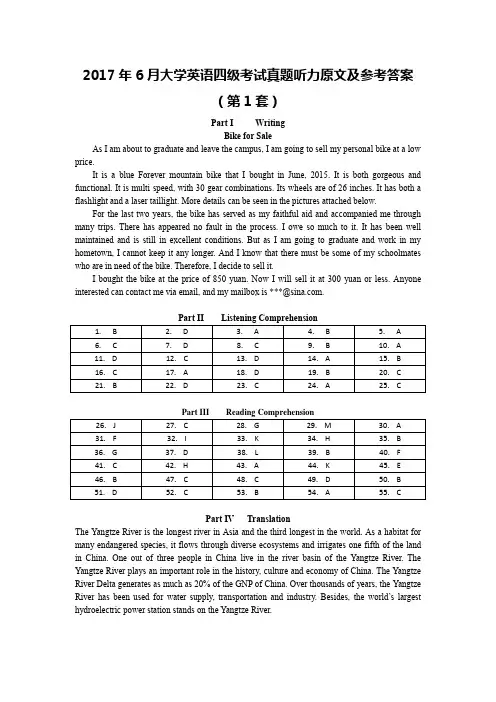
2017年6月大学英语四级考试真题听力原文及参考答案(第1套)Part I WritingBike for SaleAs I am about to graduate and leave the campus, I am going to sell my personal bike at a low price.It is a blue Forever mountain bike that I bought in June, 2015. It is both gorgeous and functional. It is multi-speed, with 30 gear combinations. Its wheels are of 26 inches. It has both a flashlight and a laser taillight. More details can be seen in the pictures attached below.For the last two years, the bike has served as my faithful aid and accompanied me through many trips. There has appeared no fault in the process. I owe so much to it. It has been well maintained and is still in excellent conditions. But as I am going to graduate and work in my hometown, I cannot keep it any longer. And I know that there must be some of my schoolmates who are in need of the bike. Therefore, I decide to sell it.I bought the bike at the price of 850 yuan. Now I will sell it at 300 yuan or less. Anyone interested can contact me via email, and my mailbox is ***@.Part IV TranslationThe Yangtze River is the longest river in Asia and the third longest in the world. As a habitat for many endangered species, it flows through diverse ecosystems and irrigates one-fifth of the land in China. One out of three people in China live in the river basin of the Yangtze River. The Yangtze River plays an important role in the history, culture and economy of China. The Yangtze River Delta generates as much as 20% of the GNP of China. Over thousands of years, the Yangtze River has been used for water supply, transportation and industry. Besides, the world’s largest hydroelectric power station stands on the Yangtze River.听力原文Section AQuestions 1 and 2 are based on the news report you have just heard.One of Google's self-driving cars crashed into a bus in California last month. There were no injuries. It is not the first time one of Google's famed self-driving cars has been involved in a crash, but it may be the first time it has caused one.On February 14th, the self-driving car, travelling at two miles per hour, pulled out in front of a public bus going fifteen miles per hour.The man in the Google vehicle reported that he assumed the bus would slow down to let the car out, and so he did not switch to the manual mode.In a statement, Google said: "We clearly bear some responsibility, because if our car hadn't moved, there wouldn't have been a crash."“That said, our test driver believed the bus was going to slow or stop to allow us to merge into the traffic, and that there would be sufficient space to do that.”The company's self-driving cars have done well over a million miles across various states in the US, and until now have only reported minor accidents.1. According to Google, what was the cause of the accident?2. How have Google’s self-driving cars performed so far?Questions 3 and 4 are based on the news report you have just heard.Thousands of bees left a town after landing on the back of a car when their queen got stuck in its boot. Tom Moses, who works at a nearby national park, noticed a “brown patch” on the back of the car after the owner parked it to do some shopping. When he looked closer he realized it was a huge group of bees.Moses said: “I have never seen that many bees in one spot. It was very unusual. They were very close together and there was a lot of noise and movement. “It was interesting to see such a strange sight, but there were a lot of people around and I was a bit worried of the bees and the people stopping to look. I thought that someone might do something stupid.”Moses called two local bees specialists who helped remove the bees by attracting them into a box. Moses spent three hours looking after the bees -- and was stung five times.He said: “My stings are a bit painful, but I am pleased that all worked out and I could help. People need to realize that bees are valuable and they should be looked after.3. What do we learn about Tom Moses?4. What do we know about the bees on the back of the car?Questions 5 to 7 are based on the news report you have just heard.A new species of snake has been discovered on a remote island in the Bahamas.Scientists identified 20 of the one meter-long snakes during two trips to the Caribbean islands. The second trip was made in October last year.One of the creatures made a dramatic appearance by moving on to the head of the team leader as he slept.The snake has been named silver boa because it is metallic colored and the first specimen found was climbing a silver palm tree.The team was led by Dr. Graham Reynolds, from Harvard University. The scientist confirmed the snake was a previously unknown species after conducting a genetic analysis of tissue samples.Commenting on the find, snake expert Robert Henderson from the Milwaukee Museum of Natural History, said: “Worldwide new species of frogs are being discovered and described quite regularity. New species of snakes, however, are much rarer.”5. What is the news report mainly about?6. What do we learn about the scientific team leader?7. How did the newly discovered creature get its name?Section BQuestions 8 to 11 are based on the conversation you have just heard.W: Did you enjoy your stay with us, Mr. Brown?M: Yes, very much. I had a wonderful time here. Now I'm going to the airport. My flight leaves in less than two hours, so could you tell me what is the quickest way to get there?W: Well, we can call a taxi for you. We also have a free airport shuttle service.M: That sounds great, but will the shuttle get me to the airport in time?W: Yes, it should. The next shuttle leaves in 15 minutes. And it takes some 25 minutes to get to the airport.M: Fantastic! I'll just wait in the lobby. Will you please let me know when it's leaving?W: Of course, sir.M: Now, I would like to settle my mini-bar bill. How much is that?W: Let's see. It comes to 37 dollars and 50 cents. How would you like to pay for it?M: I'll pay with my credit card. Thanks. But I'll need a receipt, so I can charge it to my company. W: Absolutely! Here you are, sir. If you like, I can leave your bags with the porter. And he can load them onto the shuttle for you when it arrives.M: That would be great. Thank you.W: Would you like to leave a comment on our webpage when you have time?M: Sure. I had a really good stay here, and I'd like to recommend your hotel to my friends and colleagues.W: That’s very kind of you. Thank you again for staying at Sheraton Hotel.8. Why does the man ask about the quickest way to the airport?9. How is the man going to pay his bill?10. What did the man ask the woman to do?11. What favor does the woman ask of the man?Questions 12 to 15 are based on the conversation you have just heard.M: You know, Ben’s given up making those terrible faces he used to make. The other day, he came home from school almost in tears. His teacher said if he went on like that, his face would get stuck when the winds changed.W: And he believed her?M: Yeah, he’s only a little boy. Don’t you remember all those things we used to believe when we were little? I remember my aunt Mary used to say if you swallow a cherry stone, a tree would grow out of your mouth. And I’m still terrified today, sort of subconsciously. You know, if I swallow one by mistake…W: Yeah, I suppose you're right. The one that used to get me was that swans could break your leg when they blow of the wing.M: They can, can’t they? I always thought they could.W: No, they are not that strong. But there’s another one even more terrifying. That is, if you put a post stamp on upside down, you will go to prison.M: No, never heard of that. But my grandmother was a terror for that kind of thing. For example, she would say, you will get a spot on your tongue if you tell a lie. If you eat stale bread, your hair will curl. And here is one more. We went on a campaign trip once in Italy, and my wife spent the whole time worrying about bats getting into her hair. She said her grandmother reckoned you had to shave your head to get it out. My wife was really terrified.W: Silly, isn’t it? But that’s how some parents try to keep their kids from doing the wrong thing or getting into trouble.12. What does the man say about Ben?13. What did aunt Marry used to do when the man was a child?14. What does the woman believe swans could do?15. What did the grandmother of the man’s wife say?Section CQuestions 16 to 18 are based on the passage you have just heard.If I could go back in history and live when I liked, I wouldn't go back very far. In fact, I'd like to relive a period I've already lived -- the 1960s.I was in my twenties, and everything was being renewed. People would come in out of a formal and almost Victorian attitude, and you really felt anything was possible. Meeting people was the thing, and you went to coffee bars where you met friends and spent the evening. The cinema, the theater, all that was every exciting with new things coming out. In fact, we seemed to be out all the time! I don't really remember working --of course, I was a student --or sitting around at home very much. That just wasn't where the scene was, even eating! It was the first time ordinary people started going out to eat. We were beginning to be adventurous about food, but we were more interested in meeting people than in eating or drinking. And dress, yes, that was the revolution. I mean, girls went around in really short skirts, and wore flowers in their hair. And men were in jeans, and could wear their hair long too. It was a wonderful period. It was like living in an age you could never have imagined, and that never has come back. We didn't have much money, but it didn't matter. And there was plenty of opportunity to do whatever you felt like doing.16. Why does the speaker say he would like to relive the 1960s?17. What does the speaker say was the most popular thing to do at that time?18. What do we learn about the speaker?Questions 19 to 21 are based on the passage you have just heard.Dogs, man's best friends, have a clear strategy for dealing with angry owners—they look away. New research shows that dogs limit their eye contact with angry humans. The scientists suggest this may be an attempt to calm humans down. This behavior may have evolved as dogs gradually learn they could benefit from avoiding conflicts with humans.To conduct the tests, the University of Helsinki researchers trained 31 dogs to rest in front of a video screen. Facial photos of dogs and humans were displayed on the screen for 1.5 seconds. They showed threatening, pleasant and neutral expressions. Nearby cameras tracked the dogs' eye movements.Dogs in the study looked most at the eyes of humans and other dogs to sense their emotions. When dogs looked at expressions of angry dogs, their eyes rested more on the mouth, perhaps to interpret the threatening expressions. And when looking at angry humans, they tended to turn away their gaze.Dogs may have learned to detect threat signs from humans and respond by trying to make peace. According to researcher Sanni Somppi, avoiding conflicts may have helped dogs develop better bonds with humans.The researchers also note that dogs scan faces as a whole to sense how people are feeling, instead of focusing on a given feature. They suggest this indicates that dogs aren't sensing emotions from a single feature, but piecing together information from all facial features just as humans do.19. What do dogs do when they are faced with angry humans?20. What does a dog do when it sees the expressions of angry dogs?21. How does a dog sense people's feelings?Questions 22 to 25 are based on the passage you have just heard.Winter in many places is very cold. There is lots of snow around, and the ground freezes, which can make life difficult for animals. People in cold places live in warm houses and have learned to adapt. What do animals do? There are three main ways that animals survive the cold in winter -- sleep, adapt or migrate.Some animals, such as bears, frogs and snakes, sleep all winter. They sleep very deeply and need little or no food. While sleeping, their body temperature drops, and their heartbeat slows down. To prepare for this before winter, these animals eat extra food to become fat, which gives them the energy they need while they sleep.Other animals adapt, for example, by staying active in winter. It is often hard for them to find food. So some animals, such as mice, collect extra food before winter, and hide it. When winter comes, they return to their hiding places to eat the food. Some animals grow thicker fur, or live in tree holes or underground to stay warm.Some birds migrate by flying to a warmer place for the winter, where they can find more food. Some fly very long distances, including one kind of bird that flies from the remote north of the world all the way to the distant south. Some birds fly in groups for safety, while others fly alone.22. What does the speaker say about animals in winter?23. What do we learn about animals that sleep through winter?24. How do animals like mice adapt to the severe winter?25. Why do some birds fly in groups when migrating according to the speaker?2017年6月大学英语四级考试真题听力原文及参考答案(第2套)Part I WritingSelling Second-hand Course BooksSecond-hand course books are being sold now. Detailed information about the books is as follows.Firstly, these books are the textbooks of English majors, including reading, listening, translation and interpretation. The content of these books would definitely come up on the final examinations, so these books mean a lot for whoever is struggling for the high scores. Secondly, these books are gently used. All the notes on them were written by pencils and could be erased. It is advisable for you to just keep them since they may also improve your study. Finally, their original price is about 40 RMB per book and now each one is accessible with only 5 RMB. Besides, paying online is preferred.Those who are interested in can call 1234567890 or send messages to abc@ for more information. Inquiries are encouraged.Part IV TranslationThe Pearl River, an extensive river system in South China, flows through Guangzhou. It is the third longest river in China, only after the Yangtze River and the Yellow River. The Pearl River Delta is one of the most developed regions in China with an area of around 11,000 square kilometers. In terms of size and population, the Pearl River Delta is also the largest urban agglomeration in the world. The nine largest cities in the Pearl River Delta have a total population of over 57 million. Since the reform and opening up in the late 1970s, the Pearl River Delta has become one of the major economic regions and manufacturing centers in China and around the world.Part II Listening Comprehension听力原文Section AQuestions 1 and 2 are based on the news report you have just heard.Automakers and tech companies are working hard to offer the first true self-driving car, but 75% of drivers say they wouldn’t feel safe in such a vehicle. Still, 60% drivers would like to get some kind of self-driving feature, such as automatic braking or self-parking the next time they buy a new car. The attitudes are published in a new AAA survey of 1,800 drivers. Advocates of self-driving cars argue they would be safer than in cars driven by humans because they can’t get distracted or drive when tired. But those surveyed by AAA say they trust their own driving skills. Many feel the technology is too new and unproven. John Nielsen, AAA’s managing director of automotive engineering and repair, said tests suggest drivers may be overestimating their own abilities. He also believes they will be more likely to trust self-driving cars as they become more familiar with features such as automatic braking or parking. He estimated that the “comfort level” will increase in five to ten years.1. What is the finding of the AAA survey?2. What does John Nielsen say about self-driving cars?Questions 3 and 4 are based on the news report you have just heard.One dog has been killed and multiple dogs have been injured by a snowmobile driver in what appears to be an intentional attack on competitors in the Iditarod Race in Alaska. Aliy Zirkle was the first to report an attack. A snowmobile driver had “repeatedly attempted to harm her and her team,” and one of Zirkle’s dogs had received a non-life-threatening injury. Zirkle reported the attack when she arrived in Nulato, Alaska, in the early hour of the morning. Then Jeff King, a four-time champion reported a similar attack. His team was hit by a snowmobile driver, injuring several dogs and killing a 3-year-old male dog.Reporter Zachariah Hughe says that neither King nor Zirkle was injured. Although this incident very much alters the race of the two participants competing for a win, both are going to continue on their way toward the finish line.Alaska State Troopers released a statement saying they’ve arrested Arnold Demoski, 26. He faces trial on several charges.3. What is the news report mainly about?4. What do we learn about Jeff King?Questions 5 to 7 are based on the news report you have just heard.A tour boat turned over off the coast of Nicaragua, killing at least 13 people and leaving more passengers missing, officials said.The boat was carrying 32 people -- 25 Costa Ricans, 4 Americans and 3 Nicaraguans. The 13 dead were all Costa Rican, the foreign ministry said. The boat, traveling between Nicaragua’s Big Corn Island and Little Corn Island, turned over Saturday near the larger island.Some passengers remain missing, the Costa Rican foreign ministry said, but did not specify how many. A local radio said an unspecified number of people were rescued, including the tour boat’s owner, Hilario Blandon.Nicaraguan naval authorities had banned sea travel in the area because of bad weather and strong winds, but the tour boat proceeded anyway. Blandon, the boat’s owner, has been arrested by Nicaraguan authorities, the state-run news agency said. Both he and a crew member are being investigated for unintentional murder and exposing people to danger, according to police.5. What happened to the tour boat sailing off the Nicaraguan coast?6. How many people was the boat sailing?7. What do we know about the owner of the boat?Section BQuestions 8 to 11 are based on the conversation you have just heard.M: Hi, Susan, you are looking very smart today.W: I always look smart, James. Actually, I’m on my way to a job interview.M: What job? Oh, you mean for the summer holidays?W: Yeah, there’s only two weeks to go. I’ve got a second interview with that big foreign accountancy firm in the city center. You know the one.M: That’s fantastic!W: The work is just helping out with data input. You know, but the pay isn’t too bad. It might suit you too. I know they have at least two temporary positions available. And I don’t think they have anyone else yet.M: Um, if they take you on, tell them you know a friend who’d be really good too. I really need the money and the experience will look good on my resume. Maybe we’ll be working together --the dream team!W: Ok, we’ll do. If the boss likes me, I’ll mention it. It will be good to have someone around who I know. I’ll phone you afterwards. But perhaps you should put in an application anyway.M: Thanks Susan, that’s great. Listen, do you want a lift to the city? I have my dad’s car today and nothing else to do this morning.W: Sure, thanks James.M: Let’s go then. The car is over there.W: By the way, how is your knowledge of accountancy? The interviewer may ask you about it. M: No problem. I think I can survive. I might just have to review a few accountancy terms. Maybe you can give me a practice interview first.W: Of course, let’s go then. Don’t want to be late.8. Where will Susan probably get a job?9. What will Susan’s future job involve?10. Why does James want the job in that company?11. What does James say he would have to do to prepare for the interview?Questions 12 to 15 are based on the conversation you have just heard.W: There is new data out today that confirms that many Americans are not good at Math. And when it comes to everyday technology skills, we are dead last when compared to other developed countries. Here’s Gabriel Emanuel of National Public Radio.M: Let’s start with the bad news that Americans are terrible at technology skills -- using email, naming the file on a computer, using the link on a webpage or just texting someone.W: No country scored below the U.S.?M: Only one country. Poland performed as poorly as we did. Who came out the first? Japan did the best, and then Finland. If you look at data about reading and math, you’ll notice something interesting. Young adults who went to college or graduate school were doing pretty well. In literacy, they were actually doing better than their peers in other countries.W: So that’s a bit of good news.M: But when you look at Americans who have a high school diploma, they look a lot like other countries’ high school dropouts. We have a lot of work to do. That is especially true, when it comes to math. You go to the store and there is a sale. Buy one; get the second one half off. You decide to buy two. How much do you pay?W: You mean high school graduates can’t do this task in general?M: You are right. What does that tell us about our education system? Well, it tells us that we need to think about the preparedness of our students, as they are leaving high school.W: Right. And schools, employers, in fact, we all need to do something about it. Thank you, Gabrielle.12. What does the man say about Americans?13. Who performed the best in technology skills according to the man?14. In what aspect did American college students perform well?15. What do we learn from the conversation about American high school education?Section CQuestions 16 to 18 are based on the passage you have just heard.Wild carrots probably evolved with the other flowering plants about 360 million years ago. Like apples, carrots are native to Central Asia. That’s why horses, which also come from Central Asia, like both apples and carrots so much.With wild carrots, the roots are white, small and skinny, so you’d have to pick a lot of wild carrots to get enough to eat. Doctors used carrot seeds and roots as medicine on the theory that foods that taste bad must be good for you.Around 800 AD, people in Central Asia managed to develop a new kind of carrot -- a purple carrot that attracted more interest from international traders. Then in the late 1500s, food scientists in the Netherlands cultivated large, straight, sweet, red carrots like the ones we eat today. But people still mostly fed carrots to horses, donkeys and pigs, and didn’t eat them themselves.In the 1600s, people in China used carrots as medicine, but they also ate carrots boiled in soup. The red color was popular for Chinese New Year celebrations.But carrots got their biggest boost during the two World Wars when food shortages forced people to eat them, and governments told everyone how healthy carrots were. Today, cooler countries grow most of the world’s carrots. Machines do most of the planting and picking, and carrots are easy to store and ship, so they are cheap almost everywhere.16. What do we learn from the talk about wild carrots?17. What does the speaker say about carrots in the late 1500s?18. Why did people turn to carrots for food during the two world wars?Questions 19 to 21 are based on the passage you have just heard.Katherine loved Facebook. With Facebook, she could stay connected with her family no matter how far away they were. She could see their photos and read their status updates. With Facebook, she could keep her relatives up-to-date on what she was doing.Another thing Katherine loved about Facebook was that she didn’t have to think about time zones when updating family. Whenever she called her parents or other relatives, she always had to think about the time difference so that she wouldn’t wake someone up or call when she knew they were in church. Facebook was so convenient.When Catherine joined Facebook, some of her classmates at high school started to add her as a friend. At first, this didn’t bother her. She loved learning about the success of people she knew when she was just a teenager. She loved finding out people were getting married, having babies and travelling.Soon however, Katherine found herself comparing herself with the people she was reading about on Facebook. It began to make her feel bad that some people seem to be doing so much better than she was. She was also spending a lot of time on Facebook. It took a lot of time and energy to keep up with everyone’s status updates.Katherine started to think. She looked at the list of over 500 friends she had on Facebook and realized some of them were not really friends at all.19. What was one particular convenience Katherine loved of Facebook?20. How did Katherine feel when her classmates added her as a Facebook friend?21. What made Katherine feel bad about herself later on?Questions 22 to 25 are based on the passage you have just heard.Do you know where a mule comes from? It is the child of a donkey and a horse.Mules have strong muscles like horses but they eat less, can work longer, and are gentler like donkeys.George Washington was the first person in the United States to own mules. He had heard that mules made good farm animals and he contacted the U.S. ambassador in Spain to ask about them. In 1785, King Charles III of Spain sent Washington a male donkey as a gift. That male donkey became the father of the mule industry in the U.S.Every April, Maury County holds a Mule Day celebration. Held in Columbia, Tennessee, Mule Day had its beginnings as “Breeder’s Day” in the 1840s. Farmers and farm animal breeders would bring their animals to market every April to show, buy and trade. This was an important business before the days of tractors when many families made a living from farming, and mules were used as work animals. Eventually, tractors began to replace mules, making them less in demand.A parade was added to Mule Day in 1934 to attract more people. Over the years, other activities have been added. And today more than 200,000 people show up each year to watch and participate. If you visit during Mule Day celebrations, you might see mule-driving contests, square dances, horn shows, or even tree-cutting competitions.22. What does the speaker say about mules?23. What do we learn about the donkey which is said to be the father of the US mule industry?24. What did farmers usually do on Mule day in the 1840s?25. What made mules less in demand in America?2017年6月大学英语四级考试真题听力原文及参考答案(第3套)Part I WritingComputer for SaleAs I am about to graduate and leave the campus, I am going to sell my personal laptop at a low price.It is a Lenovo ThinkPad that I bought in June, 2015. It is not big but very functional. It has a four-core CPU, an independent display card of 2G, a hard disk of 500G and a screen of 15.6 inches.For the last two years, the laptop has served as my faithful aid and helped me finish most of my assignments and my thesis. There has appeared no fault in the process. I owe so much to it. But as my workplace has already offered me a more advanced working laptop, I find there is no necessity for me to have two. And I know that there must be some of my schoolmates who are more in need of the ThinkPad. Therefore, I determined to sell it.I bought the laptop at the price of 3,500 yuan. Now I will sell it at 1500 yuan or less. Anyone interested in it can contact me via email, and my mailbox is ***@.Part II Listening Comprehension注意:听力一共两套题,故第三套答案略Part IV TranslationThe Yellow River is the third longest river in Asia and the sixth longest in the world. The word “yellow” describes the color of the muddy water in the Yellow River. Originating in Qinghai province, it flows through nine provinces and finally flows into the Bohai Sea. Yellow is one of several rivers which Chinese people rely on for existence. The river basin of the Yellow River was both the birthplace of ancient Chinese civilization and the most prosperous region in early Chinese history. However, due to frequent devastating floods, the Yellow once caused a number of disasters. Over the last decades, the government has taken plenty of measures to prevent disasters.。