
论文摘要写作
- 格式:ppt
- 大小:131.00 KB
- 文档页数:16


毕业论文摘要写作格式要求及范文临近毕业了,大家的论文写好了吗,下文是论文格式范文及撰写要求,希望大家有所收获!一、撰写结构要求1、题目:应简洁、明确、有概括性,字数不宜超过20个字。
2、摘要:要有高度的概括力,语言精练、明确,中文摘要约100—200字;3、关键词:从论文标题或正文中挑选3~5个最能表达主要内容的词作为关键词。
4、目录:写出目录,标明页码。
5、正文:专科毕业论文正文字数一般应在3000字以上。
毕业论文正文:包括前言、本论、结论三个部分。
前言(引言)是论文的开头部分,主要说明论文写作的目的、现实意义、对所研究问题的认识,并提出论文的中心论点等。
前言要写得简明扼要,篇幅不要太长。
本论是毕业论文的主体,包括研究内容与方法、实验材料、实验结果与分析(讨论)等。
在本部分要运用各方面的研究方法和实验结果,分析问题,论证观点,尽量反映出自己的科研能力和学术水平。
结论是毕业论文的收尾部分,是围绕本论所作的结束语。
其基本的要点就是总结全文,加深题意。
6、谢辞:简述自己通过做毕业论文的体会,并应对指导教师和协助完成论文的有关人员表示谢意。
7、参考文献:在毕业论文末尾要列出在论文中参考过的专著、论文及其他资料,所列参考文献应按文中参考或引证的先后顺序排列。
8、注释:在论文写作过程中,有些问题需要在正文之外加以阐述和说明。
9、附录:对于一些不宜放在正文中,但有参考价值的内容,可编入附录中。
二、毕业论文撰写格式要求1、毕业论文一律打印,采取a4纸张,页边距一律采取:上、下2.5cm,左3cm,右1.5cm,行间距取多倍行距(设置值为1.25);字符间距为默认值(缩放100%,间距:标准),封面采用教务处统一规定的封面。
2、字体要求论文所用字体要求为宋体。
3、字号第一层次题序和标题用小三号黑体字;第二层次题序和标题用四号黑体字;第三层次及以下题序和标题与第二层次同;正文用小四号宋体。
4、页眉及页码毕业论文各页均加页眉,采用宋体五号宋体居中,打印“河北大学x届本科生毕业论文(设计)”。
论文的摘要怎么写
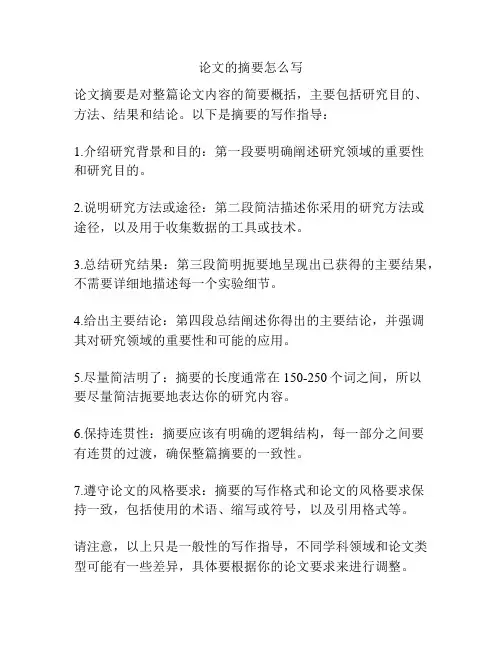
论文摘要是对整篇论文内容的简要概括,主要包括研究目的、方法、结果和结论。
以下是摘要的写作指导:
1.介绍研究背景和目的:第一段要明确阐述研究领域的重要性
和研究目的。
2.说明研究方法或途径:第二段简洁描述你采用的研究方法或
途径,以及用于收集数据的工具或技术。
3.总结研究结果:第三段简明扼要地呈现出已获得的主要结果,不需要详细地描述每一个实验细节。
4.给出主要结论:第四段总结阐述你得出的主要结论,并强调
其对研究领域的重要性和可能的应用。
5.尽量简洁明了:摘要的长度通常在150-250个词之间,所以
要尽量简洁扼要地表达你的研究内容。
6.保持连贯性:摘要应该有明确的逻辑结构,每一部分之间要
有连贯的过渡,确保整篇摘要的一致性。
7.遵守论文的风格要求:摘要的写作格式和论文的风格要求保
持一致,包括使用的术语、缩写或符号,以及引用格式等。
请注意,以上只是一般性的写作指导,不同学科领域和论文类型可能有一些差异,具体要根据你的论文要求来进行调整。

论文写作中的英文摘要范例英文摘要(Abstract)是论文写作中必不可少的一部分,其作用是概括出论文的主要内容和结论,帮助读者迅速了解论文的核心观点。
本文将提供一篇关于论文写作中英文摘要的范例,以供参考。
AbstractWith the increasing globalization of academic research, it has become essential for scholars to effectively communicate their work to a wider audience. One crucial element in this process is the abstract, which summarizes the main points and findings of a research paper. In this article, we will provide an example of an English abstract for a research paper, demonstrating key elements and tips for writing an effective abstract.IntroductionThe abstract serves as a brief overview of a research paper, allowing readers to quickly grasp the purpose, methodology, and outcomes of the study. It should be concise yet informative, providing enough information to engage the reader while remaining within a specified word limit.Main BodyI. Purpose and BackgroundThe first element of an abstract is a clear statement of the research paper's purpose and its background. It should outline the rationale for the study, highlighting any research gaps or unanswered questions in the field. For example:This research aims to investigate the effects of climate change on coastal ecosystems, with a focus on marine biodiversity and coral reef health. Given the increasing threats to these ecosystems, understanding the potential impacts of climate change is crucial for effective conservation strategies.II. MethodologyThe abstract should briefly describe the methodology employed in the research. This can include the study design, data collection methods, and analytical approaches. However, detailed technical information should be avoided. For example:A combination of field surveys, laboratory experiments, and statistical analyses were conducted to assess the long-term effects of temperature increase and ocean acidification on coral reefs. Data on species diversity, abundance, and health were collected from various reefs in the Caribbean region.III. ResultsThe abstract should highlight the key findings of the research. It should summarize the outcomes and conclusions derived from the data analysis. However, specific data or numerical results should be avoided, focusing instead on general trends and significant discoveries. For example:Our study revealed a significant decline in coral species diversity and overall health in response to increased water temperatures and ocean acidification. Furthermore, we found a decrease in the abundance of commercially important fish species, indicating potential impacts on local communities dependent on coral reef resources.IV. Implications and ConclusionThe abstract should conclude with a discussion of the broader implications of the research and its significance. It should provide a concise statement summarizing the main contributions of the study to the field and any recommendations for future research or policy implications. For example:These findings highlight the urgent need for immediate actions to mitigate the effects of climate change on coastal ecosystems. Implementing measures to reduce greenhouse gas emissions and establishing marine protected areas can help safeguard marine biodiversity and protect the livelihoods of communities dependent on coral reef resources.ConclusionIn conclusion, writing an effective English abstract is crucial for communicating the key points and contributions of a research paper. By providing a clear purpose, concise methodology, major findings, and broader implications, the abstract serves as a concise summary of the research work, enticing readers to delve deeper into the full paper. By following the guidelines and structure provided in this example abstract, researchers can enhance their chances of effectively conveying their research to a global audience.。

一、摘要概述摘要作为毕业论文的重要组成部分,是对论文研究内容、方法、结果和结论的简要概括。
它要求简洁、准确、全面地反映论文的核心内容,便于读者快速了解论文的研究价值和意义。
以下是一篇毕业论文摘要的万能模板,供同学们参考。
二、摘要模板【论文题目】摘要【关键词】【研究背景】(1)简要介绍研究领域的现状和发展趋势,阐述本研究的意义和价值。
(2)分析现有研究的不足,引出本研究的切入点。
【研究目的】(1)明确阐述本研究的总体目标和具体目标。
(2)阐述研究的目的和意义。
【研究方法】(1)介绍本研究的理论依据和研究方法。
(2)详细描述研究过程中的具体操作步骤。
【研究过程】(1)概述研究过程中所采用的主要技术和手段。
(2)介绍研究过程中的关键环节和关键问题。
【研究结果】(1)总结研究成果,包括数据、图表、公式等。
(2)分析研究结果,阐述其对研究目的的实现程度。
【结论】(1)总结论文的主要观点和发现。
(2)阐述研究的创新点和实际应用价值。
(3)提出未来研究方向和展望。
【参考文献】(1)列出论文中引用的参考文献。
(2)按照规范格式标注参考文献。
三、摘要写作要点1. 简洁性:摘要应控制在200-300字以内,避免冗长。
2. 突出重点:摘要应突出论文的核心内容,避免泛泛而谈。
3. 结构清晰:摘要应按照研究背景、研究目的、研究方法、研究过程、研究结果、结论的顺序进行撰写。
4. 语言规范:摘要应使用规范、准确、简洁的语言,避免口语化表达。
5. 关键词:关键词应具有代表性和概括性,一般为3-5个。
四、摘要修改建议1. 检查摘要中的错别字、语法错误和标点符号错误。
2. 确保摘要内容与论文内容一致,避免出现偏差。
3. 修改摘要中的语句,使其更加简洁、准确。
4. 检查关键词是否准确、全面地反映了论文的研究内容。
5. 修改摘要的结构,确保其符合学术规范。
五、总结摘要作为毕业论文的重要组成部分,对于论文的评审和推广具有重要意义。
同学们在撰写摘要时,应遵循以上模板和写作要点,力求使摘要简洁、准确、全面地反映论文的核心内容。