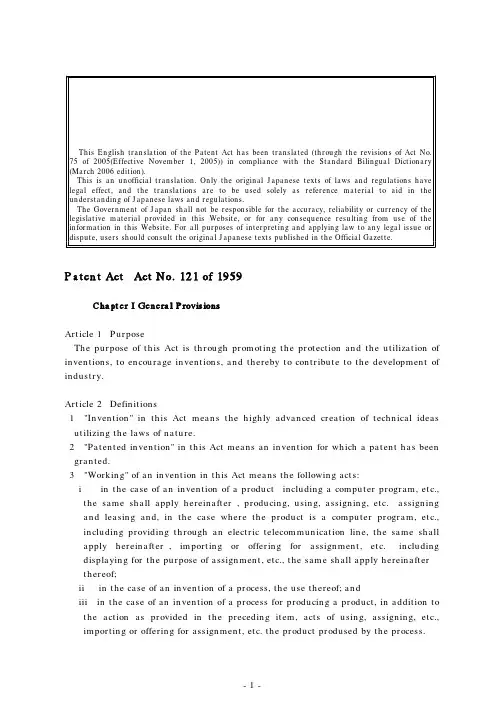
This English translation of the Patent Act has been translated(through the revisions of Act No. 75of2005(Effective November1,2005))in compliance with the Standard Bilingual Dictionary (March2006edition).This is an unofficial translation.Only the original Japanese texts of laws and regulations have legal effect,and the translations are to be used solely as reference material to aid in the understanding of Japanese laws and regulations.The Government of Japan shall not be responsible for the accuracy,reliability or currency of the legislative material provided in this Website,or for any consequence resulting from use of the information in this Website.For all purposes of interpreting and applying law to any legal issue or dispute,users should consult the original Japanese texts published in the Official Gazette.Patent Act Act No.121of1959Chapter I General ProvisionsArticle1PurposeThe purpose of this Act is through promoting the protection and the utilization of inventions,to encourage inventions,and thereby to contribute to the development of industry.Article2Definitions1"Invention"in this Act means the highly advanced creation of technical ideas utilizing the laws of nature.2"Patented invention"in this Act means an invention for which a patent has been granted.3"Working"of an invention in this Act means the following acts:i in the case of an invention of a product including a computer program,etc.,the same shall apply hereinafter,producing,using,assigning,etc.assigning and leasing and,in the case where the product is a computer program,etc., including providing through an electric telecommunication line,the same shallapply hereinafter,importing or offering for assignment,etc.including displaying for the purpose of assignment,etc.,the same shall apply hereinafterthereof;ii in the case of an invention of a process,the use thereof;andiii in the case of an invention of a process for producing a product,in addition to the action as provided in the preceding item,acts of using,assigning,etc., importing or offering for assignment,etc.the product prodused by the process.4A"computer program,etc."in this Act means a computer program a set of instructions given to an electronic computer which are combined in order to produce a specific result,hereinafter the same shall apply in this paragraph andany other information that is to be processed by an electronic computer equivalent to a computer program.Article3Calculation of time periods1The calculation of time periods under this Act or any order issued under this Act shall be made in accordance with the following provisions.i The first day of the period shall not be included in the calculation;provided,however,that this shall not apply where the period of time commences at00:00 hours.ii Where the period is indicated by months or years,such months or years shall refer to calendar months or calendar years.Where the period is not calculated from the beginning of a month or a year,the period shall expire on the preceding day of the day corresponding to the first day of the calculation in the last month or year;provided,however,that where there is no corresponding day in the last month,the period shall expire on the last day of the last month.2Where the last day of the prescribed period for any procedures relating to apatent hereinafter referred to as"procedures"including filing a patentapplication and a request,is any of the days provided for in Article11of the Acton Holidays of Administrative Organs Act No.91of1988,the day following such day shall be the last day of the period.Article4Extension of time limits,etc.The Commissioner of the Patent Office may,upon request or ex officio,extend theperiod provided for in Articles46-21iii,1081,1211and1731,for a person in a remote area or an area with transportation difficulty.Article51Where the Commissioner of the Patent Office,the chief trial examiner,or the examiner has designated a time limit by which procedures are to be undertaken under this Act,said official may,upon request or ex officio,extend the time limit.2Where the chief trial examiner has designated a specific date under this Act, said official may,upon request or ex officio,change such date.Article6Capacity of associations,etc.which are not juridical persons to undertakeprocedures1An association or foundation which is not a juridical person but for which a representative or an administrator has been designated may,in its name:i file a request for examination of an application;ii file a request for a trial for patent invalidation or a trial for invalidation of the registration of extension of duration;andiii file a request for a retrial in accordance with Article1711,against a final and binding decision in a trial for patent invalidation or a trial for invalidation of the registration of extension of duration.2An association or foundation which is not a juridical person but for which a representative or an administrator has been designated may be named as a demandee in a request filed for a retrial against a final and binding decision in a trial for patent invalidation or a trial for invalidation of the registration of extension of duration.Article7Capacity of minors or adult wards etc.to undertake procedures1Minors or adult wards may not undertake procedures except through their statutory representatives;provided,however,that this shall not apply where a minor is capable of independently performing a juristic act.2Where a person under curatorship undertakes procedures,the consent of a curator is required.3Where a statutory representative undertakes procedures,the consent of a supervisor of the guardian,if any,is required.4Where an adverse party files a request for a trial or retrial involving a personunder curatorship or a statutory representative,the preceding two paragraphs shall not apply.Article8Patent administrators for overseas residents1Unless otherwise provided for by Cabinet Order,no person domiciled or residentor,in the case of a juridical person,with a business office outside Japanhereinafter referred to as an"overseas resident"may undertake procedures or institute action against measures taken by a relevant administrative agency in accordance with the provisions of this Act or an order issued under this Act,except through a representative domiciled or resident in Japan,who is acting for suchperson in handling matters related to the person's patent hereinafter referred to as a"patent administrator".2The patent administrator shall represent the principal in all procedures and litigation against measures taken by any relevant administrative agency in accordance with the provisions of this Act or an order issued under this Act; provided,however,that this shall not apply where the overseas resident limits the scope of authority of representation of the patent administrator.Article9Scope of authority of representationAn agent of a person domiciled or resident in Japan or,in the case of a juridicalperson,with a business office and who is proceeding before the Patent Office shall not,unless expressly so empowered,convert,waive or withdraw a patent application, withdraw an application for registration of extention of the duration of a patent right, withdraw a request,application or motion,make or withdraw a priority claim underArticle411,file a patent application based on a registration of a utility model inaccordance with Article46-21,file a request for laying open of an application,file a request for a trial against an examiner's decision of refusal,waive a patent right or appoint a subagent.Article10DeletedArticle11No extinction of authority of representationThe authority of representaion of an authorized agent acting for a person undertaking procedures shall not be extinct upon the death of the principal,or in the case of a juridical person,merger of the principal,termination of trust duties of a trustee who is the principal,the death of a legal representative,or change or extinction of the statutory representative's authority of representation.Article12Independent representation by representativesWhere there are two or more representatives acting for a person who undertakes procedures,each representative may represent the principal before the Patent Office.Article13Replacement of representatives,etc.1When the Commissioner of the Patent Office or the chief trial examiner finds that a person undertaking procedures is not competent or suitable for undertaking such procedures,the official may order the person to undertake the procedures through a representative.2When the Commissioner of the Patent Office or the chief trial examiner finds that a representative acting for a person undertaking procedures is not competent or suitable for undertaking such procedures,the official may order that the representative be replaced.3In the case of the preceding two paragraphs,the Commissioner of the Patent Office or the chief trial examiner may order that a patent attorney be the representative.4The Commissioner of the Patent Office or the chief trial examiner may,after theissuance of an order under paragraph1or2,dismiss the procedures before the Patent Office undertaken by the person undertaking procedures under paragraph1or the representative under paragraph2.Article14Mutual representation of multiple parties in the caseWhere two or more persons are jointly proceeding before the Patent Office,each of them shall represent the other or others with respect to procedures other than the conversion,waiver and withdrawal of a patent application,the withdrawal of an application for registration of extention of the duration of a patent right,the withdrawal of a request,application,or motion,the making and withdrawal of apriority claim under Article411,the request for laying open of an application,and the request for a trial against an examiner's decision of refusal;provided,however, that this shall not apply where the said persons have appointed a representative for both/all of them and have notified the Patent Office accordingly.Article15Jurisdiction over overseas residentsRegarding a patent right or other right relating to the patent of a overseas resident,the location of the property under Article5iv of the Code of Civil Procedure ActNo.109of1996shall be the domicile or residence of the overseas resident's patent administrator,or if there is no such patent administrator,the address of the patent Office.Article16Ratification of acts of persons lacking legal capacity1Any procedures undertaken by a minor excluding one who has a legal capacityto juristic act independently or an adult ward may be ratified by the person'sstatutory representative or by the said adult ward,if the person later acquires a legal capacity to undertake the procedures.2Any procedures undertaken by a person with no authority of representation may be ratified by the principal holding legal capacity to undertake the procedures or the principal's statutory representative.3Any procedures undertaken by a person under curatorship without the consent of his curator may be ratified if the person under curatorship obtains the approval of his curator.4Any procedures undertaken by a statutory representative without the consent of a supervisor of a guardian may be ratified by the statutory representative if the approval of the supervisor of the guardian is obtained,or by the principal if the principal acquires a legal capacity to undertake the procedures.Article17Amendment of proceedings1A person undertaking a procedure before the Patent Office may make amendments only while the case is pending;provided,however,that the personmay not amend the description,scope of claims,drawing s or the abstract attached to the application,or the corrected description,scope of claims or drawings attached to the written request for correction or a trial for correctionunder Article134-21,unless an amendment may be made pursuant to the provisions the following Article to Article17-4inclusive.2Notwithstanding the main clause of the preceding paragraph,an applicant of awritten application in foreign language as provided in Article36-22may not amend the document and abstract in foreign language as provided in Article36-21.3The Commissioner of the Patent Office may require an applicant to amend a procedure,designating an adequate time limit,in the following cases:i where the procedures do not comply with Articles71to3or Article9;ii where the procedures do not comply with the formal requirements prescribed by this Act or an order thereunder;andiii where the fees relating to the procedures payable under Articles1951to3are not paid.4For any amendment of procedures except in the case of the payment of fees, written amendment shall be submitted in writing,except for cases provided by Article17-22.Article17-2Amendment of Description,Claim or Drawing attached to the application1An applicant for a patent may amend the description,scope of claims,or drawings attached to the application,before the service of the certified copy of the examiner's decision notifying that a patent is to be granted;provided,however, that following the receipt of a notice provided under Article50,an amendment may only be made in the following cases:i where the applicant has received the first notice hereinafter referred to inthis Article as the"notice of reasons for refusal"under Article50including the cases where it is applied mutatis mutandis pursuant to Article1592including the cases where it is applied mutatis mutandis pursuant to Article 1741and Article1632,hereinafter the same shall apply in this paragraphand said amendment is made within the designated time limit under Article50;ii where,following the receipt of the notice of reasons for refusal,the applicant has received a notice under Article48-7and the said amendment is made within the designated time limit under the said Article;iii where,following the receipt of the notice of reasons for refusal,the applicant has received a further notice of reasons for refusal and the said amendment is made within the designated time limit under Article50with regard to the final notice of reasons for refusal;andiv where the applicant files a request for a trial against an examiner's decisionof refusal and said amendment is made within30days from said request for said trial.2Where an applicant of a written application in foreign language as provided inArticle36-22amends the description,scope of claims or drawings under thepreceding paragraph for the purpose of correcting an incorrect translation,theapplicant shall submit the statement of correction of the incorrect translation,stating the grounds thereof.3Except in the case where the said amendment is made through the submission ofa statement of correction of an incorrect translation,any amendment of thedescription,scope of claims or drawings under paragraph1shall be made withinthe scope of the matters described in the description,scope of claims or drawingsoriginally attached to the application in the case of a written application inforeign language under Article36-22,the translation of the document in foreignlanguage as provided in Article36-22that is deemed to be the description,scopeof claims and drawings under Article36-24in the case where the amendmentto the description,scope of claims or drawings has been made through thesubmission of the statement of correction of an incorrect translation,the saidtranslation or the amended description,scope of claims or drawings.4In addition to the requirements provided in the preceding paragraph,in thecases of items iii and iv of paragraph1,the amendment of the scope ofclaims shall be limited to those for the following purposes:i the deletion of a claim or claims as provided in Article365;ii restriction of the scope of claims limited to the cases where the restriction isto restrict matters required to identify the invention stated in a claim or claimsunder Article365,and the industrial applicability and the problem to besolved of the invention stated in the said claim or claims prior to the amendmentare identical with those after the amendment.;iii the correction of errors;andiv the clarification of an ambiguous statement limited to the matters stated inthe reasons for refusal in the notice of reasons for refusal.5Article1265shall apply mutatis mutandis to cases under item ii of thepreceding paragraph.Article17-3Amendment of abstractAn applicant for a patent may amend the abstract attached to the applicationwithin one year and three months excluding the period after a request for layingopen of application is filed from the filing date of the patent application or in thecase of a patent application containing a priority claim under Article411,the filingdate of the earlier application provided for in the saidparagraph,in the case of apatent application containing a priority claim under Article431,43-21or43-22,the filing date of the earliest application,a patent application that is deemed tobe the earliest application under Article4.C4of the Paris Convention refers tothe Paris Convention for the Protection of Industrial Property of March20,1883,asrevised at Brussels on December14,1900,at Washington on June2,1911,at Hagueon November6,1925,at London on June2,1934,at Lisbon on October31,1958,andat Stockholm on July14,1967,the same shall apply hereinafter or a patentapplication that is recognized as the earliest application under Article4.A2of theParis Convention,and in the case of a patent application containing two or morepriority claims under Article411,431,43-21or43-22,the earliest day of thefiling dates on which the said priority claims are based,the same shall apply toArticle641.Article17-4Amendment of corrected description,scope of claims or drawings1The demandee of a trial for patent invalidation may amend the correcteddescription,scope of claims or drawings attached to the written request forcorrection under Article134-21only within the time limit designated underArticle1341,1342,134-23,134-31,134-32or1532.2The demandant of a trial for correction may amend the corrected description,scope of claims or drawings attached to the written request for a trial for correction,only prior to notice under Article1561in the case where the proceedings hasbeen reopened under Article1562,prior to further notice under Article1561.Article18Dismissal of procedures1The Commissioner of the Patent Office may dismiss the procedures where aperson ordered to make an amendment to the procedures under Article173failsto make such amendment within the designated time limit under the saidprovision,or where a person obtaining the registration establishing a patent rightfails to pay patent fees within the designated time limit under Article1081.2The Commissioner of The Patent Office may dismiss a patent application wherethe applicant ordered under Article173to pay patent fees provided for in Article1953fails to pay such patent fees within the designated time limit under Article173.Article18-2Dismissal of inadequate procedure1The Commissioner of the Patent Office shall dismiss a procedure where theprocedure is inadequate and not amendable.2Where the Commissioner of the Patent Office intends to dismiss a procedureunder the preceding paragraph,he/she shall notify the person who undertook theprocedures of the reasons therefor and give the said person an opportunity tosubmit a document stating an explanation hereinafter referred to as a"statement of explanation",designating an adequate time limit.Article19Effective time of submission of applicationAn application,a document or any other item submitted by mail to the Patent Office under this Act,or any order rendered under this Act,that is subject to a time limit,shall be deemed to have arrived at the Office at the date and time when such application or item is presented to the post office if such date and time are proven by the receipt of the mail,at the date and time of the date stamp on the mail if such date and time are clearly legible,or at noon of the day of the date stamp on the mail if only the day,but not the time,of the date stamp is clearly legible.Article20Succession of effects of proceduresThe effects of the procedures relating to a patent right or any right relating to a patent shall extend to a successor in title.Article21Continuation of proceduresWhere a patent right or any right relating to a patent is transferred while a case is pending before the patent Office,the Commissioner of the patent Office or the chief trial examiner may proceed with the procedures relating to the case to which the successor in title shall be the party.Article22Suspension or termination of procedures1Where a motion for the resumption of procedures suspended after a certified copy of a ruling,an examiner's decision or a trial decision has been served is filed, the Commissioner of the Patent Office or the trial examiner shall render a ruling on whether the resumption shall be accepted.2The ruling under the preceding paragraph shall be made in writing and state the grounds therefor.Article231Where a procedure for an examination,trial or retrial has been suspended andthe person responsible for resuming the procedure fails to do so,the Commissioner of the Patent Office or the trial examiner shall,upon a motion or ex officio,order the said person to resume the procedure and designate an adequate time limit for this purpose.2Where the resumption does not occur within the time limit designated under the preceding paragraph,the resumption may be deemed by the Commissioner of the Patent Office or the trial examiner to have commenced on the date the time limit lapsed.3When the resumption is deemed to have commenced under the preceding paragraph,the Commissioner of the Patent Office or the chief trial examiner shall notify the parties in the case thereof.Article24The Code of Civil Procedure,Articles124excluding paragraph1vi,126to 127,1281,130,131and1322suspension or termination of court proceedings shall apply mutatis mutandis to a procedure for an examination,a trial or retrial.Inthis case,the term"counsel"in Article1242of the said Code shall be deemed to be replaced with"agent entrusted with the examination,trial or retrial",the term "court"in Article127of the said Code shall be deemed to be repleced with "Commissioner of the Patent Office or the chief trial examiner",the term"court"inArticles1281and131of the said Code shall be deemed to be replaced with "Commissioner of the Patent Office or the trial examiner",and the term"court"in Article130of the said Code shall be deemed to be replaced with"Patent Office".Article25Enjoyment of rights by foreign nationalsA foreign national not domiciled or resident or,in the case of a juridical person,with a business office in Japan may not enjoy a patent right or other rights relating to a patent,except in the following cases:i where the country of the foreign national allows Japanese nationals to enjoya patent right or other rights relating to a patent under the same conditions asfor its own nationals;ii where the country of the foreign national allows Japanese nationals to enjoya patent right or other rights relating to a patent under the same conditions asfor its own nationals in the case where Japan allows nationals of that country to enjoy a patent right or others right relating to a patent;andiii where specifically provided by treaty.Article26Effect of treatiesWhere specific provisions relating to a patent are provided by treaty,such provisions shall prevail.Article27Registration in the patent registry1The following matters shall be registered in the patent registry maintained in the Patent Office:i the establishment,extension of the duration,transfer,lapse,restoration orrestriction on disposition,of a patent right;ii the establishment,maintenance,transfer,modification,lapse or restriction on disposal,of an exclusive or non-exclusive license;andiii the establishment,transfer,modification,lapse or restriction on disposal,of a right of pledge on a patent right or exclusive or non-exclusive license.2The patent registry may be prepared,in whole or in part,in the form ofmagnetic tapes including other storage media using a similar method that may record and reliably store certain matters,the same shall apply hereinafter.3In addition to those prescribed in this Act,matters relating to registration shall be prescribed by Cabinet Order.Article28Issuance of certificate of patent1The Commissioner of the Patent Office shall issue the certificate of patent to the patentee when the establishment of a patent right has been registered,or when a trial decision to the effect that the description,scope of claims or drawings attached to the application are to be corrected has become final and binding and the said trial decision has been registered.2Re-issuance of the certificate of patent shall be prescribed by Ordinance of the Ministry of Economy,Trade and Industry.Chapter II Patents and Patent ApplicationsArticle29Conditions for Patentability1An inventor of an invention that is industrially applicable may be entitled to obtain a patent for the said invention,except for the following:i inventions that were publicly known in Japan or a foreign country,prior tothe filing of the patent application;ii inventions that were publicly worked in Japan or a foreign country,prior to the filing of the patent application;oriii inventions that were described in a distributed publication,or inventions that were made publicly available through an electric telecommunication line in Japan or a foreign country,prior to the filing of the patent application.2Where,prior to the filing of the patent application,a person ordinarily skilled in the art of the invention would have been able to easily make the invention based on an invention prescribed in any of the items of the preceding paragraph,a patent shall not be granted for such an invention notwithstanding the preceding paragraph.Article29-2Where an invention claimed in a patent application is identical with an inventionor device excluding an invention or device made by the inventor of the inventionclaimed in the said patent application disclosed in the description,scope of claimsor drawings in the case of the written application in foreign language under Article36-22,the document in foreign language as provided in Article36-21originally attached to the written application of another application for a patent or for a registration of a utility model which has been filed prior to the date of filing of thesaid patent application and published after the filing of the said patent application inthe patent bulletin under Article663of the patent Act hereinafter referred to as"patent bulletin"or in the utility model bulletin under Article143of the utility model Act Act No.123of1959hereinafter referred to as"utility model bulletin"describing matters provided for in each of the paragraphs of the respective Article or for which the publication of the patent application has been effected,a patent shallnot be granted for such an invention notwithstanding Article291;provided, however,that this shall not apply where,at the time of the filing of the said patent application,the applicant of the said patent application and the applicant of the other application for a patent or for registration of a utility model are the same person.Article30Exception to lack of novelty of invention1In the case of an invention which has fallen under any of the items of Article291by reason of the fact that the person having the right to obtain a patent has conducted a test,has made a presentation in a printed publication,has made a presentation through electric telecommunication lines,or has made a presentation in writing at a study meeting held by an academic group designated by the Commissioner of the patent Office,such invention shall be deemed not have fallen under any of the items of Article291for the purposes of Article291and2for the invention claimed in a patent application which has been filed by the said person within six months from the date on which the invention first fell under any of thoseitems.2In the case of an invention which has fallen under any of the items of Article291against the will of the person having the right to obtain a patent,thepreceding paragraph shall also apply for the purposes of Article291and2to the invention claimed in the patent application which has been filed by the said person within six months from the date on which the invention first fell under any of those paragraphs.3In the case of an invention which has fallen under any of the items of Article291by reason of the fact that the person having the right to obtain a patent has exhibited the invention at an exhibition held by the Government or a local publicentity hereinafter referred to as"Government,etc.",an exhibition held by those who are not the Government,etc.where such exhibition has been designated by the Commissioner of the patent Office,an international exhibition held in the territory of a country of the Union of the Paris Convention or a member of the World Trade Organization by its Government,etc.or those who are authorized thereby to hold such an exhibition,or an international exhibition held in the territory of a state which is neither of a country of the Union of the Paris Convention nor a member of the World Trade Organization by its Government,etc.。