
人附睾蛋白4(HE4)
- 格式:ppt
- 大小:2.64 MB
- 文档页数:40

?妇科肿瘤?子宫内膜癌患者血清人附睾分泌蛋白4(H E4)、糖类抗原125(C A125)的检测及其临床价值任艳芳,张秀玲,王玉红,王慧玲,姜永杰,杨君The detection of human epididymal secretory protein 4 (H E4) and carbohydrate antigen 125 (CA125) in patients with endometrial carcinoma and their clinical valueRen Yanfang,Zhang Xiuling,W ang Yuhong,W ang H uiling,Jiang Yongjie,Yang JunDepartment of Obstetrics and Gynecology^the First Affiliated Hospital of Xinxiang Medical University yHenan Xinxiang453Q Q Q,China.【A b s t r a c t】O b je c t iv e:T o in v e s tig a te th e le v e ls o f se ru m h u m a n e p id id y m a l s e c re to ry p ro te in 4 (H E)a n d c a rb oh y d ra te a n tig e n125 (C A125) in p a tie n ts w ith e n d o m e tria l c a rc in o m a a n d th e ir c lin ic a l v a lu e.M e t lio d s:T h e re w ere126 cases o f p a tie n ts w ith e n d o m e tria l c a n c e r as th e m a lig n a n t g ro u p,81 cases o f e n d o m e tria l h y p e rp la s ia p a tie n ts asb e n ig n g ro u p,114 h e a lth y w o m e n asc o n tro l g ro u p.H E,C A125 w ere m e asu red b y R O C c u rve a n a ly s is,a n d s in g le andc o m b in ed de te c tio n of H E,C A125 w ere c o m p a re d.R e s u lt s:H E has an o b v io u s a dvantage o v e r e n d o mth a n th e d ia g n o s is o f C A125 (P<0. 05). H E4,C A125 le v e ls o f th e p a tie n ts in each g rou p w ered iffe re n c e w as s ta tis tic a lly s ig n ific a n t(P<0. 05). T h e le v e ls of H E and C A125 in m a lig n a n t g rou p w ere s ig n ific a n tlyh ig h e r th a n those in b e n ig n g ro u p a nd c o n tro l g ro u p (P< 0.05 ).T h e s e n s itiv ity,s p e c ific ity a n d c o in c id e n c e ra te o fe n d o m e tria l c a rc in o m a d ia g n o se d b y H E w e re h ig h e r th a n those of C A125,a nd th e d iffe re n c e w as n o t s ta tis tic a lly sign ific a n t(P>0.05). C o n c lu s io n:T h e c o m b in e d d e te c tio n o f H E a nd C A125 in th e d ia g n o s has h ig h e r s e n s itiv ity a nd s p e c ific ity.H E in d ia g n o s is o f e n d o m e tria l c a rc in o m a i s b e tte rC A125 jo in t in s p e c tio n has c o m p le m e n ta ry e ffe c t,ca n a v o id th e o c c u rre n c e o f separatep ro v e th e a c c u ra c y o f c lin ic a l d ia g n o s is o f e n d o m e tria l c a rc in o m a.【K e y w o r d s】h u m a n e p id id y m is se c re to ry p ro te in4, c a rb o h y d ra te a n tig e n125, e n d o m e tria l c a rc in o m a,R O C c u r v e,d i-a g n o s tic v a lu eM o d e rn O n c o lo g y2018,26(09) :1392 - 1395【摘要】目的:探讨子宫内膜癌患者血清人附睾分泌蛋白4(h u m a n e p id id y m a l s e c re to ry p ro te in4,H E)、糖类抗原125(Ca b〇h y d r t e a n tig e n 125,C A125)水平变化及其临床价值。

人附睾蛋白4在妇科肿瘤诊断及监测中的应用
蔡斌
【期刊名称】《实用妇产科杂志》
【年(卷),期】2012(28)1
【摘要】人附睾蛋白4(HE4)发现以来,国内外学者对HE4进行了一些相关研究,而日益增多的研究证据表明,HE4在卵巢癌和子宫内膜癌的早期诊断及疾病监测方面具有良好的应用前景,联合血清癌抗原125( CA125)检测,可进一步提高肿瘤诊断的敏感性和特异性,可为一个新的妇科肿瘤标志物.HE4在不同人群中的参考区间的确定,还有待于大规模的临床研究.
【总页数】3页(P25-27)
【作者】蔡斌
【作者单位】上海交通大学附属第一人民医院,上海200080
【正文语种】中文
【中图分类】R737.3
【相关文献】
1.人附睾蛋白4联合CA125检测在卵巢良恶性肿瘤诊断中的临床应用价值 [J], 石艳芬;苏悦兴;陈源清
2.糖类抗原125和人附睾蛋白4联合检测在妇科盆腔肿块中的应用价值研究 [J], 张磊
3.人附睾蛋白4在妇科肿瘤诊断中的应用 [J], 王秀华;蔡媛媛
4.人附睾蛋白4时间分辨荧光免疫分析在妇科肿瘤诊断中的价值 [J], 张艺;陈道桢;
王珂;许飞;赵军;黄飚;张珏;范俊;周彬
5.^(18)F-FDG PET/CT显像对妇科肿瘤诊断和术后监测的应用 [J], 邓凯;张成琪;刘庆伟;陈静;姚树展;刘松涛;李昕;宋吉清
因版权原因,仅展示原文概要,查看原文内容请购买。
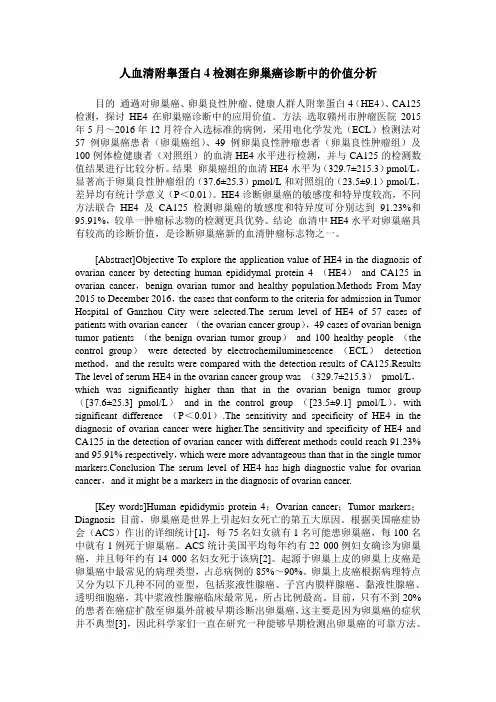
人血清附睾蛋白4检测在卵巢癌诊断中的价值分析目的通過对卵巢癌、卵巢良性肿瘤、健康人群人附睾蛋白4(HE4)、CA125检测,探讨HE4在卵巢癌诊断中的应用价值。
方法选取赣州市肿瘤医院2015年5月~2016年12月符合入选标准的病例,采用电化学发光(ECL)检测法对57例卵巢癌患者(卵巢癌组)、49例卵巢良性肿瘤患者(卵巢良性肿瘤组)及100例体检健康者(对照组)的血清HE4水平进行检测,并与CA125的检测数值结果进行比较分析。
结果卵巢癌组的血清HE4水平为(329.7±215.3)pmol/L,显著高于卵巢良性肿瘤组的(37.6±25.3)pmol/L和对照组的(23.5±9.1)pmol/L,差异均有统计学意义(P<0.01)。
HE4诊断卵巢癌的敏感度和特异度较高,不同方法联合HE4及CA125检测卵巢癌的敏感度和特异度可分别达到91.23%和95.91%,较单一肿瘤标志物的检测更具优势。
结论血清中HE4水平对卵巢癌具有较高的诊断价值,是诊断卵巢癌新的血清肿瘤标志物之一。
[Abstract]Objective To explore the application value of HE4 in the diagnosis of ovarian cancer by detecting human epididymal protein 4 (HE4)and CA125 in ovarian cancer,benign ovarian tumor and healthy population.Methods From May 2015 to December 2016,the cases that conform to the criteria for admission in Tumor Hospital of Ganzhou City were selected.The serum level of HE4 of 57 cases of patients with ovarian cancer (the ovarian cancer group),49 cases of ovarian benign tumor patients (the benign ovarian tumor group)and 100 healthy people (the control group)were detected by electrochemiluminescence (ECL)detection method,and the results were compared with the detection results of CA125.Results The level of serum HE4 in the ovarian cancer group was (329.7±215.3)pmol/L,which was significantly higher than that in the ovarian benign tumor group ([37.6±25.3] pmol/L)and in the control group ([23.5±9.1] pmol/L),with significant difference (P<0.01).The sensitivity and specificity of HE4 in the diagnosis of ovarian cancer were higher.The sensitivity and specificity of HE4 and CA125 in the detection of ovarian cancer with different methods could reach 91.23% and 95.91% respectively,which were more advantageous than that in the single tumor markers.Conclusion The serum level of HE4 has high diagnostic value for ovarian cancer,and it might be a markers in the diagnosis of ovarian cancer.[Key words]Human epididymis protein 4;Ovarian cancer;Tumor markers;Diagnosis目前,卵巢癌是世界上引起妇女死亡的第五大原因。

人附睾蛋白4在卵巢癌早期诊断及预后监测中的应用进展田园;胡卫平【摘要】卵巢癌是常见的妇科恶性肿瘤,早期无症状,一旦诊断多属晚期,病死率居妇科恶性肿瘤之首.因此,针对卵巢癌的高危因素做到早期诊断并采取一定的阻断措施,必将减少部分卵巢癌的发生与死亡.人附睾蛋白4是新近提出的肿瘤标志物,在卵巢肿瘤组织高表达,在癌旁组织不表达,特异性较CA125高,与卵巢癌的组织类型、分期、分级等存在相关性,在血液、尿液中均可检测到,对卵巢癌的早期诊断、复发和预后的监测有良好的辅助诊断效果.【期刊名称】《医学综述》【年(卷),期】2013(019)013【总页数】3页(P2349-2351)【关键词】人附睾蛋白4;卵巢癌;CA125【作者】田园;胡卫平【作者单位】安徽医科大学附属省立医院妇产科,合肥,230000;安徽医科大学附属省立医院妇产科,合肥,230000【正文语种】中文【中图分类】R737.31卵巢癌是常见的妇科恶性肿瘤,其发病率仅次于宫颈癌和子宫体癌,病死率居妇科恶性肿瘤之首。
近40 年来,其发病率增加了23 倍,并且有上升的趋势。
根据已经出现典型症状而得到诊断的病例70%通常已经到了晚期阶段,5 年生存率在50%以下[1]。
临床为了尽可能及早地进行诊断并采取手术、化疗等治疗措施,通常利用一些费时或价格较高的方法进行检测,并联合多种检测方法同时进行,然而这些检查特异性、敏感性均不高,不能给予明确诊断,常需要进一步行腹腔镜检查[2]。
研究者长期以来着重研究血清中可以用来筛查和诊断卵巢癌的标志物,但是目前尚未发现可靠的肿瘤指标[3]。
CA125 是目前唯一用于临床检测卵巢癌的肿瘤标志物,但其诊断的敏感性和特异性不理想,对其用于临床确诊有一定的限制[4]。
人附睾蛋白4(human epididymis protein 4,HE4)是新近提出的肿瘤标志物,可用来筛查卵巢癌。
1 HE4 的结构和功能HE4 基因,即WFDC2 基因,位于染色体20q12~13.1,由5 个外显子和4 个内含子组成,编码相对分子质量为13 ×103 的蛋白质,经过糖基化后形成相对分子质量为25 ×103 的成熟蛋白(WAP 四二硫化物核心域蛋白)[5-6]。