【最新】人教版九年级英语上册Unit1 第3课时教案
- 格式:doc
- 大小:130.00 KB
- 文档页数:2
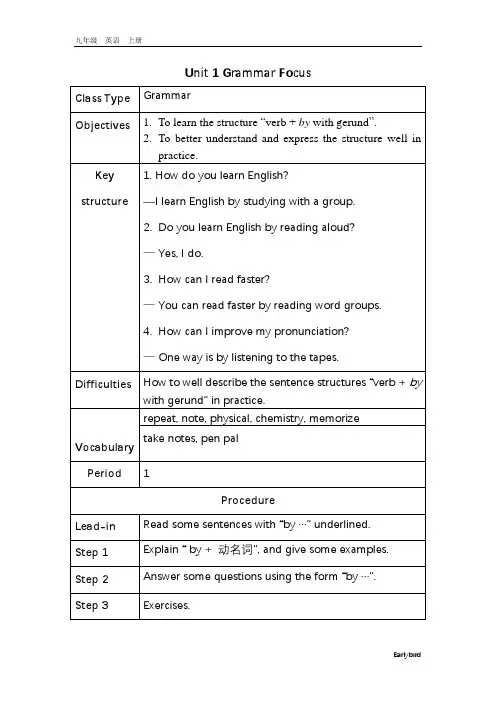
Unit1 第3课时教案
学科 English 课时 3 年级
9年级
教学
要求
1. Train students’ integrating skills.2. Train students’ ability of social
practice.3.Anything has both advantages and disadvantages. We should treat everything
correctly.
教学重点难点 1.Train students’ listening, speaking, reading and writing ability. 2.How to improve students’ integrating skills.
教法
任务型教学法
交际型学习法
游戏教学法
教学过程及教师活动 学生活动 设计意图
Step Ⅰ Revision Step Ⅱ 3a This activity provides reading practice using the target language. Show the key words on the screen by a projector. Read the words and have the students repeat again and again until they can pronounce the words fluently and accurately. Write the words advantages and disadvantages on the board and ask students to explain them in their own words. Disadvantage is the opposite of advantage. It means unfavourable condition or something that stands in: the way of progress, success, etc. Advantage and disadvantage are the opposites. Ask students to give some examples: ability→disability, trust→distrust. Read the instructions. Point out the blank lines under the words Advantages and Disadvantages below the interview. Ask students to read the interview again and write the advantages and disadvantages. Check the answers with the whole class. Answers I prefer being outside. = I prefer to go out. free--without payment; costing nothing It’s also just fun to watch people. Pay attention to the structure It’s + n./adj, +to do sth. Step Ⅲ 3b Read the instructions. Point out the conversation in the box and invite two students to read it to the class. Point out the list of advantages and disadvantages in Activity 3a. Say, You can use these items and any other items you can think of as you talk about places you usually hang out. Notes: Work in pairs. Read and spell Listen and read the article.
对单词进行复习,便于
文章的理解。
经过教师的引领,进
一步对文章进行理解,
锻炼学生独立思考能
力。
It’s kind of small. = It’s a little small. Snack means light, usual, hurriedly eaten meal Step Ⅳ 4 This activity provides reading, writing, reading and speaking practice using the target language. Read the instructions to the class. Get students to look back at the picture and activities on the first page of this unit. Point out the sample language in the box. Invite a student to read it to the class. Ask students to say the names of some stores and other places in the community and write them on the board. Say, When the groups are ready, they read their directions to the class and the other students guess the name of the place they are talking about. A: Go out the front door and take a right. Walk along Xueyuan Road, and take the fourth turning on the left. Go past the hospital, and turn right. It’s about a hundred metres along on the left. You can’t miss this place. B: Go out the front door and take a right. Walk about two blocks. Go past the bookstore, and turn left onto Yingxiong Street. Then you can see the place on your left. C: Go out the front door and take a left. Go down the street, and take the first turning on the right, then the second turning on the left. Go past the restaurant, and then you will find it. (A. the post office B. the police station C. Guangming Supermarket) Step Ⅴ Summary In this class, we’ve learned some key vocabulary words and the target language. We’ve also done a lot of listening, speaking, reading and writing practice using the target language. Read by themselves . Work in groups. Read and think. Work in pairs. DO the exercise in part 4
将文章转化成对话,便
于学生记忆,实用。
通过此活动,让学生对
本课内容进一步理解
。
将所学到的知识结合
到实际生活当中,激发
学生兴趣,能够更好记
忆。
布置
作业
1. Ask students to choose two places in the community and write careful directions from
the school to each place.
2. Finish off the exercises on the workbook.
教
学
反
思