反问疑问句的用法
- 格式:doc
- 大小:45.50 KB
- 文档页数:16
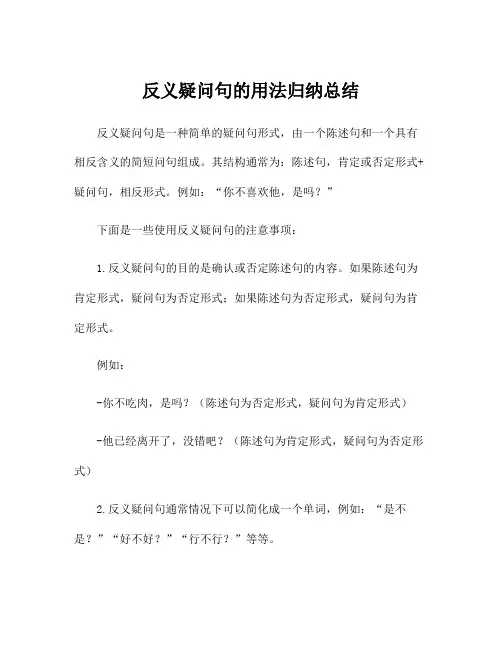
【基础知识点睛】定义:反意疑问句又名附加疑问句。
属疑问句的一种,表示说话者对某事有一定看法,但又不完全确定,需要对方加以证实。
其基本结构为陈述句+一般疑问句的简略形式。
结构:如陈述部分为肯定式,疑问部分用否定式。
反之,如陈述部分否定式,疑问部分用肯定式。
疑问部分重复陈述句的主语(必须用代词)和be , have,助动词或情态动词。
如陈述句中没有be, have,助动词或情态动词,则须另加do。
如:She has gone to town, hasn't she? 她进城了,对吗?You like it, don't you? 你喜欢它,不是吗?注意事项:1. 在朗读时,反意疑问句的前一部分用降调,后一部分,在表示疑问时用升调,在表示肯定或强调时用降调。
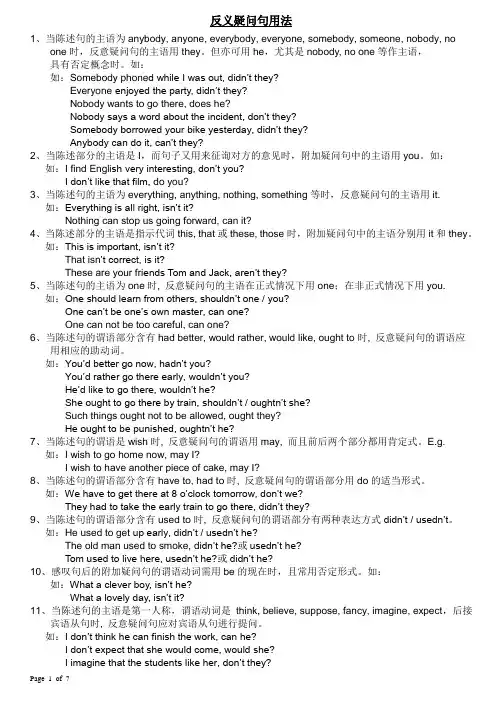
如:He's an engineer, isn't he?↑他是工程师,是不是?It's a fine day today, isn't it?↓今天天气很好,对吧?2. 附加问句的主语应与陈述句的主语保持一致,且只能用人称代词替代。
如:You come from Beijing, don't you?你来自北京,是不是? The students in Grade One won't go to the park, will they?一年级的学生不去公园了,是吗?当陈述句的主语为nobody、none、no one、anybody、anyone、everybody、everyone等表人的不定代词或these、those指示代词时,其附加问句通常用they作主语,而nothing、anything、everything等表物的不定代词或this、that指示代词作主语时,其附加问句通常用it作主语。
如:Anyone can answer the question, can't they?任何人都能回答这个问题,不是吗?Everything is ready, isn't it?一切准备好了,是不是? That is a yellow kite, isn't it?那是只黄色的风筝,不是吗? 当陈述句是第一人称I+think/suppose/consider/believe/imagine等接的宾语从句时,附加问句的主语应依从句的主语而定。
如:I don't think the film is interesting, is it?我认为这部电影没趣,是吗?如果主句主语非第一人称,附加问句的主语常依主句的主语而定。
如:Jim said no one was fond of the job, didn't he?吉姆说没人喜欢这项工作,是不是?You thought we were from the States, didn't you?你原以为我们来自美国,是吗?如果陈述句为there be句型,附加问句的主语为there。
如:There will not be any trouble, will there?There's something wrong, isn't there?出事了,不是吗? 当陈述部分的主语为不定式、动名词或句子,附加问句的主语一律为it。
如:Reading is useful, isn't it?阅读非常有用,不是吗?3. 附加问句的动词要与陈述句的动词时态保持一致,并要用相应的助动词替代。
如:He can swim, can't he?他会游泳,不是吗?The stores close at nine o'clock, don't they?商店九点关门,不是吗?但也有一些附加问句与陈述句谓语时态不一致的情况。
如:I'm late, aren't I?我晚了,不是吗?He must be lost, isn't he?他可能迷路了,不是吗?They must have completed the project last night, didn't they?他们可能昨晚完成了这项工程,是不是?They must have left, haven't they?他们可能走了,是不是?当must表推测时,附加问句的动词应依must后的动词而定。
在对过去事实进行推测时,附加问句的时态应根据主句是否带有时间状语而定。
4. 对反意疑问句的回答,肯定或否定要前后保持一致,即前面用“yes”,后面必须是肯定;前面用“no”,后面必须是否定。
5. 在回答“前否定(陈述句)+后肯定(简略问句)”的反意疑问句时,答语中“yes”和“no”的翻译恰好与汉语相反,如:He isn't a pianist, is he? 他不是钢琴家,是吗?Yes, he is. (No, he isn't.) 不,他是钢琴家。
(对,他不是钢琴家。
)【重点难点突破】1. 与祈使句有关的反意疑问句(1)以肯定祈使句开头的反意疑问句,其疑问部分通常为“will you”,也可以是“won't you”。
例如:Please turn down the radio, will / won't you?(思路:Please turn down the radio. →Will you please turn down the radio?)Wait for a moment, will / won't you?(2)以否定祈使句开头的反意疑问句,其疑问部分为“will you”。
例如:Please don't draw on the wall, will you?(3)以Let's开头,表示建议的祈使句,由于句中的实际主语包括听、说双方,所以其疑问部分为“shall / shan't we”。
例如:Let's have a rest, shall / shan't we?如果是由Let's not开头的祈使句,其疑问部分用all right或O. K.。
例如:Let's not go shopping, all right (=O. K.)?(4)以Let us / me开头,征询意见的祈使句,由于句中的实际主语仅指对方,所以其疑问部分为“will you”。
例如:Let us go there, will you?Let me have another try, will you?2. 与复合句有关的反意疑问句(1)如果陈述部分是主从复合句,其反问部分的主语和助动词应与主句的主语和助动词保持一致。
例如:If he hasn't finished his work, he can't go out to play, can he?(2)以第一人称I / We + think / believe / imagine / suppose / guess / expect / etc.开头的主从复合句,其疑问部分的主谓语应与从句的主谓语保持一致。
例如:I think he has arrived at the airport, hasn't he?但如果主句是否定句,则应将否定还原到从句中处理,(即将该主从复合句还原成单句后处理)。
例如:I don't believe she knows it, does she?(思路:I don't believe she knows it. → I believe she doesn't know it. → She doesn't know it.)如果主句的主语是第二、第三人称,其反问部分的主语应与主句的主语保持一致。
例如:He believes they will come, doesn't he?(3)当陈述部分的主语是从句、不定式(短语)、动名词等时,疑问部分的主语用it。
如:Whether they will come or not doesn't matter too much, does it?他们是否来关系不太大,对吗?(主语从句作陈述句的主语)Packing the suitcase has taken up a whole morning, hasn't it?打包(手提皮箱)花了一个上午,是吗?(动名词短语作陈述句的主语)To learn a foreign language well in such a short time isn't easy, is it?在那么短的时间内要学会一门外语是不容易的,对吗?(不定式短语作陈述句的主语)3. 与感叹句有关的反意疑问句如果陈述句部分是感叹句,其反问部分要用否定式。
例如:What a beautiful day, isn't it? How clever the girl is, isn't she?4. 与含否定意义的词有关的反意疑问句如果陈述部分含有never, hardly, scarcely, seldom, no, none, no one, rarely, nowhere, nothing, nobody, few, little等具有否定意义的词,其反问部分要用肯定式。
例如:They have never met each other before, have they? You have nothing more to say, have you?Few people know him, do they?注意:当陈述部分含有由dis-, un-, im-, in-, im-, il-, ir- 等否定前缀构成的派生词(dislike, discourage, be unfair/ untrue/ unable, etc.)时,虽意思是“不”,但疑问部分仍要用否定式。
如:You dislike it, don't you?The patient is unable to move round, isn't he?The news that they failed their driving test discouraged him, didn't it?She dislike it, doesn't she? 她不喜欢它,是吧?5. 与谓语有关的反意疑问句(1)如果陈述部分含有表推测的情态动词must,其反问部分不能用情态动词,应根据具体情况而定。