
九年级初三英语学科听课记录.(超级经典)
- 格式:pdf
- 大小:659.81 KB
- 文档页数:5
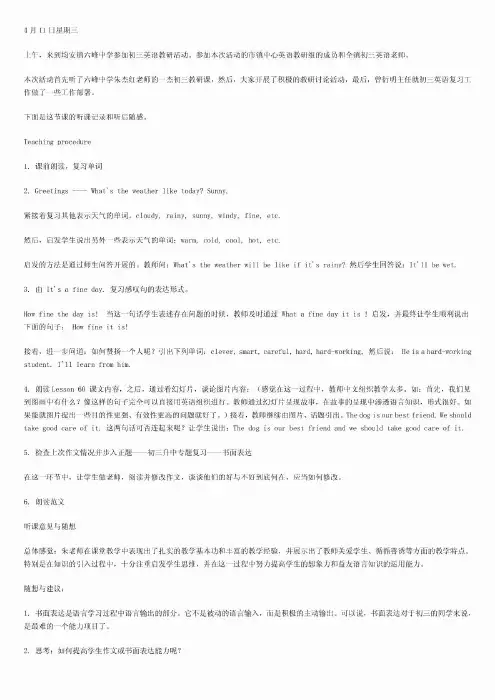

九年级英语听课记录模板范文Here is an English essay with more than 1,000 words, as requested. The title is "Sample Ninth Grade English Listening Class Observation".It was a sunny Tuesday morning when I entered the ninth-grade English classroom. The students were already seated, eagerly awaiting the start of the lesson. The teacher, Ms. Johnson, greeted the class with a warm smile and began the day's activities.The lesson commenced with a brief review of the previous day's material. Ms. Johnson asked several students to share their understanding of the key concepts covered, encouraging them to actively participate in the discussion. I was impressed by the students' attentiveness and their willingness to engage with the subject matter.Following the review, Ms. Johnson introduced the topic of the day –literary devices in poetry. She explained that the class would be analyzing a poem and identifying the various literary techniques employed by the poet. The students seemed intrigued by the prospect of delving into the nuances of poetic language.Ms. Johnson then distributed copies of the poem, "The Road Not Taken" by Robert Frost, and instructed the students to read it silently. As the students immersed themselves in the text, I observed their expressions, noting the moments of contemplation and the occasional furrow of brows as they grappled with the deeper meaning of the poem.After the individual reading, Ms. Johnson initiated a class discussion. She began by asking the students to share their initial impressions of the poem. Several students raised their hands, eager to share their thoughts. One student, Emily, commented on the imagery used by Frost, noting the vivid depiction of the diverging paths in the woods. Another student, Liam, highlighted the theme of decision-making and the significance of the choices we make in life.Ms. Johnson skillfully guided the discussion, probing the students' understanding and encouraging them to delve deeper into the poem's layers of meaning. She asked thought-provoking questions, such as "What do you think the 'two roads' represent in the poem?" and "How does the speaker's decision reflect the human experience of choice and uncertainty?"The students engaged in a lively exchange, sharing their interpretations and supporting their ideas with textual evidence. I was impressed by the depth of their analysis and the way they wereable to connect the poem to their own lived experiences.At one point, Ms. Johnson introduced the concept of literary devices, such as metaphor, symbolism, and personification. She asked the students to identify examples of these techniques in the poem and explain how they contribute to the overall meaning. The students eagerly scanned the text, pointing out various instances of literary devices and offering their insights.Throughout the discussion, Ms. Johnson demonstrated her pedagogical expertise, skillfully facilitating the conversation and ensuring that all students had the opportunity to share their perspectives. She also provided clarification and guidance when necessary, helping the students to deepen their understanding of the poetic elements.Towards the end of the lesson, Ms. Johnson assigned a writing task, instructing the students to compose a short essay analyzing the use of literary devices in the poem and how they enhance the overall message. The students seemed engaged and eager to put their newfound knowledge into practice.As the class came to a close, I was impressed by the level of engagement and the depth of understanding displayed by the ninth-grade students. The lesson was well-structured, with a clear focus ondeveloping critical thinking and analytical skills. Ms. Johnson's teaching style was both engaging and effective, creating an environment that fostered active learning and intellectual exploration.Overall, this observation of a ninth-grade English listening class was a valuable experience. I witnessed the students' enthusiasm for literature, their ability to engage in thoughtful discussions, and the teacher's skillful facilitation of the learning process. This lesson has reinforced my belief in the importance of fostering a love for language and literature in young learners, and I am inspired to incorporate similar teaching strategies in my own practice.。

初中英语听课记录1. 第一节课:英语的基本单词和发音在这节课上,老师主要教我们一些基本的英语单词和它们的发音。
我们通过听录音和跟读的方式来学习这些单词的正确发音。
老师用了一些有趣的动画图片来帮助我们记忆这些单词,让我们对英语产生了浓厚的兴趣。
2. 第二节课:日常生活用语这节课上,老师教我们一些常用的日常生活用语,比如问候语、道歉、感谢等。
老师通过举例和角色扮演的方式让我们更好地理解和记忆这些用语。
我们都积极参与课堂互动,学到了很多实用的英语表达。
3. 第三节课:英语听力训练在这节课上,老师给我们播放了一段简短的英语对话,并让我们在听完对话后回答相关的问题。
这对我们的听力训练很有帮助,提高了我们对英语的理解能力。
老师还教了我们一些听力技巧,比如注意关键词和上下文的联系等。
4. 第四节课:英语口语练习这节课上,老师让我们进行了口语练习。
我们分成小组进行了角色扮演,在模拟的情景中运用英语进行对话。
这种练习提高了我们的口语表达能力,更加自信地和他人用英语交流。
老师还给了我们一些建议,如如何提高口语流利度和自然度。
5. 第五节课:阅读理解训练这节课上,老师给我们发放了一些英语阅读材料,并让我们阅读后回答相关问题。
通过阅读,我们不仅提高了对英语文章的理解能力,还学到了一些新的词汇和表达方式。
老师还教了我们一些阅读技巧,如如何寻找关键信息和理解文章的主旨。
6. 第六节课:写作技巧和练习在这节课上,老师讲解了一些英语写作的基本技巧,包括如何构思、如何组织文章、如何运用词汇和语法等。
老师还给我们布置了一篇写作作业,让我们把刚学到的知识应用到实践中。
这次写作练习对我们的写作能力提高有很大帮助。
总结起来,这几节初中英语课程给了我很多启发和帮助。
我学到了很多实用的英语知识,提高了听说读写的综合能力。
同时,老师的引导和鼓励也让我对英语学习充满了信心和动力。
我相信,在接下来的学习中,我会越来越喜欢英语,取得更好的成绩。

九年级英语听课笔记范文10篇The world of education is ever-evolving and the importance of English language proficiency cannot be overstated. As a student in the ninth grade, I have had the privilege of attending English language classes that have not only expanded my vocabulary but also honed my listening and comprehension skills. In this essay, I will provide a detailed account of 10 sample listening notes from my ninth-grade English classes.Lesson 1: Introduction to Verb TensesIn this lesson, our teacher delved into the fundamental aspects of verb tenses in the English language. We discussed the differences between the present, past, and future tenses, as well as the various forms within each tense, such as simple, continuous, and perfect. The teacher provided numerous examples and encouraged us to practice using the different tenses in our own sentences.Lesson 2: Developing Effective Listening StrategiesOur teacher recognized the importance of developing effective listening strategies for language learning. We explored techniquessuch as active listening, note-taking, and identifying key words and phrases. The teacher emphasized the need to focus on the overall meaning rather than getting bogged down by individual words, and encouraged us to ask clarifying questions when necessary.Lesson 3: Idioms and ExpressionsThis lesson focused on the rich and diverse world of English idioms and expressions. We learned about the origins and meanings of common idioms, such as "let the cat out of the bag" and "it's raining cats and dogs." The teacher also encouraged us to identify and use idioms in our own conversations and writings.Lesson 4: Improving Pronunciation and IntonationRecognizing the importance of clear and confident pronunciation, our teacher dedicated a lesson to improving our articulation and intonation. We practiced various tongue twisters and were given feedback on our individual strengths and areas for improvement. The teacher also highlighted the significance of stress and rhythm in English speech.Lesson 5: Mastering Conversational EnglishIn this lesson, we delved into the art of conversational English. The teacher provided guidelines on how to initiate and maintain natural-sounding dialogues, including the use of appropriate greetings, responses, and follow-up questions. We engaged in role-playingexercises to practice our conversational skills in a variety of everyday scenarios.Lesson 6: Understanding Cultural Differences in CommunicationAs English is a global language, our teacher emphasized the importance of understanding cultural differences in communication styles. We discussed how factors such as body language, eye contact, and personal space can vary across different cultures, and how being aware of these differences can enhance our cross-cultural interactions.Lesson 7: Enhancing Listening Comprehension through MediaIn this lesson, our teacher utilized various media resources, such as news clips, podcasts, and TED talks, to enhance our listening comprehension skills. We learned how to identify the main ideas, key details, and overall message of the audio materials, and discussed strategies for improving our ability to understand spoken English in different contexts.Lesson 8: Mastering English Grammar: Sentence StructureThis lesson focused on the intricacies of English grammar, particularly the structure of sentences. We explored the different components of a sentence, such as subjects, verbs, and objects, and learned how to construct grammatically correct and coherent sentences. The teacher provided exercises and examples to reinforceour understanding of sentence structure.Lesson 9: Developing Academic Writing SkillsIn preparation for future academic pursuits, our teacher dedicated a lesson to improving our academic writing skills. We discussed the elements of a well-structured essay, including the introduction, body paragraphs, and conclusion. The teacher also emphasized the importance of using appropriate academic language, citing sources, and maintaining a formal tone.Lesson 10: Effective Presentation TechniquesThe final lesson in our ninth-grade English course focused on developing effective presentation skills. We learned techniques for organizing and delivering engaging presentations, such as using visual aids, maintaining eye contact, and speaking with confidence. The teacher provided opportunities for us to practice our presentation skills and receive constructive feedback.Throughout these 10 lessons, I have gained a deeper understanding and appreciation for the English language. The diverse range of topics covered, from grammar and pronunciation to cultural awareness and academic writing, has equipped me with a well-rounded set of skills that will undoubtedly serve me well in my future academic and professional endeavors. I am grateful for the dedicatedefforts of my English teacher and the valuable learning experiences provided in this ninth-grade course.。

初中英语听课记录及评议听课记录及评议讲课教师教授科目听课记录赵丽琴英语班级课题、章节九年级11班讲课时间Module9unit1听课评议11月13日第4节1,话题导入新课接近生活,引Step1:Lead-in符合教学生活化Freetalk:ask2groupsofstudentstoanswer“what’syour起学生兴趣,要求。
老师很好的调动学生积favoritecartonstory”byturns.(7minutes)极性发言,练习学生口语。
Step2SpeakingTask1:show6picturesbyPPTandaskstudentstoanswerwhat2,板书与PPT结合,并且有扩展,例如cartoon---cartoonisttheycanseeinthepicturesquickly.(2minutes)很好的把握Task2:learnnewwordsandaskstudentstousethesewordsto3,本课为听说课,住了课本要求,但是可能外研makesentences.(5minutes)版的课本较难,词汇量较多,Step3:While-listeningTask1:askstudentstoclosethebookandlistentothetapewith单词有些偏难。
4,充分利用教学资源,计算机aquestion.(2minutes)有效的提高了Task2:askstudentstolistentothetapeagainandanswerthe辅助教学模式,课堂效率。
question.(2minutes)5,应用三种不同听力方式,首Task3:askstudentstoanswerthe7questionsshownonthe先合书本带着一个问题听,第PPT.(3minutes)二次打开书本多个问题带着Task4:askstudentstoreadsentencebysentencefollowthe听,第三次跟录音机边听边radio.(3minutes)层层深入,逐步加深学生Task5:asksomestudentstoanswerthe7questionson读,对课文理解。