
计算机专业英语ppt
- 格式:ppt
- 大小:651.50 KB
- 文档页数:33


Unit Four
Software Engineering
软件过程
Text A Software processes
软件过程
A software process is a set of activities that leads
to the production of a software product.
一个软件过程是一组引发软件产品生产的活动。
These activities may involve the development of
software from scratch in a standard programming
language like Java or C.
这些活动刻画了软件使用像Java或C这样的标
准编程语言从头开始的一步步的开发过程。
Increasingly, however,new software is developed by
extending and modifying existing systems and by configuring andintegrating off-the-shelf software or
system components.
然而,现在越来越多的软件是通过在旧软件基础上修改或通过配置和集成现成软件或系统组件而形成。
Software processes are complex and, like all
intellectual and creative processes, rely on people
making decisions and judgements.
软件过程是复杂的,像所有智力过程一样,它依赖于人的判断。
Because of the need for judgement and creativity,
attempts to automate software processes have met
with limited success.
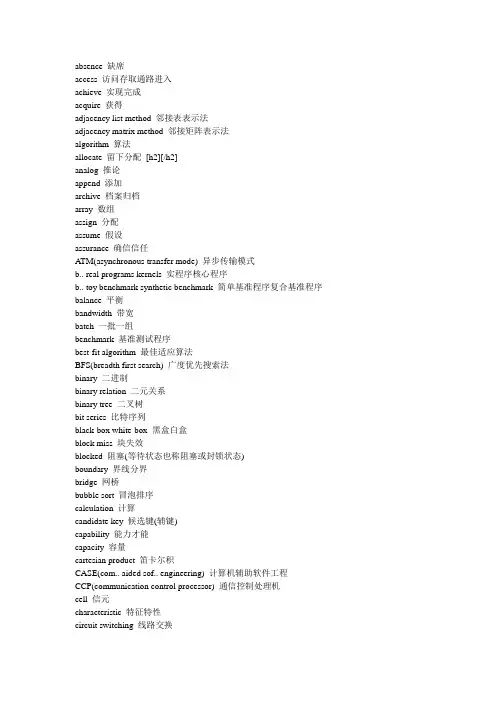
absence 缺席
access 访问存取通路进入
achieve 实现完成
acquire 获得
adjacency list method 邻接表表示法
adjacency matrix method 邻接矩阵表示法
algorithm 算法
allocate 留下分配 [h2][/h2]
analog 推论
append 添加
archive 档案归档
array 数组
assign 分配
assume 假设
assurance 确信信任
ATM(asynchronous transfer mode) 异步传输模式
b.. real programs kernels 实程序核心程序
b.. toy benchmark synthetic benchmark 简单基准程序复合基准程序
balance 平衡
bandwidth 带宽
batch 一批一组
benchmark 基准测试程序
best-fit algorithm 最佳适应算法
BFS(breadth first search) 广度优先搜索法
binary 二进制
binary relation 二元关系
binary tree 二叉树
bit series 比特序列
black-box white-box 黑盒白盒
block miss 块失效
blocked 阻塞(等待状态也称阻塞或封锁状态)
boundary 界线分界
bridge 网桥
bubble sort 冒泡排序
calculation 计算
candidate key 候选键(辅键)
capability 能力才能
capacity 容量
cartesian product 笛卡尔积
CASE(com.. aided sof.. engineering) 计算机辅助软件工程
CCP(communication control processor) 通信控制处理机

Unit 7 The Fundamentals of Computer
Software
Text 1 Data Structure
A data structure is a data type. Its values are composed of component elements that are
related by some structure.
Since a data structure is a data type, it has a set of operations on its values. In addition, there
may be operations that act on its component elements. The operations of a structured data type
might not only act on the values of the data type, they might also act on component elements of
the data structure.
The data type’s arrays and records are native to many programming languages. By using the
pointer data type and dynamic memory allocation, many programming languages also provide the
facilities for constructing linked structures. The first two higher-level abstract data types are stacks
and queues. They are extremely important to computing.
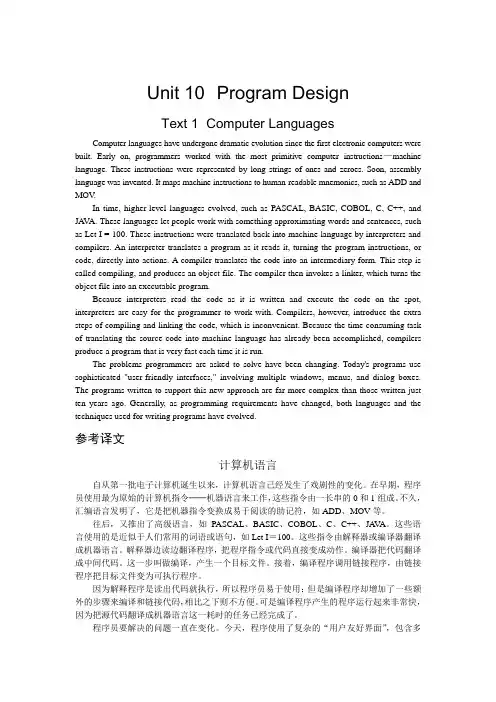
Unit 10 Program Design
Text 1 Computer Languages
Computer languages have undergone dramatic evolution since the first electronic computers were
built. Early on, programmers worked with the most primitive computer instructions—machine
language. These instructions were represented by long strings of ones and zeroes. Soon, assembly
language was invented. It maps machine instructions to human-readable mnemonics, such as ADD and
MOV.
In time, higher-level languages evolved, such as PASCAL, BASIC, COBOL, C, C++, and
JAVA. These languages let people work with something approximating words and sentences, such
as Let I = 100. These instructions were translated back into machine language by interpreters and
compilers. An interpreter translates a program as it reads it, turning the program instructions, or
code, directly into actions. A compiler translates the code into an intermediary form. This step is