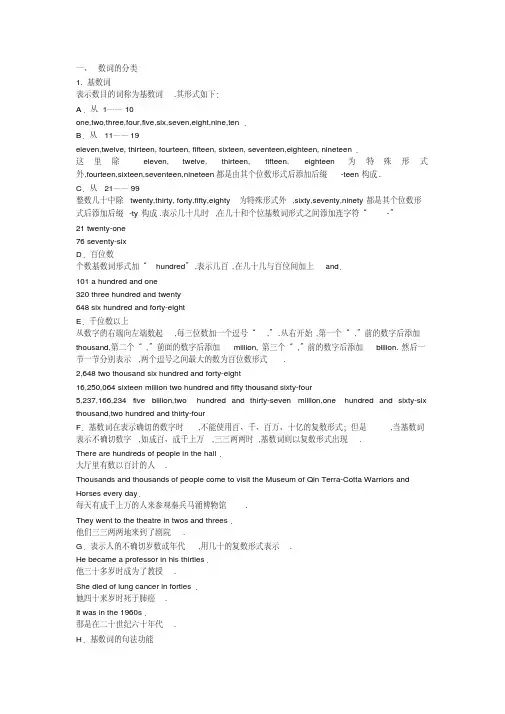
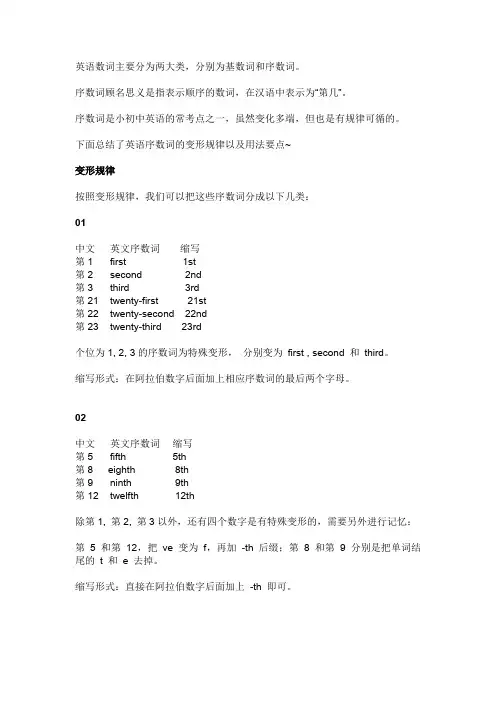
英语数词用法详解数词部分▲掌握分数、时间、日期的表达法;复习要点一基数词基数词用来表示数目,或者说表示数量的词叫基数词;最基本的基数词如下1 one11 eleven100 a hundred2 two12 twelve20 twenty1000 a thousand3 three13 thirteen30 thirty1,000,000 a million4 four14 fourteen40 forty10,000,000 ten million5 five15 fifteen50 fifty100,000,000 a hundred million6 six16 sixteen60 sixty1,000,000,000 a billion7 seven17 seventeen70 seventy8 eight18 eighteen80 eighty9 nine19 nineteen90 ninety10 ten说明:1.13—19是由个位数加后缀-teen构成;注意其中13、15的拼写是thirteen和fifteen;2.20—90由个位数加后缀-ty构成,注意其中20—50的拼写分别是twenty, thirty, forty 和fifty;80的拼写是eighty;3.其它非整十的两位数21—99是由整十位数加连字符“-”,再加个位数构成;如: 81 eighty-one;4.101—999的基数词先写百位数,后加and再写十位数和个位数;如: 691 six hundred and ninety-one;5.1000以上的基数词先写千位数,后写百位数,再加and,最后写十位数和个位数;如:5893 five thousand eight hundred and ninety-three;在基数词中只有表示“百”、“千”的单位词,没有单独表示“万”、“亿”的单位词,而是用thousand千和million百万来表达,其换算关系为:1万=10 thousand;1亿=100 million; 10亿=a thousand million=a billion;6.多位数的读法:11000以上的多位数,要使用计数间隔或逗号“,”;即从个位起,每隔三位加一个间隔或逗号;第一个间隔或逗号前是thousand千,第二个间隔或逗号前是million百万,第三个间隔或逗号前是a thousand million或a billion十亿;2每隔三位分段以后就都成了101—999;读的时候十位数或个位数的前面一般要加and;如:888,000,000读作:eight hundred and eighty-eight million;基数词的用法:1. 基数词在句中的作用基数词的作用相当于名词和形容词,在句中可作定语、主语、宾语介宾、表语、同位语等;例如:Three and five is eight. 3+5=8 作表语How many oranges do you want 你要多少桔子I want eight. 我要八个;作宾语There are eight boats in the lake. 湖里有八条小船;作定语2.Hundred, thousand, million, dozen, score这些词前面如有表示具体数字的词,它们不能加“s”,反之则须加“s”,并要与of短语连用;例如:three hundred people, five thousand years;thousands of people, hundreds of students, thousands of trees二序数词表示顺序的词,叫序数词;序数词用来表示数词顺序;除特殊情况外,序数词一般都由相应的基数词加后缀-th构成;说明:1.英语中表示第一、第二、第三的序数词属特殊形式,要注意它们的拼写;2.表示“几十”的序数词通常是将基数词词尾y变成i再加上后缀-eth;3.其余的二位数序数词是以相应的整十基数词加个位序数词;如:fifty-first 第五十一;4.少数序数词拼法不规则,如:fifth第五,eighth第八,ninth第九,twelfth第十二等;注意:1.序数词可缩写为阿拉伯数字加序数词最后两个字母;例如:第一:the first=1st 第二:the second=2nd第三:the third=3rd 第五:the fifth=5th第九十七:the ninety-seventh=97th第一百零一:the one hundred andfirst=101st2.编了号的事物要用基数词表示顺序,但是基数词要后置;例如:第一课:Lesson One 第三十二页:Page 32第305房间:Room 305 第12路公共汽车:Bas No.12序数词的用法序数词表顺序,主要作定语,其前面须加上定冠词the,此外,也作主语、宾语、表语和定语等,这时,被它所修饰的名词往往被省略;如:The first person to arrive is Kate.例如:The first is bigger than the second. 作主语第一个比第二个大;Give me the first. 作宾语把第一个给我;She’s often the first to go to school. 作表语她经常第一个去上学;We’re going to learn the eighth lesson. 作定语我们将要学习第八课;三分数表达法先写基数词表示分子,后写序数词表示分母,如果分子大于1时,分母用复数;如:one-fourth, two-fifths, three-tenths四小数表达法小数点前的整数按基数词的规则表示,小数点写作point, 小数后的数字应按其数字直接表示出来;如:18.38可写成:eighteen point three eight;注意:小数在句中常作定语,尤其在比较方式状语从句中被使用;如:This stone is 3.5 times heavier than that one.五百分数表达法根据学生情况选择使用在数词后加percent;例如:15%读作:fifteen percent;60%读作:sixty percent六表示语数根据学生情况选择使用1…几倍大小长短,数量=…几倍或分数+the sizelength, amount;例如:The earth is forty-nine times the size of the moon.地球是月球的49倍;2…比…几倍=…倍数或分数+形容词副词比较级+than+被比部分;例如:His house is three times bigger than mine. 他的房子比我的房子大三倍;3…是…倍=…倍数或分数+as +形容词+as +被比部分;例如: This factory is four times as big as that one. 这个工厂是那个工厂的四倍;七表示约数根据学生情况选择使用1“多于”用more than或over;例如:The street is overmore than 500 metres long. 这条街有500多米长;2“小于”用less than;例如:Three are less than 30 people in the classroom. 教室里不到三十人;3“或…以上”用or more;例如:The building can hold 5000 people or more.那座建筑物可容纳5000人或5000人以上;4“或…以下”用or less;例如:We can finish the work in two weeks or less.我们可以在两周内或不到两周完成这件工作;5“大约”用about, around, nearly等;例如:The box weighs about 50 pounds. 这箱子重约50镑;6“左右”用or so.如:In the past ten years or so, they have changed a lot. 在过去的十年里,他们改变了许多;八年、月、日和时间的表达法1.年份用基数词表达,分两位一读,年份前用介词in;例如:1999 nineteen ninety-nine2000 two thousand2001 two thousand and one2.月份的第一个字母要大写,有些月份名称有缩写形式;例如:一月JanuaryJan., 二月FebruaryFeb., 三月MarchMar., 四月Apr.,五月May, 六月June, 七月July, 八月AugustAug.,九月SeptemberSep., 十月OctoberOct., 十一月NovemberNov., 十二月DecemberDec.;3.日期的表达要用序数词,读时前面要加定冠词the,介词要使用on;例如:在6月1日:on June 1st 读作:on June the first.年、月、日同时表达时,一般应先写月、日、后写年;如:在2001年5月4日:on May 4 th, 2001;4.年代用基数词的复数表示;例如:20世纪90年代:nineteen nineties;21世纪20年代:twenty twenties 5.时间表达法:时间可用顺读法或倒读法两种方式表达;例如:5:00 five o’clock6:18 six eighteen或 eighteen past six12:15 twelve fifteen 或fifteen a quarter past twelve4:30 four thirty或 half past four6:45 six forty-five a quarter to seven注意:1表示整点时间,直接用基数词表达,后边可接o’clock 也可不加;表达“几点几分”时,绝不能用o’clock;2表达“15分”或“45分”时,常用quarter刻;3在倒读法中,如果钟点不过半,须用“分钟数+past+钟点数”的形式;如果钟点过半,则用“差多少分钟数+to+全钟点下个钟点数”的形式;两组与数词有关的介词短语:⑴ in+定冠词the+数词的复数形式,表示年代;如:in the 1870s或1870’s⑵ in+物主代词+数词的复数形式,表示某人的年龄;如:in one’s thirties;有时在物主代词后面可加上形容词early或late使其含义更确切些;如:The young man is at most in his early thirties.注意:带有数词的名词作定语的表达:a seven-year-old boy,a hundred-metre race英语分数、倍数、小数和百分数的表示方法一、分数的表示法分数由基数词和序数构成——分子用基数词,分母用序数,分子超过“1”时,分母用复数:a one sixth1/6, two thirds2/3, three fifths3/5说明1 1/2 通常读作 a one half,一般不读作a second;2. 1/4 可读作a one fourth,也可读作a one quarter;3. 分子超过“1”分母之所以用复数可以这样理解:“三分之二”即两个two三分之一third,既然是两个“三分之一”,那“三分之一”当然要用复数,即用thirds;4. 在数学上,为了简洁起见,分子和分母均可用基数词,其间用介词over:3/4 读作three over four对于比较复杂的分数通常采用此读法5. 带分数的读法:在整数与分数之间用and连接:five and two thirds二、倍数的表示法表示倍数时通常借助half, double, twice, three times等之类的词:Half of the apples are bad. 一半苹果是坏的;His homework is not yet half done. 他的作业还没完成一半;He eats twice what I eat. 他的食量是我的两倍;比较以下三句,虽然表达形式不同,但含义相同:1. This rope is three times as long as that one. 这根绳子是那根的三倍长;2. This rope is three times longer than that one. 这根绳子是那根的三倍长;3. This rope is three times the length of that one. 这根绳子是那根的三倍长;第1句和第3句的意思比较清楚,但第2句常容易误解,有人认为它与其他两句意思不同,应理解为“这根绳子比那根绳子长三倍”,但绝大多数语法学家并不这样认为,而是认为以上三句意思相同;三、小数的表示法与汉语一样,小数点前的数按普通基数词的读法读,小数点后的数按单个数字一一读出;小数点后的0通常读作oh,有时也读作nought或zero,小数点读作point:one point five six1.56, ten point three oh five说明被大于“1”的小数修饰的名词要用复数,如说 1.3 meters,不说1.3 meter;即使是被小于“1”的小数修饰,名词也通常可以用复数:One centimeter equals0.3937 inches. 1厘米等于0.3937英寸;四、百分数的表示法百分数由基数词或小数和百分号%组成,百分号%读作per cent:fifteen percent15%, ero point six percent0.6%说明百分数后接名词时有时用介词of,有时不用:30% of the students30%的学生,a 30% chance30%的把握;两者的区别是:后接介词of时,percent 为名词,of表示整体中的部分;不接介词of时,percent 为形容词此时不表示整体与部分的关系,再比较:6 percent of the interest=利息中的百分之六,at 6 percent interest=按百分之六的利息;英语序数词用法指导一、序数词的表示法1. 以下是最基本的序数词,学习者必须牢记:first第1, second第2, third第3, fourth 第4, fifth第5, sixth第6, seventh第7, eighth第8, ninth第9, tenth 第10, eleventh第11, twelfth第12, thirteenth第13, fourteenth第14, fifteenth第15, sixteenth第16, seventeenth第17, eighteenth第18, nineteenth第19, twentieth第20, thirtieth第30, fortieth第40, fiftieth第50, sixtieth第60, seventieth第70, eightieth第80, ninetieth第90;说明①许多序数词是由相应的基数词后加th构成的,如:four / fourth,six / sixth,ten / tenth,sixteen / sixteenth,但是nine变为序数词是ninth,而不是nineth;②twentieth, thirtieth, fortieth 等表示整十的序数词,由相应的基数词将词尾y改为ie,再加th 构成;③first, second, third 通常可缩写为1st, 2nd, 3rd;凡是以th结尾的序数词可缩写为“基数词+th”:4th, 5th, 9th, 11th, 60th, 128th等;2. 非整十的多位数,将个位数变成序数词即可:twenty-first第21,thirty-sixth 第36,ninety-ninth第99,three hundred and sixty-fifth第365等;3. hundred, thousand, million 等序数词形式为hundredth, thousandth, millionth 等:five hundredth 500th 第500 ten thousandth 10, 000th 第10000 注意:这类词前用数字“一”时,这个“一”只用one,不用a:one hundredth 第100不说a hundredth二、既可序数词也可用基数词的场合1. 日期的表示法通常用序数词,也可用基数词,如“5月5日”在书面语中通常写成5 May英或May 5th美,而在口语中则通常说成the fifth of May,May the fifth英, May fifth美等;2. 在类似编号的场合,用序数词应放在被修饰词语之前,若用基数词则置于其后:the First Lesson / lesson one 第一课the tenth chapter / chapter ten 第10章the sixth line / line 6 第6 行the third part / part three 第三部分但是,在许多情况下,用基数词比用序数词更合适、更方便:Book One 第一册Room 805 805房page 110 第110页Bus Number Ten 第10路公共汽车三、序数词前使用冠词应注意的两点1. 序数词前通常要用定冠词It’s the third time I’ve been here. 这是我第三次来这儿;The second is better than the first. 第二个比第一个好;说明①表示考试或比赛等的名次时,通常省略定冠词:She was the third in the exam. 她考试得了第三名;②序数词用作副词时也通常不用冠词:He came first. 他先来;I’ll have to finish my homework first. 我得先把作业做完;③有些习语中的序数词前没有冠词:at first 开始at first sight 乍看起来first of all 首先④但若序数词前用了物主代词或名词所有格,则不能再用定冠词:his second wife 他的第二个妻子Tom’s third book 汤姆的第三本书2. 序数词前有时可用不定冠词,表示次第在原有基础上的增加:A second student stood up. 又一个第二个学生站了起来;I want to read the book a third time. 这本书我想读第三次;序数词前用定冠词和不定冠词的区别在于,定冠词表特指,不定冠词表泛指,有类似another的意思,但比another 的意思更明确:I like the third girl. 我喜欢第三个女孩;至少有三个女孩供选择,特指I saw a third girl. 我又看见了第三个女孩;暗示原来已看见两个,这已是第三个英语基数词的用法一、基数词的表示法1. 以下是最基本的基数词,学习者必须牢记:one1, two2, three3, four4, five5, six6, seven7, eight8, nine9, ten10, eleven11, twelve12, thirteen13, fourteen14, fifteen15, sixteen16, seventeen17, eighteen18, nineteen19, twenty20, thirty30, forty40, fifty50, sixty60, seventy70, eighty80, ninety90,a hundred100, a thousand1000, a million1000000, a billion 十亿2. 21—99 的表示法;先说“几十”,再说“几”,中间加连字号:twenty-one21, thirty-six36, forty-five45, ninety-nine99等;3. 101—999的表示法;先说“几百”,后接and,再加末尾两位数或末位数:one hundred and one101, five hundred and thirty530, seventy hundred and eighty-nine7894. 1000 以上的基数词的表示法;先从右至左数,每三位数加一个逗号即以此把数目分为若干段;第一个逗号前的数为thousand千,第二个逗号前的数million百万,第三个逗号前的数为billion十亿,第四个逗号前的数为trillion万亿,然后一段一段地数:9, 883 nine thousand, eight hundred and eighty-three65, 359 sixty-five thousand, three hundred and fifty-nine265, 468 two hundred and sixty-five thousand, four hundred andsixty-eight60, 263, 150 sixty million, two hundred and sixty-three thousand, one hundred and fifty说明①英语没有“万”这个单位,要表示“万”须借用thousand,如“一万”用“十千”表示ten thousand,“十万”用“百千”表示one hundred thousand;②hundred, thousand, million, billion 等词在读数时不带复数词尾-s即用单数形式;③在hundred 后通常加上连词,不过此and 在美国英语中可以省略;若读数中没有hundred,则在thousand后加and;④一个数的最高位若为“一”,这个“一”可用a或one表示,但在数字中间的“一”,则只能用one,不能用a:1600 a one thousand and six hundred6100 six thousand and one hundred 其中的one 不可改为a⑤在非正式场合,人们也常以hundred 为单位来读数,对于1100至1900之间的整数尤其如此参见年代的读法:It cost fifteen hundred pounds. 这东西花了1500英镑;二、时刻、日期、年份等的表示法1. 时刻的表示法①若为整点钟,则直接读相应的基数词;若为非整点钟,则分别以“时”和“分”为单位用相应的基数词读出:twelve12, eight twenty8:20, nine forty-five9:45 ②对于带“分”的时间,也可借助past过和to差这两个介词来表示在美国英语中用after表示“过”;但是注意,这样表示时“分”不能超过30,否则应作处理,如9.38应处理成“10点差22分”:18 eighteen minutes past after nine = nine eighteen46 fourteen minutes to eleven = ten forty-six以上分钟后带了minutes一词;若“分”为5, 10, 15, 20 等五的倍数,则可省略minutes:05 five minutes past after eight = eight five20 twenty minutes past after nine =nine twenty若“分”为15或45,可借用quarter 一词;若“分”为30,可借用half一词:15 a quarter past six 8.45 a quarter to nine 10.30 half past ten说明时刻表示法分为12小时编时制和24小时编时制;2. 日期的表示法:日期的写法书面语和读法口语稍有不同,如“十月一日”可以写成October 1, October 1st, 1 October, 1st October, the 1st of October 等,表示月份的词也可用缩略式,如Oct. 1, 1 Oct. 1,但是在口语中通常只有两种读法October the first或the first of October;说明日期与星期排列时,通常是星期在前,日期在后:He arrived on Friday, May 10. 他于5月10日星期五到达;3. 年份的表示法:通常以“百”为单位来读;如1986年通常读作nineteen hundred and eighty-six,除非在正式场合,其中的hundred and通常都省,但在通常情况下不能按普通基数词的读法那样读成one thousand nine hundred and eighty-six;不过,像1500这样的年份可以有两种读法one thousand five hundred和fifteen hundred,而2000年通常读作two thousand,2003年读作two thousand and three;若表示某个年代,则按类似以下的读法:1980s 读作nineteen-eighties20世纪80年代, 1600s 读作sixteen hundreds17世纪头10年,即1600—1610,比较:1300 thirteen hundred1300年;三、用于复数形式的基数词1. 表示整十的基数词用复数形式可以表示人的岁数或年代:in the sixties 在60年代in one’s thirties 在某人30多岁时2. 基数词转化为名词,可用复数形式:How many twos are there in ten 10里面有几个2The soldiers marched in tens. 士兵们10人一排前进;3. 某些习语中也用复数形式的基数词:in by twos and threes 三三两两地at sixes and sevens 乱其八糟。